Dinosaur discovery helps solve piece of evolutionary puzzle (w/ Video)
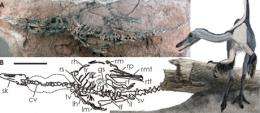
(PhysOrg.com) -- A George Washington University expedition to the Gobi Desert of China has enabled researchers to solve the puzzle of how one group of dinosaurs came to look like birds independent of birds. The discovery extends the fossil record of the family Alvarezsauridae - a bizarre group of bird-like dinosaurs with a large claw on the hand and very short, powerful arms - back 63 million years, further distancing the group from birds on the evolutionary tree.
Until now, there was no direct evidence that dinosaurs of this type lived during the Late Jurassic, approximately 160 million years ago. George Washington University doctoral candidate Jonah Choiniere named the newly discovered species of dinosaur, Haplocheirus sollers (meaning simple, skillful hand). Mr. Choiniere's research is featured in the Jan. 29 issue of the journal Science.
"Haplocheirus is a transitional fossil, because it shows an early evolutionary step in how the bizarre hands of later alvarezsaurs evolved from earlier predatory dinosaurs," said Mr. Choiniere. "The fossil also confirms our predictions that Alvarezsauridae should have been evolving in the Late Jurassic time period."
The fossil of the new species contains several distinguishing features that link it to Alvarezsauridae, the family of dinosaurs that includes species such as Mononykus (meaning one claw) and that was previously thought to be a flightless offshoot of ancient birds due to skeletal similarities. Despite the similarity between the skeletons, Mr. Choiniere's research demonstrates that the family Alvarezsauridae evolved in parallel to birds and did not descend from them. The new species shows some of the earliest evolutionary stages in the development of a short, powerful arm with a single functional claw that may have been used for digging termites.
The Late Jurassic is an important time period for bird evolution, as evidence suggests that birds first evolved from theropod, or bird-footed, dinosaurs at that time. Paradoxically, fossils of dinosaurs closely related to birds from this time period are extremely rare, furthering the importance of Mr. Choiniere's work.
The ten-foot long, nearly complete skeleton of Haplocheirus sollers specimen was found preserved in river-lain rock in the Xinjiang Autonomous Region of northwestern China, a region well-known for its Late Jurassic fossils. It was collected in 2004 during a series of expeditions to Xinjiang co-led by Dr. James Clark of GW and Dr. Xu Xing of the Chinese Academy of Sciences' Institute of Vertebrate Paleontology and Paleoanthropology, co-authors on the report. These expeditions were extremely successful, resulting in the discovery of a small, agile relative of crocodilians (Junggarsuchus sloani); the oldest horned dinosaur (Yinlong downsi); one of the oldest tyrannosaurs (Guanlong wucaii); and several skeletons of an unusual, toothless new ceratosaurian dinosaur (Limusaurus inextricabilis) that were buried while stuck in mud pits. These discoveries were described in a TV documentary by National Geographic ("Dino Death Trap") and a June 2009 article in National Geographic Magazine.
"The primary goal of our expeditions was to find evidence of the theropod dinosaurs closest to birds, and the discovery of Haplocheirus is one of our major discoveries," said Dr. Clark. "This spectacular skeleton shows how the strange arms of Mononykus and other alvarezsaurs evolved from a more typically theropod grasping hand."
Theropod dinosaurs include charismatic, meat-eaters like Tyrannosaurus rex but also modern birds. Alvarezsaurs are one of several groups of theropods closely related to birds, including well-known species like Velociraptor.
This research was funded by the National Science Foundation (NSF) Division of Earth Sciences, the National Geographic Society, the Chinese National Science Foundation and The George Washington University.
"This NSF-supported research sheds light on the poorly understood early evolution of birds in the Late Jurassic in China by eliminating alvarezsaurids as ancestors of the birds," said H. Richard Lane, program director in the National Science Foundation (NSF)'s Division of Earth Sciences.
Mr. Choiniere is a student of James Clark, the Ronald B. Weintraub Professor of Biology in The George Washington University's Columbian College of Arts and Sciences, and first accompanied Dr. Clark on his excavations in China in 2005.
"Faculty/student collaboration to advance science and foster a better understanding of the world around us is a cornerstone of our mission," said Peg Barratt, dean of the Columbian College of Arts and Sciences. "I applaud the work of Dr. Clark and Mr. Choiniere for this truly significant evolutionary finding."
More information: The article, "A Basal Alvarezsauroid Theropod from the Early Late Jurassic of Xinjiang, China," appears in the Jan. 29 edition of Science.
Provided by George Washington University


.jpg)


