Rotifers avoid sex for millions of years by blowing away
January 28, 2010 By Krishna Ramanujan
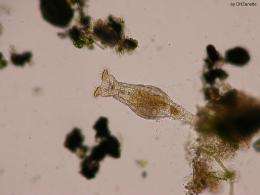
Lateral view of bdelloidea

Enlarge

Lateral view of bdelloidea. Image: Wikipedia.

(PhysOrg.com) -- They haven't had sex in some 30 million years, but some very small invertebrates named bdelloid rotifers are still shocking biologists - they should have gone extinct long ago. Cornell researchers have discovered the secret to their evolutionary longevity: these rotifers are microscopic escape artists. When facing pathogens, they dry up and are promptly gone with the wind.

"These animals have evolved a way to avoid parasites and pathogens by drying up and blowing away," said Paul Sherman, Cornell professor of neurobiology and behavior, who wrote the paper with lead author Chris Wilson, a Cornell doctoral candidate in Sherman's lab.

After drying up, bdelloids come back to life when re-exposed to fresh water. The Cornell study is featured on the cover of the Jan. 29 issue of Science.

Bdelloid rotifers (pronounced DELL - oyd ROW-tiff-ers) are tiny, freshwater invertebrates that have long puzzled scientists because, as completely asexual animals, they should have been extinguished by parasites and pathogens long ago in evolutionary time. Instead, the bdelloids have proliferated into more than 450 species. Asexual animals like rotifers reproduce by cloning and this makes for a fixed .

Many scientists believe that the function of sex itself is to shuffle genes around. They theorize that the fresh genetic combinations that which sex provides allow sexual animals to fend off relentlessly evolving parasites and pathogens.

The discovery that bdelloids can desiccate and wisp away with the wind helps resolve the mystery of their ancient asexuality and success.

"It also helps answer one of the deepest puzzles in - why sex is nearly ubiquitous," said Wilson.

To study the bdelloids' adaptations, Wilson infected populations of rotifers with deadly fungi and found that they all died within a few weeks.

He then tried drying out other infected populations for varying lengths of time before rehydrating them. He found that the fungi were far more sensitive to dehydration than the rotifers. The longer the infected populations remained dried out, the more successful they were at completely ridding themselves of fungi and eluding death.

In a second wave of experiments, Wilson placed dried, fungus-infected rotifers in a wind chamber. The scientists observed that the rotifers were able to disperse without the fungi and establish parasite-free populations. After just seven days of blowing around, there were as many fungus-free rotifer populations as there were after three weeks of dehydration without wind. So, by drying and drifting passively on the wind - sometimes for hundreds of miles - bdelloids can continually establish new, uninfected populations.

"These animals are essentially playing an evolutionary game of hide and seek," said Sherman. "They can drift on the wind to colonize parasite-free habitat patches where they reproduce rapidly and depart again before their enemies catch up. This effectively enables them to evade biotic enemies without sex, using mechanisms that no other known animals can duplicate."

Provided by Cornell University (news : web)

4.5 /5 (15 votes)  

Rank 4.5 /5 (15 votes)
Related Stories
Relevant PhysicsForums posts
  • Protease cleavage
    created5 hours ago
  • Pertubance in a model
    created12 hours ago
  • Cancer drugs and Alzheimer's, Oh my!
    created20 hours ago
  • Squishing cells
    created21 hours ago
  • Any books/articles for evolutionary stable strategy models in humans?
    createdFeb 09, 2012
  • Science behind the bore feeling?
    createdFeb 09, 2012
  • More from Physics Forums - Biology

More news stories

The power of estrogen -- male snakes attract other males

A new study has shown that boosting the estrogen levels of male garter snakes causes them to secrete the same pheromones that females use to attract suitors, and turned the males into just about the sexiest ...

Biology / Plants & Animals

created 10 hours ago | popularity 4.8 / 5 (5) | comments 0 | with audio podcast

Grass to gas: Researchers' genome map speeds biofuel development

Researchers at the University of Georgia have taken a major step in the ongoing effort to find sources of cleaner, renewable energy by mapping the genomes of two originator cells of Miscanthus x giganteus, a large perenn ...

Biology / Biotechnology

created 7 hours ago | popularity 3.7 / 5 (3) | comments 0 | with audio podcast

Experts reveal how plants don't get sunburn

(PhysOrg.com) -- Experts at the University of Glasgow have discovered how plants survive the harmful rays of the sun.

Biology / Cell & Microbiology

created 10 hours ago | popularity 5 / 5 (2) | comments 0 | with audio podcast

Protein libraries in a snap

(PhysOrg.com) -- A Rice University undergraduate will depart with not only a degree but also a possible patent for his invention of an efficient way to create protein libraries, an important component of biomolecular ...

Biology / Cell & Microbiology

created 13 hours ago | popularity 5 / 5 (2) | comments 0 | with audio podcast

Miami battling invasion of giant African snails

No one knows how they got there. But an invasion of African giant snails has southern Florida in a panic over potential crop damage, disease and general yuckiness surrounding the slimy gastropods.

Biology / Ecology

created 14 hours ago | popularity 4 / 5 (1) | comments 4


Google users warned of threat to smartphone wallets

Users of Google smartphone wallets were being warned on Friday that there is a way to crack pass codes intended to thwart thieves from going on illicit shopping sprees.

Anonymous knocks CIA website offline (Update)

The website of the Central Intelligence Agency was inaccessible on Friday after the hacker group Anonymous claimed to have knocked it offline.

Complex wiring of the nervous system may rely on a just a handful of genes and proteins

Researchers at the Salk Institute have discovered a startling feature of early brain development that helps to explain how complex neuron wiring patterns are programmed using just a handful of critical genes. ...

NASA sees wide-eyed cyclone Jasmine

Cyclone Jasmine's eye has opened wider on NASA satellite imagery, as it moves through the Southern Pacific Ocean.

Putting the squeeze on planets outside our solar system

(PhysOrg.com) -- Using high-powered lasers, scientists at Lawrence Livermore National Laboratory and collaborators discovered that molten magnesium silicate undergoes a phase change in the liquid state, abruptly ...

NASA sees Giovanna reach cyclone strength, threaten Madagascar

Tropical Storm 12S built up steam and became a cyclone on February 10, 2012 as NASA's Terra satellite passed overhead. Residents of east-central Madagascar should prepare for this cyclone to make landfall ...