Studying Titan's Lakes on Earth
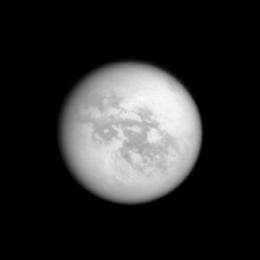
A new project aims to replicate the surface on the moon Titan in order to learn more about its hydrocarbon lakes. This study could also tell us about the chemistry that led to the origin of life on early Earth.
The recent discovery of lakes on Saturn's moon Titan make it the only other object in the solar system known to have liquid on its surface. However, dipping 179°C (290°F) below freezing, these lakes are definitely not filled with water.
"The water is frozen so solid on Titan that you can liken it to silicate rocks on Earth," says Vincent Chevrier of the University of Arkansas.
The liquid on Titan is likely a hydrocarbon cocktail of mostly methane and ethane, judging from observations by the Cassini-Huygens space probe. The exact proportions are uncertain because scientists have little data on how these substances behave at such low temperatures.
"There was never before much interest in the liquid and solid properties of methane and ethane, since they are normally gases on Earth's surface," Chevrier says.
But that's all changed. Titan's "liquid assets" drive geologic and chemical processes that may mimic those on our own planet. To better understand this, Chevrier and his colleagues have received NASA funding to recreate Titan's surface in a lab.
Lake country
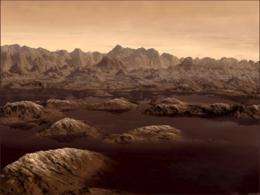
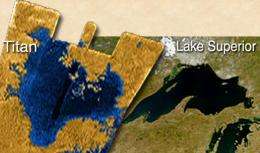
Thanks to radar maps taken by Cassini, we know that the polar regions of Titan are dotted with numerous lakes. Some of these are as large as the Great Lakes in the U.S.
Scientists are not sure where these large bodies of hydrocarbons come from. One possibility is that methane rain and possibly ethane snow drive a "hydrological cycle" that eventually drains into these lakes.
Alternatively, Titan may have large reservoirs of liquid underground, and the lakes are the result of impact craters carving deep enough to expose this sub-surface ocean.
It has been difficult to rule out any of these hypotheses in part because the process of evaporation from the hydrocarbon lakes in Titan’s environment is poorly understood. If researchers knew how fast the lakes were disappearing, they would have a better sense of what makes them appear.
"The rates of exchange of hydrocarbons over seasonal and potentially longer climate cycles on Titan is an important goal of current research," says Oded Aharonson of the California Institute of Technology, who is not involved with this new project.
Mini-lakes
For their part, Chevrier's team will be measuring the evaporation rates of methane and ethane in a Titan simulation chamber. To mimic the moon's atmosphere, the 2-meter-high steel cylinder will hold ultra-cold nitrogen gas at a pressure about 50% higher than on Earth.
Chevrier's group will introduce small quantities of methane and/or ethane into the chamber. Below about 95 Kelvin (or -178 degrees Celsius), the hydrocarbon gas will condense into roughly 1 centimeter deep "mini-lakes" at the bottom of the cylinder. The researchers will then raise the temperature slightly and record the rate of evaporation.
It is assumed that ethane (whose molecules are heavier than methane's) will have a much slower evaporation rate, but by how much is unknown. It's even less clear what happens when methane and ethane are mixed together, along with nitrogen gas dissolving in from the atmosphere above.
"It is highly likely that the lakes are in fact complex mixtures of ethane, methane and nitrogen," Chevrier says. "We will study the behavior of pure compounds first and then shift to mixtures."
The team also plans to look at the possibility of other organic compounds mixing in with the Titan broth and perhaps slowing the evaporation.
Earth analog
Determining the evaporation rates on Titan will not only help sort out the geologic processes that formed the lakes, it also will provide some needed information about the atmospheric chemistry.
Titan is the only moon in our solar system with a substantial atmosphere. The moon’s surface is totally obscured by an orange haze made up of complex organics (called tholins), which form when methane is destroyed by ultraviolet light from the Sun.
This same sort of organic chemistry may have gotten the biological ball rolling on Earth billions of years ago.
"Titan shows how you can have organic reactions without life," Chevrier says. Such organic chemical reactions may have provided the first necessary steps towards the origin of life on Earth.
On Titan, because the methane-fueled organic reactions in the atmosphere end up destroying the methane molecules, to keep the reactions operating a constant source of gaseous methane is needed. The evaporation of methane from Titan’s lakes may be one such source, and Chevrier's data should help say whether it is enough.
"Titan's surface is rich with geological features similar to those found on Earth but based on different materials," says Christophe Sotin from the Jet Propulsion Lab in Pasadena. "So any lab experiment that can reproduce conditions on Titan and give some pieces of information of the processes that can happen on this moon are important."
Source: Astrobio.net


