Bees recognize human faces using feature configuration
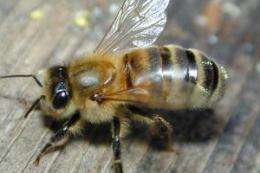
Going about their day-to-day business, bees have no need to be able to recognise human faces. Yet in 2005, when Adrian Dyer from Monash University trained the fascinating insects to associate pictures of human faces with tasty sugar snacks, they seemed to be able to do just that. But Martin Giurfa from the Université de Toulouse, France, suspected that that the bees weren't learning to recognise people.
'Because the insects were rewarded with a drop of sugar when they chose human photographs, what they really saw were strange flowers. The important question was what strategy do they use to discriminate between faces,' explains Giurfa. Wondering whether the insects might be learning the relative arrangement (configuration) of features on a face, Giurfa contacted Dyer and suggested that they go about systematically testing which features a bee learned to recognise to keep them returning to Dyer's face photos. The team publish their discovery that bees can learn to recognise the arrangement of human facial features on 29 January 2010 in the Journal of Experimental Biology.
Teaming up with Aurore Avargues-Weber, the team first tested whether the bees could learn to distinguish between simple face-like images. Using faces that were made up of two dots for eyes, a short vertical dash for a nose and a longer horizontal line for a mouth, Avargues-Weber trained individual bees to distinguish between a face where the features were cramped together and another where the features were set apart. Having trained the bee to visit one of the two faces by rewarding it with a weak sugar solution, she tested whether it recognised the pattern by taking away the sugar reward and waiting to see if the bee returned to the correct face. It did.
So the bees could learn to distinguish patterns that were organised like faces, but could they learn to 'categorize' faces? Could the insects be trained to classify patterns as face-like versus non-face like, and could they decide that an image that they had not seen before belonged to one class or the other? To answer these questions, Avargues-Weber trained the bees by showing them five pairs of different images, where one image was always a face and the other a pattern of dots and dashes. Bees were always rewarded with sugar when they visited the face while nothing was offered by the non-face pattern. Having trained the bees that 'face-like' images gave them a reward, she showed the bees a completely fresh pair of images that they had not seen before to see if the bees could pick out the face-like picture. Remarkably they did. The bees were able to learn the face images, not because they know what a face is but because they had learned the relative arrangement and order of the features.
But how robust was the bees' ability to process the "face's" visual information? How would the bees cope with more complex faces? This time the team embedded the stick and dot faces in face-shaped photographs. Would the bees be able to learn the arrangements of the features against the backgrounds yet recognise the same stick and dot face when the face photo was removed? Amazingly the insects did, and when the team tried scrambling real faces by moving the relative positions of the eyes, nose and mouth, the bees no longer recognised the images as faces and treated them like unknown patterns.
So bees do seem to be able to recognise face-like patterns, but this does not mean that they can learn to recognise individual humans. They learn the relative arrangements of features that happen to make up a face-like pattern and they may use this strategy to learn about and recognize different objects in their environment.
What is really amazing is that an insect with a microdot-sized brain can handle this type of image analysis when we have entire regions of brain dedicated to the problem. Giurfa explains that if we want to design automatic facial recognition systems, we could learn a lot by using the bees' approach to face recognition.
More information: Avargues-Weber, A., Portelli, G., Bénard, J., Dyer, A. and Giurfa, M. (2010). Configural processing enables discrimination and categorization of face-like stimuli in honeybees. J. Exp. Biol. 213, 593-601. jeb.biologists.org
Provided by The Company of Biologists


