Astronomers discover cool stars in nearby space
January 29, 2010
Astronomers discover cool stars in nearby space

Enlarge

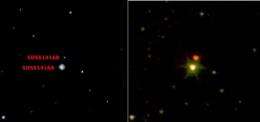
The images show the cool brown dwarf SDSS1416B and its warmer companion brown dwarf SDSS1416A (the left image is from the UKIRT telescope and the right image from the Subaru telescope).

(PhysOrg.com) -- An international team, led by astronomers at the University of Hertfordshire have discovered what may be the coolest sub-stellar body ever found outside our own solar system. Using the United Kingdom Infrared Telescope (UKIRT) in Hawaii, a discovery has been made of an object which is technically known as a brown dwarf. The team's findings have been accepted for publication in the journal Monthly Notices of the Royal Astronomical Society.

What has excited astronomers are its very peculiar colours, which actually make it appear either very blue or very red, depending on which part of the spectrum is used to look at it.

The object is known as SDSS1416+13B and it is in a wide orbit around a somewhat brighter and warmer brown dwarf, SDSS1416+13A. The brighter member of the pair was detected in visible light by the Sloan Digital Sky Survey. By contrast, SDSS1416+13B is only seen in . The pair is located between 15 and 50 light years from the solar system, which is quite close in astronomical terms.

"This looks like being the fourth time in three years that the UKIRT has discovered made a record breaking discovery of the coolest known brown dwarf, with an estimated temperature not far above 200 degrees Celsius,” said Dr Philip Lucas at the University of Hertfordshire’s School of Physics, Astronomy and Mathematics.

“We have to be a bit careful about this one because its colours are so different than anything seen before that we don't really understand it yet. Even if it turns out that the low temperature is not quite record breaking, the colours are so extreme that this object will keep a lot of physicists busy trying to explain it.”

SDSS1416+13B was first noticed by Dr Ben Burningham of the University of Hertfordshire as part of a dedicated search for cool in the UKIRT Infrared Deep Sky Survey (UKIDSS). The object appeared far bluer at near than any brown dwarf seen before. A near infrared spectrum taken with the Japanese Subaru Telescope in Hawaii showed that it is a type of brown dwarf called a T dwarf, which has a lot of methane in its atmosphere, but with peculiar features including a big gap at certain wavelengths.

Dr Burningham soon noticed that a previously observed brighter star (SDSS1416+13A) which appears close by in the UKIDSS discovery image was also a brown dwarf. Team member Dr Sandy Leggett, of the Gemini Observatory, then used the orbiting Spitzer Space Telescope to investigate SDSS1416+13B at longer wavelengths. She measured its colour at mid-infrared wavelengths, which are thought to be the most reliable indicator of temperature, and found that it is the reddest known brown dwarf at these wavelengths by some margin. Comparison with theoretical models of the brown dwarf atmospheres then provided a temperature estimate of about 500 Kelvin (227 degrees Celsius).
The Coolest of Orbs
Enlarge

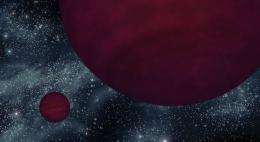
This artist's concept shows a pair of cool brown dwarfs. Image credit: NASA/JPL-Caltech

"The fact that it is a binary companion to a warmer brown dwarf that also has an unusual spectrum is helping us to fill in some gaps in our understanding", says Dr Burningham. "It seems likely that both brown dwarfs are somewhat poor in heavy elements. This can be explained if they are very old, which also fits with the very low temperature of the faint companion."

Too small to be stars, brown dwarfs have masses smaller than stars but larger than gas giant planets like Jupiter. Due to their low temperature these objects are very faint in visible light, and are detected by their glow at infrared wavelengths. They were originally dubbed "brown dwarfs" long before any were actually discovered, to describe the idea of bodies that were cooler, fainter and redder than red dwarf stars, with the colour brown representing the mix of red and black.

More information: A preprint of the paper can be found at http://xxx.soton.a … bs/1001.4393

Provided by Royal Astronomical Society (news : web)

4.5 /5 (10 votes)  

Filter


Move the slider to adjust rank threshold, so that you can hide some of the comments.


Display comments: newest first

Nik_2213
Jan 29, 2010

Rank: 5 / 5 (1)
I hope they can pin down the distance, as this will go some way to filling in the long tail of mass distribution in our solar neighbourhood.
Going
Jan 29, 2010

Rank: 4.7 / 5 (3)
At this proximity its precise distance should be able to be pinned down within 6 - 9 months by the method of parallax. Six months if the Earths motion is currently towards/away from the star, Nine moths if we are currently traveling at right angles to its direction . This is because the Earth needs to be at the opposite sides of its orbit to measure a parallax shift in the stars position. The article does not state the stars position in the sky.
anonperson
Jan 29, 2010

Rank: not rated yet
The article does not state the stars position in the sky.

A quick google of the name of the object only turned up shorter repeats of the above article. Is there an online catalog of the universe? An Internet Astronomical Object Data Base? IAODB? Where do citizen scientists go when researching the stars?
jsa09
Jan 29, 2010

Rank: not rated yet
Nearly as warm as venus
yyz
Jan 30, 2010

Rank: 5 / 5 (2)
A look at the paper gave the full designation of the bright component as SDSS J141624.08+134826.7. This would translate to R.A. 14h 16m 24s Dec +13d 48' 27" (epoch 2000.0). A pretty empty corner of Bootes! Positional information can usually be gleaned from a paper related to the press release. Getting the *complete* designation can help greatly. With proper coordinates, online planetaria like Stellarium or sites like Google Sky, WikiSky or World Wide Telescope can let you zoom in on the area of interest. Or you can check it out using the STScI Digitized Sky Survey : http://archive.st...dss_form .
SteWe
Jan 31, 2010

Rank: 5 / 5 (2)
Take a look at it yourself at SDSS:
http://cas.sdss.o...78021639
Rank 4.5 /5 (10 votes)
Related Stories
Relevant PhysicsForums posts
  • Scale of the Universe
    created13 hours ago
  • Titan's lack of impact craters
    createdFeb 09, 2012
  • Real pictures of black hole eating a star?
    createdFeb 08, 2012
  • Hypothetical way to travel faster than light, but not technically exceed lightspeed
    createdFeb 06, 2012
  • How do scientists monitor the Sun's activity?
    createdFeb 05, 2012
  • Search patterns in observational studies
    createdFeb 05, 2012
  • More from Physics Forums - General Astronomy

More news stories

Humans may have helped the decline of African rainforests 3000 years ago

(PhysOrg.com) -- Large areas of rainforests in Central Africa mysteriously disappeared over three thousand years ago, to be replaced by savannas. The prevailing theory has been that the cause was a change ...

Space & Earth / Environment

created 23 hours ago | popularity 4.3 / 5 (13) | comments 13 | with audio podcast report

Could Venus be shifting gear?

(PhysOrg.com) -- ESA’s Venus Express spacecraft has discovered that our cloud-covered neighbour spins a little slower than previously measured. Peering through the dense atmosphere in the infrared, the ...

Space & Earth / Space Exploration

created 19 hours ago | popularity 5 / 5 (7) | comments 8 | with audio podcast

NASA budget will axe Mars deal with Europe: scientists

US President Barack Obama's budget proposal to be submitted next week for 2013 will cut NASA's budget by 20 percent and eliminate a major partnership with Europe on Mars exploration, scientists said Thursday.

Space & Earth / Space Exploration

created 22 hours ago | popularity 5 / 5 (2) | comments 19

Mars Science Laboratory computer issue resolved

(PhysOrg.com) -- Engineers have found the root cause of a computer reset that occurred two months ago on NASA's Mars Science Laboratory and have determined how to correct it.

Space & Earth / Space Exploration

created 20 hours ago | popularity 4.7 / 5 (6) | comments 4 | with audio podcast

Two new moons for Jupiter

Advances in technology have lead to the discovery of new planets outside of our Solar System, and now even new moons in our own backyard.

Space & Earth / Space Exploration

created 19 hours ago | popularity 4 / 5 (1) | comments 7


Anonymous knocks CIA website offline (Update)

The website of the Central Intelligence Agency was inaccessible on Friday after the hacker group Anonymous claimed to have knocked it offline.

New error-correcting codes guarantee the fastest possible rate of data transmission

Error-correcting codes are one of the triumphs of the digital age. They’re a way of encoding information so that it can be transmitted across a communication channel — such as an optical fiber o ...

Small modular reactor design could be a 'SUPERSTAR'

(PhysOrg.com) -- Though most of today's nuclear reactors are cooled by water, we've long known that there are alternatives; in fact, the world's first nuclear-powered electricity in 1951 came from a reactor ...

New power source discovered

(PhysOrg.com) -- Researchers at the Massachusetts Institute of Technology (MIT) and RMIT University have made a breakthrough in energy storage and power generation.

The power of estrogen -- male snakes attract other males

A new study has shown that boosting the estrogen levels of male garter snakes causes them to secrete the same pheromones that females use to attract suitors, and turned the males into just about the sexiest ...

Google users warned of threat to smartphone wallets

Users of Google smartphone wallets were being warned on Friday that there is a way to crack pass codes intended to thwart thieves from going on illicit shopping sprees.