Seeing the brain hear reveals surprises about how sound is processed
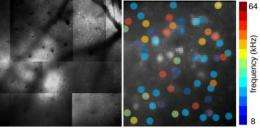
(PhysOrg.com) -- New research shows our brains are a lot more chaotic than previously thought, and that this might be a good thing. Neurobiologists at the University of Maryland have discovered information about how the brain processes sound that challenges previous understandings of the auditory cortex, which had suggested an organization based on precise neuronal maps. In the first study of the auditory cortex conducted using advanced imaging techniques, Patrick Kanold, assistant professor of biology, Shihab Shamma, professor of electrical and computer engineering, and Sharba Bandyopadhyay, post-doctoral associate, describe a much more complex picture of neuronal activity. Their findings are published in the January 31 online edition of Nature Neuroscience.
All our knowledge of how the brain really works has been based on taking a small sampling of all available neurons and making inferences about how the other neurons respond, Dr. Kanold explains. "This is like showing someone who wants to know how America looks, 'Here is one person from New York City and one person from California.' You don't get a very good picture of what the country looks like from that sampling," says Kanold, originally from Germany.
In contrast, Kanold and colleagues were able to look at the activity of all the neurons in a large region of the auditory cortex simultaneously. To get the highest resolution picture to date of how auditory cortex neurons are organized, the researchers used a technique to fill neurons in living mice with a dye that glows brightly when calcium levels rise, a key signal that neurons are firing. They then selectively illuminated specific regions of the cortex with a laser and measured the neuronal activity of hundreds of neurons in response to stimulation by simple tones of different frequencies.
This "in vivo 2-photon calcium imaging" technique was developed by German researchers and advanced by Harvard scientists who used it to study the visual cortex in the mid-2000s. Kanold's study is the first to apply this technique to the auditory cortex and provides an unprecedented amount of detail about how hearing happens.
Dr. Andrew King, Professor of Neurophysiology at the University of Oxford, explains that "The functional organization of the auditory cortex has remained unclear and a matter of some controversy, despite the efforts of many labs over a number of years. The approach used by Dr. Kanold and colleagues is an important advance in this field."
"We discovered that the organization of the cortex does not look as pretty as it does in the textbooks, which surprised us," explains Kanold. "Things are a lot messier than expected." And we don't see evidence of the maps previously proposed using less precise techniques."
But the disorder they found could indicate that the brain is far more adaptable than previously thought. "These results may rewrite our classical views of how cortical circuits are organized and what functions they serve," suggests Dr. Shihab Shamma, whose previous research has involved mapping responses in the auditory cortex using traditional microelectrodes.
By using different dyes, this study measured differences in how the neurons receive sound information (the inputs), and how they process that sound (the outputs). It was previously assumed that neighboring neurons receiving the same inputs would also produce the same outputs, but Kanold's research found something very different. "Neighboring neurons do their own thing by creating different outputs," Kanold explains. "You can imagine that you and your neighbor both receive water to your houses from the same pipe, but you do different things with it - you might cook with it while your neighbor waters the lawn. You can't assume that they are doing the same thing just because they are neighbors."
This is the first time that this level of individuality has been observed in neighboring neurons. Dr. Kanold, who is an expert in neuroplasticity, the brain's ability to reorganize neural pathways, believes that there is a tremendous advantage in this apparent disorder. "Each individual neuron is getting inputs from a wide range of frequencies, and by selecting which frequencies they are strongly responding to, they might be very easily able to shift their function," he says. For example, it is well known that we can quickly listen in on a variety of conversations around us, the so-called "cocktail party effect." It may be that neurons having access to a large range of inputs might be able to quickly change which inputs they are responding to.
This suggests that there is very little redundancy in the function of cells in the auditory cortex, which differs notably from the visual cortex, in which neighboring neurons perform the same function as one another. This could be because our acoustic environment, such as the speech we hear, changes much faster than our visual environment, so we have to constantly adapt to new situations.
Kanold continues to study the mechanisms of brain circuitry involved in early development to gain a better understanding of why we can learn so well in early development but lose some of this ability as we age. For example, why can children easily learn new languages, while adults often struggle? Kanold's work has been focusing on identifying circuits in the young brain that mediate this remarkable ability. He is also working to apply his knowledge of developmental brain circuitry to the prevention and treatment of diseases such as cerebral palsy and epilepsy, which can be caused by early brain injuries. With his collaborator Shihab Shamma, who is studying adult mechanisms of plasticity and hearing, he is exploring how brain circuitry and learning changes over time.


