Magnetic nanoparticles show promise for combating human cancer
February 1, 2010
Magnetic nanoparticles show promise for combating human cancer

Enlarge

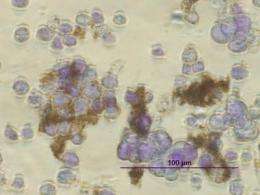
Nanoparticles, in brown, attach themselves to cancer cells, in violet, from the human abdominal cavity. Credit: Ken Scarberry/Georgia Tech

Scientists at Georgia Tech and the Ovarian Cancer Institute have further developed a potential new treatment against cancer that uses magnetic nanoparticles to attach to cancer cells, removing them from the body. The treatment, tested in mice in 2008, has now been tested using samples from human cancer patients. The results appear online in the journal Nanomedicine.

"We are primarily interested in developing an effective method to reduce the spread of cells to other organs ," said John McDonald, professor at the the School of Biology at the Georgia Institute of Technology and chief research scientist at the Ovarian Cancer Institute.

The idea came to the research team from the work of Ken Scarberry, then a Ph.D. student at Tech. Scarberry originally conceived of the idea as a means of extracting viruses and virally infected cells. At his advisor's suggestion Scarberry began looking at how the system could work with .

He published his first paper on the subject in the in July 2008. In that paper he and McDonald showed that by giving the cancer cells of the mice a fluorescent green tag and staining the red, they were able to apply a magnet and move the green cancer cells to the abdominal region.

Now McDonald and Scarberry, currently a post-doc in McDonald's lab, has showed that the magnetic technique works with human cancer cells.

"Often, the lethality of cancers is not attributed to the original tumor but to the establishment of distant tumors by cancer cells that exfoliate from the primary tumor," said Scarberry. "Circulating tumor cells can implant at distant sites and give rise to secondary tumors. Our technique is designed to filter the peritoneal fluid or blood and remove these free floating cancer cells, which should increase longevity by preventing the continued spread of the cancer."

In tests, they showed that their technique worked as well with at capturing cancer cells from human patient samples as it did previously in mice. The next step is to test how well the technique can increase survivorship in live animal models. If that goes well, they will then test it with humans.

Provided by Georgia Institute of Technology


Rank 5 /5 (2 votes)
Relevant PhysicsForums posts
  • Mitosis
    created7 hours ago
  • Stem cell question.
    created8 hours ago
  • Protease cleavage
    created14 hours ago
  • Pertubance in a model
    created21 hours ago
  • Cancer drugs and Alzheimer's, Oh my!
    createdFeb 09, 2012
  • Squishing cells
    createdFeb 09, 2012
  • More from Physics Forums - Biology

More news stories

What lies beneath: Mapping hidden nanostructures

The ability to diagnose and predict the properties of materials is vital, particularly in the expanding field of nanotechnology. Electron and atom-probe microscopy can categorize atoms in thin sheets of material, ...

Nanotechnology / Nanophysics

created 19 hours ago | popularity 5 / 5 (3) | comments 1

New kind of solar cell could capture significantly more energy than current cells

New solar cells could increase the maximum efficiency of solar panels by over 25%, according to scientists from the University of Cambridge.

Nanotechnology / Nanophysics

created Feb 08, 2012 | popularity 4.5 / 5 (12) | comments 14 | with audio podcast

Nanoshell whispering galleries improve thin solar panels

Visitors to Statuary Hall in the U.S. Capitol Building may have experienced a curious acoustic feature that allows a person to whisper softly at one side of the cavernous, half-domed room and for another on ...

Nanotechnology / Nanomaterials

created Feb 07, 2012 | popularity 4.3 / 5 (6) | comments 6 | with audio podcast

'Dark plasmons' transmit energy

Microscopic channels of gold nanoparticles have the ability to transmit electromagnetic energy that starts as light and propagates via "dark plasmons," according to researchers at Rice University.

Nanotechnology / Nanophysics

created Feb 09, 2012 | popularity 4.8 / 5 (9) | comments 1 | with audio podcast

Revealing how a battery material works

Since its discovery 15 years ago, lithium iron phosphate (LiFePO4) has become one of the most promising materials for rechargeable batteries because of its stability, durability, safety and ability to deliver ...

Nanotechnology / Nanomaterials

created Feb 08, 2012 | popularity 5 / 5 (5) | comments 0 | with audio podcast


Anonymous knocks CIA website offline (Update)

The website of the Central Intelligence Agency was inaccessible on Friday after the hacker group Anonymous claimed to have knocked it offline.

New error-correcting codes guarantee the fastest possible rate of data transmission

Error-correcting codes are one of the triumphs of the digital age. They’re a way of encoding information so that it can be transmitted across a communication channel — such as an optical fiber o ...

Humans may have helped the decline of African rainforests 3000 years ago

(PhysOrg.com) -- Large areas of rainforests in Central Africa mysteriously disappeared over three thousand years ago, to be replaced by savannas. The prevailing theory has been that the cause was a change ...

Small modular reactor design could be a 'SUPERSTAR'

(PhysOrg.com) -- Though most of today's nuclear reactors are cooled by water, we've long known that there are alternatives; in fact, the world's first nuclear-powered electricity in 1951 came from a reactor ...

New power source discovered

(PhysOrg.com) -- Researchers at the Massachusetts Institute of Technology (MIT) and RMIT University have made a breakthrough in energy storage and power generation.

The power of estrogen -- male snakes attract other males

A new study has shown that boosting the estrogen levels of male garter snakes causes them to secrete the same pheromones that females use to attract suitors, and turned the males into just about the sexiest ...