Japanese Manufacturers Developing Millimeter-Wave Communication Chips
February 1, 2010 by John Messina weblog
Japanese Manufacturers Developing Millimeter-Wave Communication Chips

Enlarge

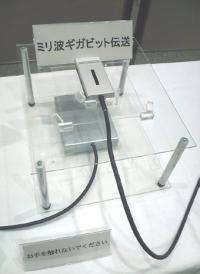
(PhysOrg.com) -- The three large Japanese manufactures, Hitachi, Panasonic Corp., and Toshiba Corp, have announced that they are developing radio frequency (RF) transceiver ICs in the 60GHz band. All three manufactures plan to make ultra-small transceiver modules with integrated antennas that will be used in digital home electronics.

By utilizing the 60GHz , a bandwidth of approximately 7GHz will make it possible to have transfer rate of 1.5 Gigabits per second. As compared to 802.11g of 54Mbs, this technology offers a much larger . At a transfer rate of 1Gbs, it would be possible to download a 640MB CD in about 5 seconds or a 2-hour SD quality video in about 9 seconds.
Japanese Manufacturers Developing Millimeter-Wave Communication Chips
Enlarge

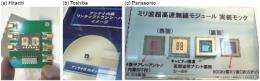
Three manufactures shown here with their millimeter-wave transceiver modules: (a) Hitachi integrates LNA, mixer, VCO, etc. (b) Toshiba's single-chip RF transceiver. (c) Panasonic's millimeter-wave transceiver module.

Because of an unknown market demand for millimeter-wave communication, Japanese manufactures have not been actively developing this technology, until now. Expectations are now rising for market growth, supporting the release of AV equipment with the WirelessHD standard utilizing chipsets from SiBEAM, Inc. was released by Panasonic, , Inc., and others.

Hitachi plans to use millimeter-wave communication for the transfer of high-definition video streams between AV equipment, such as large screen TVs and Blu-ray Disc recorders.

Hitachi has already developed a prototype CMOS receiver IC. The module combines the IC with an antenna and other components supporting data communication in compliance with 802.15.3c. The IC was manufactured using 130nm CMOS technology, and integrates a VCO (voltage-controlled oscillator), mixer, and low-noise amplifier (LNO).

Panasonic is focusing on applications that will be used in mobile phones and they are hoping to single-chip the whole package using CMOS technology.

Toshiba wants to use millimeter-wave communication to make completely cordless digital equipment. The company is currently working on an RF transceiver IC that uses the bonding wires as the antenna. is hoping to come up with a single-chip solution that can be made with CMOS technology and does not require a dedicated antenna or other components.

The first products, using millimeter-wave communication, could appear as early as the second half of this year.

© 2010 PhysOrg.com

4.3 /5 (8 votes)  

Rank 4.3 /5 (8 votes)
Relevant PhysicsForums posts
  • Calling function with no input argument
    created16 hours ago
  • Force free body diagram problem on gym equipment
    created17 hours ago
  • Empirical data regarding shower heads and water
    createdFeb 10, 2012
  • feed hold button on CNC lathe
    createdFeb 09, 2012
  • RFAC in Fortran
    createdFeb 09, 2012
  • dynamics 2/32
    createdFeb 08, 2012
  • More from Physics Forums - General Engineering

More news stories

Japan scientist makes 'Avatar' robot

A Japanese-developed robot that mimics the movements of its human controller is bringing the Hollywood blockbuster "Avatar" one step closer to reality.

Electronics / Robotics

created 22 hours ago | popularity 5 / 5 (7) | comments 8

Intel packs performance and reliability into its latest SSD 520 series

Intel Corporation announced today its fastest, most robust client/consumer solid-state drive (SSD) to date, the Intel Solid-State Drive 520 Series (Intel SSD 520), a 6 gigabit-per-second (gbps) SATA III SSD ...

Electronics / Hardware

created Feb 07, 2012 | popularity 5 / 5 (1) | comments 4

Google rumored to have built Heads-Up-Display glasses prototype

(PhysOrg.com) -- 9to5Google is reporting that they have received a tip from someone they believe to be a reliable source saying that Google is working on a Heads-Up-Display (HUD) pair of eye-glasses. The per ...

Electronics / Consumer & Gadgets

created Feb 08, 2012 | popularity 4.3 / 5 (8) | comments 2 | with audio podcast weblog

Apple to debut 'iPad 3' in March: report

Apple will unveil a new version of its market-ruling iPad table computer in March, according to a report in Dow Jones-owned technology blog All Things D.

Electronics / Consumer & Gadgets

created Feb 09, 2012 | popularity 1.9 / 5 (21) | comments 0

New Kindle Touch is an impressive e-reader

When it comes to reading digital books, tablets are all the rage. But there's a lot to like about simple e-readers, which over the past year have become both a lot cheaper and a lot less clunky.

Electronics / Consumer & Gadgets

created Feb 09, 2012 | popularity 5 / 5 (3) | comments 1


Anonymous knocks CIA website offline (Update)

The website of the Central Intelligence Agency was inaccessible on Friday after the hacker group Anonymous claimed to have knocked it offline.

New error-correcting codes guarantee the fastest possible rate of data transmission

Error-correcting codes are one of the triumphs of the digital age. They’re a way of encoding information so that it can be transmitted across a communication channel — such as an optical fiber o ...

Humans may have helped the decline of African rainforests 3000 years ago

(PhysOrg.com) -- Large areas of rainforests in Central Africa mysteriously disappeared over three thousand years ago, to be replaced by savannas. The prevailing theory has been that the cause was a change ...

Google users warned of threat to smartphone wallets

Users of Google smartphone wallets were being warned on Friday that there is a way to crack pass codes intended to thwart thieves from going on illicit shopping sprees.

New power source discovered

(PhysOrg.com) -- Researchers at the Massachusetts Institute of Technology (MIT) and RMIT University have made a breakthrough in energy storage and power generation.

The power of estrogen -- male snakes attract other males

A new study has shown that boosting the estrogen levels of male garter snakes causes them to secrete the same pheromones that females use to attract suitors, and turned the males into just about the sexiest ...