Engineers develop cancer-targeting nanoprobe sensors
February 1, 2010 By Sarah Yang
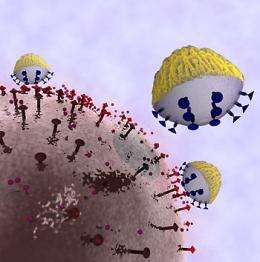
UC Berkeley scientists are designing smart nanoprobes, called nanocorals, to selectively attach to cancer cells, deliver therapeutic drugs and report on the local molecular environment. One side of the nanocorals is designed to selectively target the cell, while the other has a roughened surface to sense tell-tale chemical particles in the environment. (Benjamin Ross and Liz Wu, UC Berkeley)
(PhysOrg.com) -- Scientists at UC Berkeley have created smart nanoprobes that may one day be used in the battle against cancer to selectively seek out and destroy tumor cells, as well as report back on the mission's status. The research team created multi-functioning probes, which they have dubbed nanocorals.
A small number of research teams around the world have been developing target-specific nanoprobes for the past 10 years in an effort to reduce and perhaps eliminate the toxic toll chemotherapy takes on the healthy cells that reside near their diseased counterparts.
What had been missing, however, is a mechanism by which the nanoprobes could not only find the cancer cell, but also relay information once they latched onto the target. The UC Berkeley team created such multi-functioning probes, which they have dubbed nanocorals.
The development of the new nanocorals is the cover story for the Feb. 22 print issue of the peer-reviewed journal Small.
"If you're sending a satellite into space, you need it to do more than one thing. It must reach its target, detect its surroundings, and communicate back to ground control," said Luke Lee, Lloyd Distinguished Professor of Bioengineering at UC Berkeley and head of the UC Berkeley team that developed the nanocoral. "The same is true in the molecular galaxy. We need probes that can find a diseased cell, treat it, and tell us about the local environment so we can determine whether the treatment is working. The nanocoral probes we invented are an important step in this direction."
The tiny probes measure a few hundred nanometers in diameter one-thousandth the width of a human hair, and one-hundredth the size of most cancer cells. The teams insight was to combine different materials roughened gold on one side, and smooth polystyrene on the other onto a single probe.
The name of the new probe is inspired by natural sea corals, which use rough surfaces to enhance the capture of light and food particles.
"Like natural corals, the highly roughened nanocoral surface is designed to capture molecules near the probes, and report their presence back to researchers," said Benjamin Ross, a Ph.D. student in UC Berkeley's Applied Science and Technology Program, and one of two co-lead authors of the study. "The type of molecules present or absent at the cell's surface can provide telltale signs of how a cell is reacting to the new drug being delivered."
The sensing side of the nanocoral relies upon a technique called surface-enhanced Raman spectroscopy (SERS), which takes advantage of the electromagnetic excitations that occur as molecules make contact with the roughened surface of a metal, such as gold. Molecules produce oscillations that resonate at signature frequencies when exposed to laser light, revealing their presence to the scientists.
The researchers verified the sensitivity of the nanocoral by measuring its ability to detect a standard chemical compound for Raman spectroscopy.
To get the nanocoral to target specific cells, the researchers took advantage of the capability to attach antibodies to polymer surfaces.
"We can tailor the nanocoral to cancer cells of interest by attaching the appropriate antibodies," said the study's other co-lead author, Liz Wu, who conducted this research as a Ph.D. student in the Applied Science and Technology program.
The researchers demonstrated this concept by coating the polystyrene surface with antibodies that attack human epidermal growth factor receptor 2 (HER-2), a well-known target for cancer treatment since it is often over-expressed in aggressive forms of breast cancer. They confirmed with both bright field and fluorescent images that the nanocoral attached to breast cancer cells with HER-2 receptors, while control experiments showed that no binding occurred when different antibodies or when cells lacking HER-2 were used.
"We are still in the early stages of development, but we are optimistic that the nanocorals will eventually become useful diagnostic and treatment tools for a wide range of cancers," said Lee. "This will potentially allow us not only to deliver a drug, but also to see the response in real time at a sub-cellular level."
Another co-author of the study is SoonGweon Hong, UC Berkeley graduate student in bioengineering.
Provided by University of California - Berkeley (news : web)
-
Nanoparticle Probes Light Up Cancer Cells
Nov 06, 2006 |
not rated yet |
0
-
Nanoscopic probes can track down and attack cancer cells
Mar 16, 2009 |
not rated yet |
0
-
Nanoprobes hit targets in tumors, could lessen chemo side effects
Dec 14, 2009 |
not rated yet |
0
-
Cell receptor may lead to new 'biomarker' for pancreatic cancer
Jul 01, 2007 |
not rated yet |
0
-
Chemical probes beat antibodies at own game
Apr 26, 2007 |
not rated yet |
0
-
Engineers build first sub-10-nm carbon nanotube transistor
Feb 01, 2012 |
4.9 / 5 (29) |
30
-
Something old, something new: Evolution and the structural divergence of duplicate genes
Jan 31, 2012 |
4.6 / 5 (7) |
1
-
The hidden nanoworld of ice crystals: Revealing the dynamic behavior of quasi-liquid layers
Jan 30, 2012 |
5 / 5 (3) |
1
-
Stock market network reveals investor clustering
Jan 27, 2012 |
3.9 / 5 (23) |
8
-
Of microchemistry and molecules: Electronic microfluidic device synthesizes biocompatible probes
Jan 26, 2012 |
5 / 5 (1) |
0
-
a single mRNA strand is attached to sevaral ribosomes?
22 hours ago
-
Oestrogen and FSH
Feb 07, 2012
-
Linear Blood Vessel Network Examples in Animals or Plants
Feb 07, 2012
-
Neuroscientists: What is a Principal Cell Layer?
Feb 06, 2012
-
How does slime mould grow?
Feb 04, 2012
-
Why are mosquitoes and bedbugs successful?
Feb 04, 2012
- More from Physics Forums - Biology
More news stories
New kind of solar cell could capture significantly more energy than current cells
New solar cells could increase the maximum efficiency of solar panels by over 25%, according to scientists from the University of Cambridge.
13 hours ago |
4.8 / 5 (5) |
13
|
Revealing how a battery material works
Since its discovery 15 years ago, lithium iron phosphate (LiFePO4) has become one of the most promising materials for rechargeable batteries because of its stability, durability, safety and ability to deliver ...
Nanotechnology / Nanomaterials
17 hours ago |
5 / 5 (5) |
0
|
'Shish kebab' structure provides improved form of 'buckypaper'
Scientists are reporting development of a new form of buckypaper, which eliminates a major drawback of these sheets of carbon nanotubes -- 50,000 times thinner than a human hair, 10 times lighter than steel, ...
Nanotechnology / Nanomaterials
10 hours ago |
not rated yet |
0
|
Will bubble-powered microrockets zoom through the human stomach?
Scientists have developed a new kind of tiny motor which they term a "microrocket" that can propel itself through acidic environments, such as the human stomach, without any external energy source, ...
Nanotechnology / Nanomaterials
11 hours ago |
not rated yet |
0
Nanoshell whispering galleries improve thin solar panels
Visitors to Statuary Hall in the U.S. Capitol Building may have experienced a curious acoustic feature that allows a person to whisper softly at one side of the cavernous, half-domed room and for another on ...
Nanotechnology / Nanomaterials
Feb 07, 2012 |
4.2 / 5 (5) |
6
|
Astronomy team discovers nearby dwarf galaxy
(PhysOrg.com) -- A team led by UCLA research astronomer Michael Rich has used a unique telescope to discover a previously unknown companion to the nearby galaxy NGC 4449, which is some 12.5 million light years ...
Amasia: As next supercontinent forms, Arctic Ocean, Caribbean will vanish first
(PhysOrg.com) -- Geologists at Yale University have proposed a new theory to describe the formation of supercontinents, the epic process by which Earths major continental blocks combine into a single ...
Physicists build highly efficient 'no-waste' laser
A team of University of California, San Diego researchers has built the smallest room-temperature nanolaser to date, as well as an even more startling device: a highly efficient, "thresholdless" laser that ...
Why are there so few fish in the Earth's oceans?
(PhysOrg.com) -- A Stony Brook University researcher has found that, contrary to popular belief, there are not plenty of fish in the sea.
Transparent iron? For the first time, an experiment shows that atomic nuclei can become transparent
At the high-brilliance synchrotron light source PETRA III, a team of DESY scientists headed by Dr. Ralf Röhlsberger has succeeded in making atomic nuclei transparent with the help of X-ray light. At the ...
Study shows how DNA finds its match
It's been more than 50 years since James Watson and Francis Crick showed that DNA is a double helix of two strands that complement each other. But how does a short piece of DNA find its match, out of the millions ...