New adhesive device could let humans walk on walls (w/ Video)
February 1, 2010 By Anne Ju
New adhesive device could let humans walk on walls

Enlarge

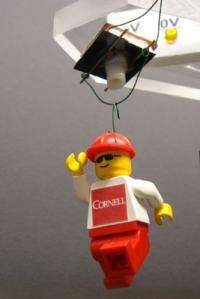
Paul Steen and Michael Vogel's surface tension-based adhesive device with a lego man payload.

(PhysOrg.com) -- Could humans one day walk on walls, like Spider-Man? A palm-sized device invented at Cornell that uses water surface tension as an adhesive bond just might make it possible.

The rapid mechanism could lead to such applications as shoes or gloves that stick and unstick to walls, or Post-it-like notes that can bear loads, according to Paul Steen, professor of chemical and biomolecular engineering, who invented the with Michael Vogel, a former postdoctoral associate.

The device is the result of inspiration drawn from a beetle native to Florida, which can adhere to a leaf with a force 100 times its own weight, yet also instantly unstick itself. Research behind the device is published online Feb. 1 in .

This video is not supported by your browser at this time.

The researchers demonstrate a larger version of their switchable adhesive device. When voltage is applied, the device becomes adhesive. Reversing the voltage also turns off the adhesion. Credit: David Anderson

The device consists of a flat plate patterned with holes, each on the order of microns. A bottom plate holds a liquid reservoir, and in the middle is another porous layer. An electric field applied by a common 9-volt battery pumps water through the device and causes droplets to squeeze through the top layer. The surface tension of the exposed droplets makes the device grip another surface - much the way two wet glass slides stick together.

"In our everyday experience, these forces are relatively weak," Steen said. "But if you make a lot of them and can control them, like the beetle does, you can get strong adhesion forces."

For example, one of the researchers' prototypes was made with about 1,000 300-micron-sized holes, and it can hold about 30 grams - more than 70 paper clips. They found that as they scaled down the holes and packed more of them onto the device, the adhesion got stronger. They estimate, then, that a one-square-inch device with millions of 1-micron-sized holes could hold more than 15 pounds.

To turn the adhesion off, the electric field is simply reversed, and the water is pulled back through the pores, breaking the tiny "bridges" created between the device and the other surface by the individual droplets.

The research builds on previously published work that demonstrated the efficacy of what's called electro-osmotic pumping between surface tension-held interfaces, first by using just two larger water droplets.

One of the biggest challenges in making these devices work, Steen said, was keeping the droplets from coalescing, as water droplets tend to do when they get close together. To solve this, they designed their pump to resist water flow while it's turned off.

Steen envisions future prototypes on a grander scale, once the pump mechanism is perfected, and the adhesive bond can be made even stronger. He also imagines covering the droplets with thin membranes - thin enough to be controlled by the pump but thick enough to eliminate wetting. The encapsulated liquid could exert simultaneous forces, like tiny punches.

"You can think about making a credit card-sized device that you can put in a rock fissure or a door, and break it open with very little voltage," Steen said. "It's a fun thing to think about."

Provided by Cornell University (news : web)

4.2 /5 (26 votes)  

Filter


Move the slider to adjust rank threshold, so that you can hide some of the comments.


Display comments: newest first

wawadave
Feb 01, 2010

Rank: not rated yet
make it round and insert into hole drilled in rock face you can blast rock with out powder.
h1ghj3sus
Feb 02, 2010

Rank: not rated yet
This example highlights my understanding of partitioning systems:

http://www.youtub...2rZQgO_c
Ricochet
Feb 03, 2010

Rank: not rated yet
I, personally, don't understand how a membrane over the water would actually help with the adhesion. If it's the water, itself, that ultimately provides the adhesion, then it seems to me that the membrane, itself, would then have to provide the adhesion, with the water simply being used to to push it against the surface and pull back, etc.
Rank 4.2 /5 (26 votes)
Related Stories
Relevant PhysicsForums posts
  • Stoichiometry
    created23 hours ago
  • Boiling and melting point of impure substances
    createdFeb 10, 2012
  • Safe nitrogen compound to decompose a 500 deg C in a furnace?
    createdFeb 09, 2012
  • [ask]electron inside drinking water
    createdFeb 08, 2012
  • How to avoid formation of Lithium Chromate ???
    createdFeb 08, 2012
  • how to choose a reduced or oxidated form in a redox
    createdFeb 08, 2012
  • More from Physics Forums - Chemistry

More news stories

Fool's gold may prove an unlikely alternative to overexploited catalytic materials

Catalytic materials, which lower the energy barriers for chemical reactions, are used in everything from the commercial production of chemicals to catalytic converters in car engines. However, with current catalytic materials ...

Chemistry / Materials Science

created 15 hours ago | popularity 4.4 / 5 (8) | comments 5 | with audio podcast

Unpicking HIV’s invisibility cloak

Drug researchers hunting for alternative ways to treat human immunodeficiency virus (HIV) infections may soon have a novel target—its camouflage coat. HIV hides inside a cloak unusually rich in a sugar ...

Chemistry / Biochemistry

created 15 hours ago | popularity 5 / 5 (5) | comments 0

Hydrogen from acidic water: Researchers develop potential low cost alternative to platinum for splitting water

A technique for creating a new molecule that structurally and chemically replicates the active part of the widely used industrial catalyst molybdenite has been developed by researchers with the Lawrence Berkeley ...

Chemistry / Materials Science

created Feb 09, 2012 | popularity 4.8 / 5 (14) | comments 15 | with audio podcast

No entry without protein recycling: Researchers discover new coherence in enzyme transport

The group of Prof. Dr. Ralf Erdmann at the Ruhr-Universität Bochum, Germany, discovered a connection of peroxisomal protein import and receptor export. In the Journal of Biological Chemistry, they disclo ...

Chemistry / Biochemistry

created 15 hours ago | popularity not rated yet | comments 0

Under the microscope #7

In this video Dr Ingrid Graz shows us a thin layer of gold on top of rubber. Cracks in the gold allow it to stretch and we can use this for stretchable electronics.

Chemistry / Other

created 17 hours ago | popularity not rated yet | comments 0


Anonymous knocks CIA website offline (Update)

The website of the Central Intelligence Agency was inaccessible on Friday after the hacker group Anonymous claimed to have knocked it offline.

Google users warned of threat to smartphone wallets

Users of Google smartphone wallets were being warned on Friday that there is a way to crack pass codes intended to thwart thieves from going on illicit shopping sprees.

New error-correcting codes guarantee the fastest possible rate of data transmission

Error-correcting codes are one of the triumphs of the digital age. They’re a way of encoding information so that it can be transmitted across a communication channel — such as an optical fiber o ...

Humans may have helped the decline of African rainforests 3000 years ago

(PhysOrg.com) -- Large areas of rainforests in Central Africa mysteriously disappeared over three thousand years ago, to be replaced by savannas. The prevailing theory has been that the cause was a change ...

New power source discovered

(PhysOrg.com) -- Researchers at the Massachusetts Institute of Technology (MIT) and RMIT University have made a breakthrough in energy storage and power generation.

The power of estrogen -- male snakes attract other males

A new study has shown that boosting the estrogen levels of male garter snakes causes them to secrete the same pheromones that females use to attract suitors, and turned the males into just about the sexiest ...