Spray-on liquid glass is about to revolutionize almost everything
February 2, 2010 by Lin Edwards report
Spray-on liquid glass

Enlarge

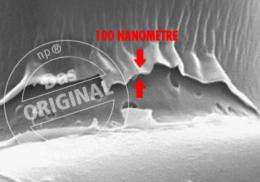
The fissure was induced in order present an image which shows the characteristics of the coating. The image shows the SiO2 coating on a filament of a microfibre.

(PhysOrg.com) -- Spray-on liquid glass is transparent, non-toxic, and can protect virtually any surface against almost any damage from hazards such as water, UV radiation, dirt, heat, and bacterial infections. The coating is also flexible and breathable, which makes it suitable for use on an enormous array of products.

The liquid glass spray (technically termed “SiO2 ultra-thin layering”) consists of almost pure (, the normal compound in glass) extracted from quartz sand. Water or ethanol is added, depending on the type of surface to be coated. There are no additives, and the nano-scale glass coating bonds to the surface because of the quantum forces involved. According to the manufacturers, liquid glass has a long-lasting antibacterial effect because microbes landing on the surface cannot divide or replicate easily.

Liquid glass was invented in Turkey and the patent is held by Nanopool, a family-owned German company. Research on the product was carried out at the Saarbrücken Institute for New Materials. Nanopool is already in negotiations in the UK with a number of companies and with the National Health Service, with a view to its widespread adoption.

The liquid glass spray produces a water-resistant coating only around 100 nanometers (15-30 molecules) thick. On this the glass is highly flexible and breathable. The coating is environmentally harmless and non-toxic, and easy to clean using only water or a simple wipe with a damp cloth. It repels bacteria, water and dirt, and resists heat, and even acids. UK project manager with Nanopool, Neil McClelland, said soon almost every product you purchase will be coated with liquid glass.

Food processing companies in Germany have already carried out trials of the spray, and found sterile surfaces that usually needed to be cleaned with strong bleach to keep them sterile needed only a hot water rinse if they were coated with liquid glass. The levels of sterility were higher for the glass-coated surfaces, and the surfaces remained sterile for months.

Other organizations, such as a train company and a hotel chain in the UK, and a hamburger chain in Germany, are also testing liquid glass for a wide range of uses. A year-long trial of the spray in a Lancashire hospital also produced “very promising” results for a range of applications including coatings for equipment, medical implants, catheters, sutures and bandages. The war graves association in the UK is investigating using the spray to treat stone monuments and grave stones, since trials have shown the coating protects against weathering and graffiti. Trials in Turkey are testing the product on monuments such as the Ataturk Mausoleum in Ankara.

The liquid glass coating is breathable, which means it can be used on plants and seeds. Trials in vineyards have found spraying vines increases their resistance to fungal diseases, while other tests have shown sprayed seeds germinate and grow faster than untreated seeds, and coated wood is not attacked by termites. Other vineyard applications include coating corks with liquid glass to prevent “corking” and contamination of wine. The spray cannot be seen by the naked eye, which means it could also be used to treat clothing and other materials to make them stain-resistant. McClelland said you can “pour a bottle of wine over an expensive silk shirt and it will come right off”.

In the home, spray-on glass would eliminate the need for scrubbing and make most cleaning products obsolete. Since it is available in both water-based and alcohol-based solutions, it can be used in the oven, in bathrooms, tiles, sinks, and almost every other surface in the home, and one spray is said to last a year.

Liquid glass spray is perhaps the most important nanotechnology product to emerge to date. It will be available in DIY stores in Britain soon, with prices starting at around £5 ($8 US). Other outlets, such as many supermarkets, may be unwilling to stock the products because they make enormous profits from cleaning products that need to be replaced regularly, and liquid glass would make virtually all of them obsolete.

More information: Nanopool: http://www.nanopoo … uk/index.htm


Join PhysOrg.com on Facebook!
Follow PhysOrg.com on Twitter!

© 2010 PhysOrg.com

4.7 /5 (276 votes)  

Filter


Move the slider to adjust rank threshold, so that you can hide some of the comments.


Display comments: newest first

CreepyD
Feb 02, 2010

Rank: 5 / 5 (5)
I think this was shown on the gadget show in the UK a few months ago, if it was the same stuff.
They were able to spray something onto shoes (as an example) -They previously soaked up water, but after treating, water just rolled off.
shinobue111
Feb 02, 2010

Rank: 3.1 / 5 (13)
sounds like the new asbestos.


Oh please, it's silicon oxide! we've been using it for centuries.. no potential for poisonous effects cause its GLASS
Zander
Feb 02, 2010

Rank: 3.5 / 5 (11)
sounds like the new asbestos.


Oh please, it's silicon oxide! we've been using it for centuries.. no potential for poisonous effects cause its GLASS


seamlessly non toxic products, when formed into nano-particles, can be toxic. take TiO2 for example, its a non toxic salt, but the TiO2 nano-particles can penetrate through the skin and cause organ damage. [http://www.ncbi.n...alpos=14]
Doug_Huffman
Feb 02, 2010

Rank: 4.1 / 5 (11)
Asbestos is not 'poisonous' but it is a hazardous material that that features oxides of silicon in all of the minerals classified as asbestos. Indeed, unless this thin layering SiO2 can be shown not to occur in physical forms anyway resembling asbestos, then I'm with Mr. S. Lewis and disagree with Shino. La la.
fourthrocker
Feb 02, 2010

Rank: 2.9 / 5 (9)
Sounds too good to be true and I was wondering if it was April 1st too. Things don't have to be poisonous to poison you. If you drink enough water you can get water poisoning. Almost anything in small quantities is non-poisonous, and almost anything in large enough quantites can kill you and if what they are saying is true this stuff could be everywhere before we know it. It doesn't sound dangerous but what does it break down to chemically or mechanically over time?
antialias
Feb 02, 2010

Rank: 3.9 / 5 (11)
There should be some studies on how much of this rubs off (e.g. if we try using it in food containers - especially flexible ones) with a particular eye on the manner of the degradation (does it splinter off or does it bond to other stuff?)

I can see it being useful in many technical areas, though. I'd have no problem with tables at restaurants or toilets being coated with this stuff.

But before we start spraying corn fields or covering our kitchen knives with this I'd like some more research to be done on the long term health aspects.
Doug_Huffman
Feb 02, 2010

Rank: 3.5 / 5 (8)
Almost anything in small quantities is non-poisonous,..

Up jump the precautionary principle principal devil - in the details! Care to comment on hormesis and homeopathy? Stuff with no side-effects generally has no effect at all.

rproulx45
Feb 02, 2010

Rank: 3.9 / 5 (7)
It probably would not be a good idea to use it as a nasal mist, but as a roof coating, it could add 20 years to the life of a roof, as a car sealant, the Michigan cancer would be a thing of the past. We are surrounded by toxins, they are everywhere, from the car exhaust, to the goo you put in your hair to make it look better(?).This is a good practical idea and I hope we can find a way to mass produce it here in America.
deatopmg
Feb 02, 2010

Rank: 4.9 / 5 (13)
sounds like the new asbestos.


Oh please, it's silicon oxide! we've been using it for centuries.. no potential for poisonous effects cause its GLASS

Ever hear of silicosis caused by inhaling crystalline silica?
Skeptic_Heretic
Feb 02, 2010

Rank: 4.3 / 5 (9)
One can question how well this adheres to surfaces. Most home products have a high wood content so the shrink and expand with humidity and temperature. If this glass is applied when the surface is not stretched how well does it bond when stretched? I'd like to not be eating glass particles every time I prepare food on my countertop.
LKD
Feb 02, 2010

Rank: 4.4 / 5 (8)
All I can think of is how this will be liquid asbestos. UFP's are already acknowledged to be a threat, and I pray this get THOROUGHLY tested before it ever goes anywhere.
winthrom
Feb 02, 2010

Rank: 4.5 / 5 (10)
Let me see..... This stuff coats whatever it touches and adheres to organic matter. Then if someone is getting small doses of this stuff in their lungs because it is mechanically rubbed off of the many articles it might be used on, and since the body does not know how to remove these nano particles, we get "glass lung" disease. deatopmg mentions "silicosis caused by inhaling crystalline silica", and I agree.
Mr_Man
Feb 02, 2010

Rank: 1.8 / 5 (6)
I keep picturing someone (accidentally) breathing in a thin mist of this spray and over time the alveoli in the lungs getting permanently clogged up with the stuff.

OR maybe, because Silicon is so similar to Carbon, could this stuff easily enter the blood stream through the lungs like Carbon Dioxide?
Skeptic_Heretic
Feb 02, 2010

Rank: 4.5 / 5 (8)
CO2 doesn't enter the bloodstream from the lungs. It's a one way ion channel that specifically moves CO2 from your blood to the air in your lungs. Si compounds will not act similarly to CO2 in your lungs.
MikeKier
Feb 02, 2010

Rank: 3.3 / 5 (4)
I would imagine it could be quite abrasive if the particles become mixed into the food supply from shedding off surfaces - would do wonders for your tooth enamel.
derricka
Feb 02, 2010

Rank: 3.9 / 5 (8)
I think studies would have to be done to show this product doesn't cause Silicosis of the lungs, a very real threat in many occupations such as mining and sandblasting. As the water/solvent evaporates from the mist of liquid glass, some Silicon dioxide dust would be formed in the air. Like with Asbestosis, symptoms may take years to develop. Another reason to be cautious is that nano-particles are small enough to be taken up by living cells, so it's possible for them to disrupt cellular activities, even though the bulk material would normally be classed as non toxic.
TJ_alberta
Feb 02, 2010

Rank: 5 / 5 (2)
some interesting videos on the company website
http://www.nanopo...load.htm
Crucialitis
Feb 02, 2010

Rank: 3 / 5 (3)
Haha suckers, it's breathable. That means you can take it straight to the lungs, huffers! /s
tothal
Feb 02, 2010

Rank: 1.7 / 5 (3)
Great product but worried a little bit for invisible small glass crystals in the air.Can they puncture lung cells? Hope it was not tested on mice but on pigs at least.
NotAsleep
Feb 02, 2010

Rank: 4.3 / 5 (3)
So if I coat my car with this, I'll just have to drive it in the rain every once in a while to clean it? I can coat my house and never have to repaint it? How about putting it on my teeth and never worrying about cavities?

Sounds like someone invented a snake oil that really works...
Parsec
Feb 02, 2010

Rank: 3 / 5 (3)
I totally agree with potential problems with health effects. At least, studies must be done on how the stuff wears, either by splintering, atomic wear, etc. What happens on coated surfaces exposed to shock? If I coat my table with it, and my kid hits the table with a hammer (again), does the coating shatter?

Asbestosis is caused by mechanical damage to the lungs. The lungs cannot get rid of it or the damaged cells. This stuff really does sound like it has the potential to cause similar types of lung damage. Really.
bfast
Feb 02, 2010

Rank: 3.5 / 5 (4)
NotAsleep, "Sounds like someone invented a snake oil that really works..."

I've been watching new technologies pop into existance for half a century. If 10% of the hype proved to be true we'd be miles ahead. Sheut, I remember when the segue was going to replace all cars, and when the internet was going to make all retail obsolete. This stuff might prove to be a bit useful, but it would shock the death out of me if cleaners became obsolete over it. Not all that "really works", i'd say.
Crucialitis
Feb 02, 2010

Rank: 4 / 5 (3)
NotAsleep, "Sounds like someone invented a snake oil that really works..."

I've been watching new technologies pop into existance for half a century. If 10% of the hype proved to be true we'd be miles ahead. Sheut, I remember when the segue was going to replace all cars, and when the internet was going to make all retail obsolete. This stuff might prove to be a bit useful, but it would shock the death out of me if cleaners became obsolete over it. Not all that "really works", i'd say.


The fundamentals that both of those examples mention are growing and expanding into the industry.
Rome wasn't built in a day.
VOR
Feb 02, 2010

Rank: 5 / 5 (2)
I wonder if this will revolutionize wood preservation, like decks, funiture, and framing lumber. Seems impossible that it could keep a soft wood new in the weather, but I hope otherwise.
Mercury_01
Feb 02, 2010

Rank: 5 / 5 (2)
Radical! Now can we spray it in space and make a large dome out of it?
NotAsleep
Feb 02, 2010

Rank: 4 / 5 (2)
bfast, I also remember when intelligent people said computers would forever be relegated to only a few of the biggest and richest companies in the world. Agreed, talk is cheap, but it goes both ways!

I've always hated tupperware. I'm glad they've finally come up with a product I can spray directly on my food to preserve it. Just kidding... or am I? Yea, probably just kidding
fixer
Feb 02, 2010

Rank: 5 / 5 (1)
Make it in thin sheets and call it "Gladwrap".
frajo
Feb 02, 2010

Rank: 1.8 / 5 (5)
There are no additives, and the nano-scale glass coating bonds to the surface because of the quantum forces involved. According to the manufacturers, liquid glass has a long-lasting antibacterial effect because microbes landing on the surface cannot divide or replicate easily.
Nano-scale, quantum forces, "no replication allowed" signs for landing microbes (but not for floating and walking ones) - why do they hesitate to mention entanglement effects?
Quantum_Conundrum
Feb 02, 2010

Rank: 1 / 5 (1)
If this is harmless, certain chemical cleanser companies will be completely out of business.

This has so many applications that it would be like the Morgan Freeman "Chain Reaction" movie...we're talking total upheaval of world economics.

Does anyone realize how many people this will put out of work within a year or two if you need a mere fraction of the number of household and commercial cleansers, and clothing never gets stained?

I don't want to be a pesimist because I'm a big fan on nano-tech and have even proposed things like this in the past not exactly in detail, but similar in concept, BUT silicon dioxide actually is VERY dangerous when inhaled...yeah someone already mentioned silicosis...

I also think it's a terrible idea to spray crops in the field with this...maybe the trunks and branches of fruit and nut trees, but regular veggies no. Just not a good idea to eat glass.
fixer
Feb 02, 2010

Rank: 1 / 5 (2)
This sounds like sillicone spray, a lubricant commonly used in clothing manufacture.
Its been around as long as me!
Quantum_Conundrum
Feb 02, 2010

Rank: 4.5 / 5 (2)
...but if it's safe...

I mean, imagine your car...you could even have a layer of glass on top of the paint so that the paint lasts much longer, and never waxing...

You could spray a layer over the studs, joists, and rafters in conventional stick houses, making the house resistant to mildew, termites, ants, and even cockroaches.

Shipping might benefit from this in being able to coat the bottoms of ships in a layer which woudl prevent barnacles and other sea creatures from attaching themselves to the hull.

And yeah, anything metalic that is normally painted could probably be coated in this instead, including large things like bridges that are normally too expensive to keep re-painting...

So many potential uses...

Like everyone else says, "too good to be true".

There's almost certainly something going to be dangerous about it. Imagine if you got this stuff in your eyes...
Caliban
Feb 02, 2010

Rank: 1.8 / 5 (4)
From the article, it appears that this product has been licensed and cleared for retail in EU/UK.
This will mean that it will be "fast-tracked" for retail in US as well, and I would be surprised, indeed, if it was not available within 6 months. The thing we should all bear in mind is that there is money to be made here-and lots of it- so all other considerations will be ignored. Since it is almost certain that no pre-market testing has been performed regarding this product's safety, the likelihood of anyone ever being found at fault for any(almost certain) adverse health effects are next to zero. That's the kind of world we live in. Get used to it.
EvgenijM
Feb 02, 2010

Rank: 4.6 / 5 (5)
If this is harmless, certain chemical cleanser companies will be completely out of business.

This has so many applications that it would be like the Morgan Freeman "Chain Reaction" movie...we're talking total upheaval of world economics.

Does anyone realize how many people this will put out of work within a year or two if you need a mere fraction of the number of household and commercial cleansers, and clothing never gets stained?


And that is very good. That's how humanity progressed so far - many jobs become obsolete after introduction of new technologies. There will certainly come a time, when people simply don't need to work to sustain their lives and can spend their time for whatever they like.
adamg
Feb 02, 2010

Rank: 4.4 / 5 (5)
Silicon dioxide is not the same as asbestos or TiO2, and since it polymerizes on or binds to the surface it is coating, it's not going to fly off into your lungs.

Since it is not in powder form, unless you intentionally inhale it all the time, you aren't going to get silicosis from its use.

Finally, because it is completely biologically harmless, your body can easily take care of any particles that you may encounter (your lungs are filled with cilia for this exact purpose). The safety claim is valid--whether or not the product works as advertised should be the only real concern here.
otto1923
Feb 02, 2010

Rank: 1.5 / 5 (2)
The thing we should all bear in mind is that there is money to be made here-and lots of it- so all other considerations will be ignored.
Some of your logical deduction could be a slight chemical imbalance you know. One does not necessarily follow the other. Im more concerned about that teflon stuff they use on furniture, or fiberglass insulation, or salt dust from icy roads, or ... But not radiation. I think radiation is cool. Ive got a large uraninite crystal around somewhere. A friend and I were walking around the geology building of some university not long ago and opened a drawer, and this large tuft of raw asbestos billowed out-
I wonder if this will revolutionize wood preservation
Yah, better than the cyanide they used to use until recently? They used to use pcb oil on our driveway to keep the dust down. And what about lead solder? Not to mention copper which gives you alsheimers-
Supermegadope
Feb 02, 2010

Rank: 2 / 5 (1)
sounds like the new asbestos.


Oh please, it's silicon oxide! we've been using it for centuries.. no potential for poisonous effects cause its GLASS


Silicosis is a disabling, nonreversible and sometimes fatal lung disease caused by overexposure to respirable crystalline silica. Silica exposure remains a serious threat to nearly two million US workers. The National Institute for Occupational Safety and Health (NIOSH) reports that each year more than 250 die from silicosis and hundreds more are disabled. There is no cure for the disease.
jimbo92107
Feb 02, 2010

Rank: 5 / 5 (2)
Well I wouldn't recommend inhaling the stuff, but on balance it may turn out to be a good trade-off if it eliminates the need for so many toxic detergents. Silicon dioxide can't be as toxic as the stuff we're inundating our environment with today.
Caliban
Feb 02, 2010

Rank: 1.7 / 5 (3)
Yes, it's true that SiO2 is not a CHEMICAL toxin, but it may very well prove to be one structurally, or chemically in terms of down-stream reaction products. Asbestos is one of a group of chemically identical, inert minerals, and yet it causes disease because of its physical structure.
merthin
Feb 02, 2010

Rank: 3 / 5 (3)
Well, from reading these comments I see the dark side of the force is out. So my two cents...I wonder if this can be used to coat toxins and bacteria for enhanced dispersion bioweapons?
nuge
Feb 02, 2010

Rank: 2 / 5 (1)
Sounds if anything less dangerous than a great deal of the other stuff we use for those applications.

I'd like to hear more about its potential for radiation shielding. I'd guess its a lot lighter than lead. Sounds like it could be useful in space.
Nartoon
Feb 03, 2010

Rank: 2.5 / 5 (2)
If they claim everything here, I can't wait for the infomercials!
retrosurf
Feb 03, 2010

Rank: not rated yet
I hear if you dip an egg into it, the egg will keep
for 9 months, without refrigeration. And you can
preserve wood with it. And coat masonry with it.

Oh wait, that's water glass, also known as sodium silicate. Huh. That technology is a hundred years old.

Hell. Call it nano-stuff. They'll buy it for sure.
abadaba
Feb 03, 2010

Rank: 5 / 5 (1)
asbestos exerts its effects due to its needle-like fibrous structure, so a comparison of this nano-glass particle spray to asbestos is poor. I wish they better explained the adhesion, because if the particles are water-soluble it seems like they would easily wash away although they indicate this is not true when referring to kitchen studies.
MadMikeScott
Feb 03, 2010

Rank: not rated yet
I wonder if you can layer it into opals or if you can manipulate the partical size to to do opal jells
knightcap
Feb 03, 2010

Rank: not rated yet
I'm surprised no one has mentioned spray on condoms....wait, is this stuff removable?

Wonder what would happen if you spray some in your eye?
Could be a neat hair spray too.

It keeps things clean? Perhaps I'll spray my hamster.

Does it make things really slippery? you could spray your concrete driveway and make an adhoc ice skating ring, or better yet, a round about - or down a steep road and make a sled, could work on a spiral staircase too.

So, its breathable heh? Lets see what the first person who tries chroming with it has to say.
neo_kefka
Feb 03, 2010

Rank: not rated yet
I do agree that this product sounds like asphestos but only in the way that it's being pushed into market rapidly due to its potential applications without adequate testing. The coating may not be dangerous, but the amount of respirable silica dust that it releases due to wear should be known and the dangers for those workers handling the raw silica dust to make the spray should be known before mass production begins. This could be a great product but you can bet if there has been any hint of negligence about it's safety those who's industries are threated by it will latch onto it for sure.
pete_dl
Feb 03, 2010

Rank: 5 / 5 (2)
This article does read a little like an advert on a shopping channel. Glass has quite a high surface energy, so there are many substances that bond to glass. People have lots of personal experience that it usually takes more than water to clean a glass surface. Why would a 100nm layer of glass act any differently? Also, would such a thin layer not be vulnerable to abrasion ?
LKD
Feb 03, 2010

Rank: not rated yet
Abadaba, I know what you are saying, but I am not worried about the application so much as what form it takes when sheared off it's intended surface. I have this mental image of plate like particles that will embed themselves in tissue like caltrops and slowly tear it apart.
holders66
Feb 03, 2010

Rank: not rated yet
We should be concerned about the biological effects of nanoparticles because so little is known. For example, nanoparticles that make their way into living organisms adsorb proteins (see http://www.inspir...-e.aspx) and this may be based on size rather than the underlying material. The protein coating on these nanoparticles may have biological activity (for example, stimulating immune responses, as in vaccine adjuvants such as aluminum hydroxide or squalene) which can include triggering auto-immune disease. As these illnesses can take a long time to manifest, short-term safety studies may not pick them up.
karmal64
Feb 03, 2010

Rank: not rated yet
As usual, nearly all the commentary here is from the opinionated but wholly unqualified.

karmal64
Feb 03, 2010

Rank: not rated yet
sounds like the new asbestos.


Oh please, it's silicon oxide! we've been using it for centuries.. no potential for poisonous effects cause its GLASS


Don't waste your time arguing with people who've already made up their minds about something they know nothing about. It'll drive you as nuts as they probably already are.
absin
Feb 03, 2010

Rank: 5 / 5 (1)
I don't really get the concerns about this. The types of things this spray-on glass would replace (such as cleaning and decorating products) are already known to be dangerous when inhaled. All you have to do is NOT inhale them. Maybe you guys are the kind of people who drank bleach as kids.
Royale
Feb 03, 2010

Rank: not rated yet
wasn't Teflon supposed to revolutionize the home? You could put it on everything and you'd never have to clean again! As you may have noticed teflon is not covering everything in our homes. I'd equate this product to that. It will have its uses but it won't collapse an economy.
PMende
Feb 03, 2010

Rank: not rated yet
Teflon doesn't coat everything in the home because the binding process requires high temperature baking - which most home products cannot handle.
trekgeek1
Feb 03, 2010

Rank: not rated yet
"But what if you inhale it"? Well, don't inhale it. Half the stuff we use daily could kill you instantly if you inhale it. At least this wont kill you on the spot.
otto1923
Feb 03, 2010

Rank: 1 / 5 (1)
Teflon doesn't coat everything in the home because the binding process requires high temperature baking
No but we're still contaminated with it.
http://www.consum...lon.html
-I'm not sure if Stainmaster or Scotchgard contain teflon or related materials; the article mentions them though. Stuff might be good for smokers, to coat their lungs and allow crud to be ejected more easily? (either way you die)
theknifeman
Feb 03, 2010

Rank: not rated yet
I could see a real problem with low quality gemstones being sprayed and sold for much more than the true worth.
M4l4
Feb 03, 2010

Rank: not rated yet
First, it doesn't say "nano-particles" anywhere so it should just be a very small layer of normal particles, reacting normally with the lungs. Also I'm guessing it's bonded by either the Strong Nuclear Force or the Electromagnetic Force, so no problems with the bonding.
Caliban
Feb 03, 2010

Rank: 1 / 5 (2)
So, when you gave the artificially enhanced gemstones to your doctor to pay for the treatment to cure your horrible, progressive, debilitating, painful nanoglass-induced disease, he'd remove the loupe from his eye and say "Sorry kid, but it looks like you're not gonna make it."?
PMende
Feb 03, 2010

Rank: not rated yet
No but we're still contaminated with it.
http://www.consum...lon.html
-I'm not sure if Stainmaster or Scotchgard contain teflon or related materials; the article mentions

Teflon itself is one of the most chemically inert compounds known to humanity. If it is improperly cured/synthesized, of course there can be a problem, but not with PTFE itself.

Also I'm guessing it's bonded by either the Strong Nuclear Force or the Electromagnetic Force, so no problems with the bonding.


Uh... The strong force? You're making a joke, right? Please tell me you're joking.
nothxkbi
Feb 04, 2010

Rank: not rated yet
This stuff isn't bad, I could spray it on my dog and he'll stay clean like forever, or on all the windows around my house....perfect!
Royale
Feb 04, 2010

Rank: not rated yet
This will put poor Rain-X out of business. Their stuff smells bad and only lasts a month, then you need to reapply or deal with a worse windshield than you started with. It'll be interesting to see where this goes.
Skeptic_Heretic
Feb 04, 2010

Rank: 5 / 5 (1)
This will put poor Rain-X out of business. Their stuff smells bad and only lasts a month, then you need to reapply or deal with a worse windshield than you started with. It'll be interesting to see where this goes.

So you think a spray on glass material will put a glass protectant out of business? People use rainex because it stop water from adhering to imperfection in the glass of your windshield. Putting a second, thinner pane of glass in place will not replace glass protectants.
Royale
Feb 04, 2010

Rank: 1 / 5 (1)
"There are no additives, and the nano-scale glass coating bonds to the surface because of the quantum forces involved." Sounds to me like that would patch up a windshield and make water float away as you're cruising down the highway.
Skeptic_Heretic
Feb 04, 2010

Rank: not rated yet
Until the exact same thing, that eroded the GLASS windshield, eroded this GLASS coating.
Suchros
Feb 05, 2010

Rank: not rated yet
I can just imagine some graffiti-makers would love this-make graffiti, cover it with glass - voila'

They better get an idea how to remove the stuff, or they better spray every monument, like, yesterday. Just saying, and this in 30 seconds of thinking abuse-potential... Spraying crops-troll? How can anything grow inside glass huh ? They sell those neat buddha-shaped pears in Japan though.
El_Nose
Feb 05, 2010

Rank: 5 / 5 (5)
I just got a warning from Physorg
One of your comments was removed by the site staff for violation of the comments guidelines. The comment was removed for the following reason: POINTLESS VERBIAGE


my original post was
@ rproulx45

Michigan cancer??


I am from Michigan and had no clue to what he was referring ... a couple posts later someone explained he meant ... Rust

the moderators have gone a little overboard if you can't ask a question on here... and its termed Pointless Verbiage
Royale
Feb 05, 2010

Rank: 5 / 5 (2)
yes. I agree fully with you El Nose. I've had 5 posts so far removed for various reasons, one of them being pointless verbiage. Why do I see shoe advertisements in peoples posts that arent removed? Anyway, getting back on topic, i think it would be a bad idea to start spraying this new wonder material on our food crops. That's just a bit scary, to say the least. And Skeptic, this material is "highly flexible" which i'd imagine would help protect your windshield from whatever caused the "erosion" in the first place. Maybe not forever, but for longer than rain-x which fills things in for about a month.
otto1923
Feb 05, 2010

Rank: 1 / 5 (1)
Apparently brevity is read as lack of meaningful content. When I rewrite posts with the same content and more words, they dont get deleted. By the by,
Until the exact same thing, that eroded the GLASS windshield, eroded this GLASS coating.
This stuff might be a way of renewing windshields which are full of microscratches and wear which make them prone to cracks. Also eyeglasses scratch repair and as a hard coating for plastic lenses?
otto1923
Feb 05, 2010

Rank: 1 / 5 (1)
Oh sorry Royale I missed your windshield comment. Food crops are already sprayed; fruit is bathed in waxes and dyes and crap to preserve fresh appearance. Maybe this inert stuff can replace the more persistant, reactive chem.
Royale
Feb 05, 2010

Rank: 1 / 5 (1)
i suppose assuming it's safer and "breathable" why not, right? I just hope they don't start mass using this stuff only to find out in 10 years that there were some harsh unintended consequences. i suppose it's better than pesticides, but if you can't wash it off i'd hope you could break this stuff down in your stomach.
Javinator
Feb 05, 2010

Rank: 5 / 5 (2)
I'd like to hear more about its potential for radiation shielding. I'd guess its a lot lighter than lead. Sounds like it could be useful in space.


UV radiation shielding is much different than shielding from gammas. You don't use lead for sunblock. You don't put sunblock on spacecraft.
FastEddy
Feb 05, 2010

Rank: not rated yet
I think studies would have to be done to show this product doesn't cause Silicosis of the lungs, a very real threat in many occupations such as mining and sandblasting. As the water/solvent evaporates from the mist of liquid glass, some Silicon dioxide dust would be formed in the air. Like with Asbestosis, symptoms may take years to develop. Another reason to be cautious is that nano-particles are small enough to be taken up by living cells, so it's possible for them to disrupt cellular activities, even though the bulk material would normally be classed as non toxic.


Oh, please: Just use electrostatic powder coating techniques or similar = no waste, no airborne dust, no sucky, no blowey ... stand back and let the robot in the bubble do it.
KB6
Feb 06, 2010

Rank: not rated yet
I could see a real problem with low quality gemstones being sprayed and sold for much more than the true worth.


But how much are gemstones *truly* worth?
Slick
Feb 06, 2010

Rank: 5 / 5 (1)
Seems to me that medical problems associated with silicon and asphestos stem from the sharp edges of their particles so that they cannot be expelled from the lungs. The article appears to address this issue, stating that the material is very flexible, therefore it won't break into particles with sharp edges. And the spray will produce particles with rounded edges that can be expelled. Still, I would expect these issues will have been addressed before the product hits the market.
Fazer
Feb 07, 2010

Rank: not rated yet
The finished layer is supposed to be 100 namometers thick, so the individual particles must therefore be less than 100nm. Since they are very small (approx 100 times smaller than the thickness of Asbestos fibers on average) and likely round and blunt as opposed to long and hooked, I don't think there is a danger of tissue trauma, as in asbestos. The real concern is the possibility of damage on much smaller scales, such as interference in cell functioning, which needs more study.

The adhesion between the particles is likely from the 'Van Der Waals force', where deformation of molecules creates slightly positive and negative regions on the surface of each molecule which then attract the oppositely charged regions on neighboring molecules. What I don't understand is how they keep the molecules from sticking together while still in the bottle. Why would water keep them soluble when it doesn't interfere with the Van Der Waals force. Geckos and frogs do just fine in water!
maybeperfect
Feb 07, 2010

Rank: not rated yet
Alas, I am persuaded that all discussion of product safety is moot due to the fact that soulless corporations have insisted on vandalizing the planet and its genomes through liberal application of products such as depleted uranium munitions and GMO food crops, soft kill food, water, and drug contamination, etc., etc.
The product seems to be one of possibly thousands sequestered by the elite, which could have made our planet a wonderland of discovery and promise, instead of the hellish parody of Mordor it has increasingly more obviously become.
SmartK8
Feb 07, 2010

Rank: 1 / 5 (2)
I'm more afraid, if someone took it, and applied it on a downhill highway, or on the random stair steps. Because an original texture is preserved. I guess the YouTube pranks will be ever more fun from now on.
Edylc
Feb 07, 2010

Rank: 5 / 5 (1)
I can't believe pretty much every comment on here is negative.
Come on, this is pretty cool.
wawadave
Feb 07, 2010

Rank: 5 / 5 (1)
I think it would make a very interesting gasoline and oil additive. Keep the valves from wearing keep carbon build up from happening.Would kill catalytic converters. add to oil would make sludge easier to get rid of. not sure of ring cylinder surfaces with this on them how it would be.
zbarlici
Feb 08, 2010

Rank: 1 / 5 (1)
I can't believe pretty much every comment on here is negative.
Come on, this is pretty cool.


gotta admit that the applications for this amazing technology would be awesome! I also gotta admit that i`ve looked into the whole "nanotechnology" thing and i was quite shocked to find out that some nanoparticles are on a scale of thousands of times smaller than our body`s organic cell. Easy enough for the nanoparticles to infiltrate and screw with your DNA. WHO THE HELL NEEDS THAT?
zbarlici
Feb 08, 2010

Rank: 1 / 5 (1)
http://tinyurl.com/yakz9wf

...and yet hundreds of products in use by the public ALREADY employ the use of nanoparticles... and if the stuff gets in your lungs, how is it different from asbestos?

All-in-all Nanotech studies should not be hampered, but safety cannot be disregarded either.
localcooling
Feb 08, 2010

Rank: 1 / 5 (1)
This sounds like a revolutionary product from Turkey!!! I would spray it on glass panes. They are so difficult to keep clean. So a micro-layer of glass, on top of the glass, sounds great. I would be wary putting it on plants though. In this revolutionary article, they mention it protects from UV-radiation. Alas, that is what drives photosynthesis. So just spray the wine grapes, not the leaves !!!
ancible
Feb 08, 2010

Rank: not rated yet
Hey illicit, this close enough? And it's from wayback in 1995, too...

http://www.techno...sNum=481
Fazer
Feb 08, 2010

Rank: not rated yet
I see a lot of comments about UV or radiation blocking...I think what they are saying is that this product resists being broken down by UV light, not that it blocks UV.
hapticz
Feb 09, 2010

Rank: 1 / 5 (1)
is this going to wreck the heads on my hard drives? if it really is nanoscale, it will get through the micronfilters and contaminate my hard drive surfaces and abraid my rw heads! will it waterproof my roof? i dont want to replace my roof so often! it's very expensive to do.
SentinelWolf
Feb 09, 2010

Rank: 2.3 / 5 (3)
So we put it on everything and it coats everything it touches at a molecular and seals it against moisture. Over time, we continuously ingest this stuff and it comes in contact with our internal organs, coating them, waterproofing them. No, I don't see any problems here. Moving on....
billpoet
Feb 09, 2010

Rank: 5 / 5 (1)
It's April 1st - right...and nobody told me because I believe in infinity and not time? check this out:

http://allpoetry..../3239956
Unlimited123
Feb 09, 2010

Rank: not rated yet
I have read through these posts and it appears as though a couple of ppl touched on the topic, but no one really commented nor followed up. I am curious what is the useful life of this spray. Meaning how long does single application last? How does it degrade over a period of time?
On surface this appears to be a fantastic do it all product, invention.
antialias
Feb 09, 2010

Rank: not rated yet
It says right in the article:

one spray is said to last a year.
otto1923
Feb 09, 2010

Rank: 1 / 5 (1)
Maybe the suff will actually be good for us:
http://www.scienc...1922.htm
-Less fattening too-
yotvata
Feb 09, 2010

Rank: not rated yet
I'd definitely give it a few years--like maybe 10--to see what side effects may "pop up", before using it myself on anything I would have regular contact with, namely everything inside my house!
kickass
Feb 09, 2010

Rank: not rated yet
Maybe it will reduce calorie absorption and increase regularity. Does it come in chocolate flavor?
NanolabOne
Feb 10, 2010

Rank: not rated yet
Smart fluids are here and changing the way everything works, hopefully leading to a better and healthier Society. Machines that never wear out, surfaces that self-clean, walls that stop heat escape, cars that run without emissions, teeth that deflect bacteria etc etc. We need to embrace this stuff, to understand it and make it work for us. Anyone interested in the positive and negatives can follow the dialogue at nanoland.net
Royale
Feb 12, 2010

Rank: not rated yet
Now teeth that self-clean (i.e. deflect bacteria) now THAT is a good idea. I'll invest in that product.
RJ32
Feb 14, 2010

Rank: 5 / 5 (1)
All this negativity reminds me of a song from maybe the early '50s about warning some folks from Mexico who are going to visit the US, "Don't Drink the Water and Don't Breathe the Air." I'm surprised that those fearful folk even get out of bed in the morning, much less turn on a computer or TV set that still uses a CRT. Just think of the radiation that you're exposed to. And you'd better stay out of direct sunlight or suffer from overexposure of UV radiation (without which we would have no life on earth). Why not just curl up in a corner and die instead of spreading paranoia among the happy rest of us?
stealthc
Feb 21, 2010

Rank: 5 / 5 (1)
I would feel safe using this product. The nano particles are contained within a suspension, and I am guessing that the solubility is a by-product of the actual size of the molecules, they are big enough to remain as a suspension, until the evaporation of the solvent (water or ethanol or whatever is used) pulls everything tight by using vanderwall forces, which gets things close enough for quantum forces to take over. Ingenious design, and rather innocuous once the solvent is gone. Just don't spray this stuff and breathe it in, otherwise, I am willing to chance that it is perfectly harmless.
Rank 4.7 /5 (276 votes)
Related Stories
Relevant PhysicsForums posts

More news stories

Photovoltaic panels made from plant material could become a cheap alternative to traditional solar cells

Within a few years, people in remote villages in the developing world may be able to make their own solar panels, at low cost, using otherwise worthless agricultural waste as their raw material.

Nanotechnology / Nanomaterials

created 14 hours ago | popularity 5 / 5 (6) | comments 1 | with audio podcast

Engineers build first sub-10-nm carbon nanotube transistor

(PhysOrg.com) -- Engineers have built the first carbon nanotube (CNT) transistor with a channel length below 10 nm, a size that is considered a requirement for computing technology in the next decade. Not ...

Nanotechnology / Nanophysics

created Feb 01, 2012 | popularity 5 / 5 (21) | comments 19 | with audio podcast feature

Researchers move graphene electronics into 3D

In a paper published this week in Science, a Manchester team lead by Nobel laureates Professor Andre Geim and Professor Konstantin Novoselov has literally opened a third dimension in graphene research. Their ...

Nanotechnology / Nanomaterials

created Feb 02, 2012 | popularity 5 / 5 (15) | comments 5 | with audio podcast

Nanotube-based terahertz polarizer nears perfection

(PhysOrg.com) -- Researchers at Rice University are using carbon nanotubes as the critical component of a robust terahertz polarizer that could accelerate the development of new security and communication ...

Nanotechnology / Nanophysics

created Jan 30, 2012 | popularity 4.7 / 5 (10) | comments 2 | with audio podcast

Nanoparticles used to increase thermal properties of transformer oil

Rice University scientists have created a nano-infused oil that could greatly enhance the ability of devices as large as electrical transformers and as small as microelectronic components to shed excess heat.

Nanotechnology / Nanomaterials

created Feb 01, 2012 | popularity 4.8 / 5 (4) | comments 2 | with audio podcast


Whole exome sequencing identifies cause of metabolic disease

Sequencing a patient's entire genome to discover the source of his or her disease is not routine – yet. But geneticists are getting close.

Amazon fungi found that eat polyurethane, even without oxygen

(PhysOrg.com) -- Until now polyurethane has been considered non-biodegradable, but a group of students from Yale University in the US has found fungi that will not only eat and digest it, they will do so even in the absence ...

Scientists chart high-precision map of Milky Way's magnetic fields

(PhysOrg.com) -- Scientists at the Naval Research Laboratory (NRL) are part of an international team that has pooled their radio observations into a database, producing the highest precision map to date of ...

Hearing metaphors activates brain regions involved in sensory experience

When a friend tells you she had a rough day, do you feel sandpaper under your fingers? The brain may be replaying sensory experiences to help understand common metaphors, new research suggests.

Renowned physicist invents microscope that can peer at living brain cells

(PhysOrg.com) -- Ever since scientists began studying the brain, they’ve wanted to get a better look at what was going on. Researchers have poked and prodded and looked at dead cells under electron microscopes, ...

New kind of high-temperature photonic crystal could someday power everything from smartphones to spacecraft

A team of MIT researchers has developed a way of making a high-temperature version of a kind of materials called photonic crystals, using metals such as tungsten or tantalum. The new materials — which ...