Suspected Asteroid Collision Leaves Odd X-Pattern of Trailing Debris
February 2, 2010
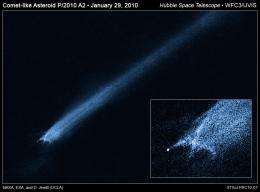
This is a NASA Hubble Space Telescope picture of a comet-like object called P/2010 A2, which was first discovered by the LINEAR (Lincoln Near-Earth Asteroid Research program) sky survey on January 6. The object appears so unusual in ground-based telescopic images that discretionary time on Hubble was used to take a close-up look. This picture, from the January 29 observation, shows a bizarre X-pattern of filamentary structures near the point-like nucleus of the object and trailing streamers of dust. The inset picture shows a complex structure that suggests the object is not a comet but instead the product of a head-on collision between two asteroids traveling five times faster than a rifle bullet (5 kilometers per second). Credit: NASA, ESA, and D. Jewitt (UCLA)
(PhysOrg.com) -- NASA's Hubble Space Telescope has imaged a mysterious X-shaped debris pattern and trailing streamers of dust that suggest a head-on collision between two asteroids. Astronomers have long thought that the asteroid belt is being ground down through collisions, but such a smashup has never before been seen.
The comet-like object imaged by Hubble, called P/2010 A2, was first discovered by the LINEAR (Lincoln Near-Earth Asteroid Research program) sky survey on January 6. New Hubble images taken on January 25 and 29 show a complex X-pattern of filamentary structures near the nucleus.
"This is quite different from the smooth dust envelopes of normal comets," says principal investigator David Jewitt of the University of California at Los Angeles. "The filaments are made of dust and gravel, presumably recently thrown out of the nucleus. Some are swept back by radiation pressure from sunlight to create straight dust streaks. Embedded in the filaments are co-moving blobs of dust that likely originate from tiny unseen parent bodies."
Hubble also shows that the main nucleus of P/2010 A2 lies outside its own halo of dust. This has never before been seen in a comet-like object. The nucleus is estimated to be 460 feet (140 meters) in diameter.
Normal comets fall into the inner regions of the solar system from icy reservoirs in the Kuiper Belt and Oort Cloud. As comets near the Sun and warm, ices near the surface vaporize and eject material from the solid comet nucleus via jets. But P/2010 A2 may have a different origin. It orbits in the warm, inner regions of the asteroid belt where its nearest neighbors are dry rocky bodies lacking volatile materials.
This leaves open the possibility that the complex debris tail is the result of an impact between two bodies rather than ices from a parent body simply turning into vapor. Asteroid collisions are energetic, with an average impact speed over 11,000 miles per hour (5 km/s, or five times faster than a rifle bullet).
"If this interpretation is correct, two small and previously unknown asteroids recently collided, creating a shower of debris that is being swept back into a tail from the collision site by the pressure of sunlight," says Jewitt.
The main nucleus of P/2010 A2 would be the surviving remnant of this so-called hypervelocity collision. "The filamentary appearance of P/2010 A2 is different from anything seen in Hubble images of normal comets, consistent with the action of a different process," says Jewitt. An impact origin would also be consistent with the absence of gas in spectra recorded using ground-based telescopes.
The asteroid belt itself contains abundant evidence for ancient collisions that have shattered precursor bodies into fragments. The orbit of P/2010 A2 is itself consistent with membership in the Flora asteroid family, produced by collisional shattering a few hundred million years ago. (One fragment of that ancient smashup may have struck Earth 65 million years ago, triggering a mass extinction that wiped out the dinosaurs.) But, until now, no such asteroid-asteroid collision has been caught "in the act."
Continued observations with Hubble and an armada of ground-based telescopes may reveal the mechanisms by which natural impacts generate dust to supply the zodiacal cloud, a plane of dust in our solar system.
At the time of the Hubble observations, the object was approximately 180 million miles (300 million km) from the Sun and 90 million miles (140 million km) from Earth. The Hubble images were recorded with the new Wide Field Camera 3 (WFC3).
-
Evidence for more dust than ice in comets
Oct 13, 2005 |
not rated yet |
0
-
Asteroid Shower
Dec 03, 2007 |
not rated yet |
0
-
Mini-Comets within a comet lit up 17P/Holmes during megaoutburst
Sep 16, 2009 |
not rated yet |
0
-
Hubble provides spectacular view of ongoing comet breakup
Apr 27, 2006 |
not rated yet |
0
-
The 2006 Geminid Meteor Shower
Dec 13, 2006 |
not rated yet |
0
-
Engineers build first sub-10-nm carbon nanotube transistor
Feb 01, 2012 |
4.9 / 5 (30) |
30
-
Something old, something new: Evolution and the structural divergence of duplicate genes
Jan 31, 2012 |
4.6 / 5 (7) |
1
-
The hidden nanoworld of ice crystals: Revealing the dynamic behavior of quasi-liquid layers
Jan 30, 2012 |
5 / 5 (3) |
1
-
Stock market network reveals investor clustering
Jan 27, 2012 |
3.9 / 5 (23) |
8
-
Of microchemistry and molecules: Electronic microfluidic device synthesizes biocompatible probes
Jan 26, 2012 |
5 / 5 (1) |
0
-
Titan's lack of impact craters
12 hours ago
-
Real pictures of black hole eating a star?
Feb 08, 2012
-
Hypothetical way to travel faster than light, but not technically exceed lightspeed
Feb 06, 2012
-
How do scientists monitor the Sun's activity?
Feb 05, 2012
-
Search patterns in observational studies
Feb 05, 2012
-
Derivation of Pogson's law
Feb 03, 2012
- More from Physics Forums - General Astronomy
More news stories
Deconstructing a mystery: What caused Snowmaggedon?
In the quiet after the storms, streets and cars had all but disappeared under piles of snow. The U.S. Postal Service suspended service for the first time in 30 years. Snow plows struggled to push the evidence ...
Space & Earth / Earth Sciences
8 hours ago |
4.7 / 5 (3) |
1
|
Ocean microbe communities changing, but long-term environmental impact is unclear
As oceans warm due to climate change, water layers will mix less and affect the microbes and plankton that pump carbon out of the atmosphere but researchers say it's still unclear whether these processes ...
Space & Earth / Earth Sciences
10 hours ago |
5 / 5 (2) |
2
|
Researchers create 3-D laser maps that show how earthquake changes landscape
Geologists have a new tool to study how earthquakes change the landscape down to a few inches, and it's giving them insight into how earthquake faults behave. In the Feb. 10 issue of the journal Science, a team ...
Space & Earth / Earth Sciences
10 hours ago |
5 / 5 (4) |
0
|
New views show old NASA Mars landers
(PhysOrg.com) -- The High Resolution Imaging Science Experiment (HiRISE) camera on NASA's Mars Reconnaissance Orbiter recorded a scene on Jan. 29, 2012, that includes the first color image from orbit showing ...
Space & Earth / Space Exploration
16 hours ago |
4.9 / 5 (7) |
5
|
Black holes and star formation
(PhysOrg.com) -- It has long been recognized that galaxy mergers or even close interactions can play a vital role in shaping the morphology of galaxies. One way they can do so, it is thought, is by triggering ...
15 hours ago |
4 / 5 (6) |
3
|
'Dark plasmons' transmit energy
Microscopic channels of gold nanoparticles have the ability to transmit electromagnetic energy that starts as light and propagates via "dark plasmons," according to researchers at Rice University.
Hydrogen from acidic water: Researchers develop potential low cost alternative to platinum for splitting water
A technique for creating a new molecule that structurally and chemically replicates the active part of the widely used industrial catalyst molybdenite has been developed by researchers with the Lawrence Berkeley ...
FDA-approved drug rapidly clears amyloid from the brain, reverses Alzheimer's symptoms in mice
Neuroscientists at Case Western Reserve University School of Medicine have made a dramatic breakthrough in their efforts to find a cure for Alzheimer's disease. The researchers' findings, published in the journal Science, show t ...
Ultraviolet protection molecule in plants yields its secrets
Lying around in the sun all day is hazardous not just for humans but also for plants, which have no means of escape. Ultraviolet (UV) radiation from the sun can damage proteins and DNA inside cells, leading ...
Anyone can learn to be more inventive, cognitive researcher says
There will always be a wild and unpredictable quality to creativity and invention, says Anthony McCaffrey, a cognitive psychology researcher at the University of Massachusetts Amherst, because an "Aha moment" is rare and ...
Flexible paper robots
(PhysOrg.com) -- These inexpensive robots can stretch, bend and twist under control, and lift objects up to 120 times their own weight. Being soft, they can apply gentle and even pressure, and adapt to varied ...
Feb 02, 2010
Rank: 3 / 5 (2)
Feb 02, 2010
Rank: 4.5 / 5 (2)
Feb 02, 2010
Rank: 5 / 5 (2)
I thought it was ET sacrificing themselves to save the Earth from that dastardly asteroid, just like Tunguska in 1908. :-)
Seriously, I wonder what the composition of the debris cloud is, and how it compares to debris disks seen around other stars, especially sun-like stars? How long will astronomers be able to track this asteroidal dissection and will they be able to detect signs of space weathering of the debris? Will a pronounced debris stream now form' similar to those observed relating to meteor showers (i.e. similar to Phaethon)….even though we'll miss out on a new shower? Lots of questions!
Mar 31, 2010
Rank: not rated yet