Iran sends rocket with animal menagerie into space
February 3, 2010 By ALI AKBAR DAREINI , Associated Press Writer
Iran launches new research rocket into space (AP)

Enlarge

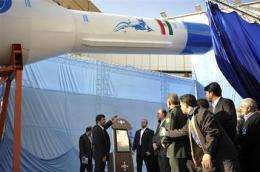
Iranian President Mahmoud Ahmadinejad, center, gestures towards a model of Iran's new domestically-built light booster rocket, named Simorgh, in Tehran, Iran, Wednesday, Feb. 3, 2010. Iranian President Mahmoud Ahmadinejad has unveiled a domestically-built satellite booster rocket, part of an ambitious space program that has worried Western powers because they fear the same technology used to launch satellites could also deliver warheads. (AP Photo)

(AP) -- Iran announced Wednesday it has successfully launched a 10-foot-long research rocket carrying a mouse, two turtles and worms into space - a feat President Mahmoud Ahmadinejad said showed Iran could defeat the West in the battle of technology.

Ahmadinejad also unveiled the model of a light booster rocket that is being built and three new, Iranian-built satellites, touted as the latest achievements in the country's ambitious space program.

The Iranian space program has worried Western powers, which fear the same technology used to launch satellites and research capsules could also be used to build long-range intercontinental missiles and deliver warheads.

A U.S. defense expert said there was no scientific purpose to launching such animals into space and that the launch was likely more aimed at boosting Iran's prestige.

"If they had wanted to test a life-support system, the obvious choice would be to send a monkey," said James Lewis, senior fellow at Washington-based Center for Strategic and International Studies. "Worms in space serve no purpose."

"The launch was clearly part of Iran's effort to advance military technology and assert political dominance in space," said Lewis "It's also a show of confidence. Space rockets give you prestige and influence, and that is what Iran seeks."

The launch of the rocket Kavoshgar-3, which means Explorer-3 in Farsi, was announced by Defense Minister Gen. Ahmad Vahidi to mark the National Day of Space Technology. It comes a year after Iran sent its first domestically made telecommunications satellite, called Omid, or Hope, into orbit for 40 days.

Iran's state TV broadcast images Wednesday of officials putting a mouse, two turtles and about a dozen creatures that looked like worms inside a capsule in the rocket, which appeared to be about 10 feet long. TV then aired footage of the rocket blasting off.

Vahidi gave no details on the research, and there was no information on what experiment the animals would serve on board. The report also did not disclose when or where the launch took place.

Iran's lofty space plans also include putting a man in orbit within 10 years.

Ahmadinejad praised the latest launch and said greater events would come in the future.

"The scientific arena is where we should defeat the (West's) domination," Ahmadinejad said in remarks broadcast live on state TV. He said the launch is a "very big event. This is the first presence of animals in space launched by Iran. It's the start of bigger achievements."

The model of the light booster rocket, named Simorgh, was displayed at a space show in Tehran, along with the three new Iranian-built satellites - Mesbah-2, Tolo and Navid-e-Elm-o-Sanat.

Officials said the Simorgh rocket can carry a satellite weighing 220 pounds (100 kilograms) up to 310 miles (500 kilometers) above the Earth. Ahmadinejad said the Simorgh would carry Mesbah-2 into space but did not say when.

As it seeks to expand its influence in the Middle East, Iran showcases its technological successes as signs it can advance despite the threat of U.S. and U.N. sanctions over its controversial nuclear program.

The West is concerned Iran is trying to build an atomic weapon but Tehran denies the charge and says it's nuclear program is only for peaceful purposes, such as electricity production.

Ahmadinejad said Iran built the Mesbah-2 with domestic technology after foreign partners refused to cooperate. Italy and Russia have both declined to help in launching Iran's Mesbah project.

In 2005, Iran launched its first commercial satellite on a Russian rocket in a joint project with Moscow, which is a partner in transferring space technology to Iran. That same year, the government said it had allocated $500 million for space projects for the next five years.

The ceremony Wednesday was part of 10-day celebrations leading up to 31st anniversary of the Islamic Revolution, which falls on Feb 11.

©2010 The Associated Press. All rights reserved. This material may not be published, broadcast, rewritten or redistributed.

Filter


Move the slider to adjust rank threshold, so that you can hide some of the comments.


Display comments: newest first

mikehevans
Feb 03, 2010

Rank: not rated yet
If the first Soviet and American satellites were launched with ICBM boosters, then it seems logical to assume that Iran's launch vehicles for satellites are capable of delivering warheads anywhere in the world.
trekgeek1
Feb 03, 2010

Rank: 5 / 5 (3)
Beat the west in technology? I'll assume that was a jab at the U.S. specifically and not a reference to just any country west of them. Sorry buddy, you're trailing us by about 60 years.
Royale
Feb 03, 2010

Rank: not rated yet
Yea seriously, we put people into orbit with the technology equivalent to a calculator made 10 years ago. Come on now. People with huge ego's are typically lacking elsewhere. I almost feel bad for that guy. That little guy.... little little guy... aww he's a cutie, but that's a BAD BOY. BAD! ICBM bad! Actually i think we should let them do what they want, it would make us less of an enemy if we stopped trying to demand restrictions on tech that we certainly have.
LKD
Feb 03, 2010

Rank: not rated yet
I don't understand why I don't recall at all last year that they managed to get a satellite into space? All I can recall is Kim Jong Il's failed attempts.

So! Congratulations to Iran on your LEO execution of worms? And turtles? They have turtles? Never mind, your accomplishment was a well earned feat... I guess.
LuckyBrandon
Feb 03, 2010

Rank: not rated yet
I would tend to agree with Lewis. This is just a stance they are taking in trying to "strut their stuff" while we are in the process of cutting them off completely.
I also agree with the statement in the comments of "let them do what they want" and that they are 60 years behind...they aren't 60 years behind the US though, maybe 35-40.....remember, we didnt build nukes and launch them...we dropped em from planes or made them ground based "drop and run" bombs for quite a number of years before we developed intercontinental missiles for that purpose.

Either way it goes...let them build them. Hell, let them launch them at us...it will be a good test of our missile defense systems. And WHEN every last single bomb of theirs is simply shot out of the sky...they will come crawling back asking why our country kicks ass in military defense (and offense), while they kiss ours trying to get some info on "how".
:D
yyz
Feb 03, 2010

Rank: not rated yet
If they're using plans similar to what AQ Khan was supplying (of the Chinese 1964 fission device), good luck getting that on a ballistic missile that will reach Israel. However bio-chem-dirty bomb-conventional explosive is obviously possible. And that Chinese device on a truck in Tel Aviv is always an option.
Truth
Feb 03, 2010

Rank: 4.5 / 5 (2)
Don't assume that Iran is the only country which keeps its people blind to the achievments of other nations. When my lady friend was in Peking for the Olympics, she was fortunate enough to get limited permission to go sight-seeing in the surrounding countryside. She was astounded to find that many if not most of the Chinese peasants had never heard that the U.S. had already gone into space or had landed on the moon decades ago. As far as they were concerned, China was the only nation launching rockets into space and the only nation ever to put a man in orbit. Such news is considered by the Chinese government as a threat to the national security, not to mention their extremely fragile ego, and so they keep their people in almost total isolation. Luckily, the Internet has become a massive threat to their efforts at secrecy, so there is still hope that the blackout will some day be over.
Royale
Feb 04, 2010

Rank: not rated yet
I agree with Truth. Luckily we have full access to the internet, but if the Iranians or the Chinese can just get access to a few Reuters stories they will be able to spread the word.
dtxx
Feb 06, 2010

Rank: 2 / 5 (1)
His commentary is intended for the Iranian people. They are largely uneducated and superstitious, so they believe a rocket in space puts them in league with the US. Even college kids can build low orbit rockets (not commercial grade of course). Congrats, your whole country just caught up to a small team of kids at BYU (think it was there).
Quantum_Conundrum
Feb 07, 2010

Rank: 1 / 5 (2)
We should go full scale with the anti-nuke scale directed energy weapons program for the east and west coast.

If we had multi-million watt lasers every mile or so along each coast, as well as the ability to mobilize aircraft and even Missiles(?) sporting directed energy weapons, then it wouldn't matter how many nukes these bozos made anyway. Ehem, in addition, LEO geo-synchronized directed energy weapon satellites along east and west coast as well...better still, put a couple in LEO over Iran itself, and just shoot down the missiles as they come out of their silos...would be much easier, and the only "colateral damage" would be Iranians.
LuckyBrandon
Feb 08, 2010

Rank: not rated yet
lol...the only casualties would be iranians...nice...
technically, a pre-emptive strike with the directed energy beams in use currently could easily be effective with minimal casualties outside of the missile silo facility itself...but then again..gotta burn through the silo doors first....
Rank 5 /5 (4 votes)
Related Stories
Relevant PhysicsForums posts
  • Titan's lack of impact craters
    created5 hours ago
  • Real pictures of black hole eating a star?
    created23 hours ago
  • Hypothetical way to travel faster than light, but not technically exceed lightspeed
    createdFeb 06, 2012
  • How do scientists monitor the Sun's activity?
    createdFeb 05, 2012
  • Search patterns in observational studies
    createdFeb 05, 2012
  • Derivation of Pogson's law
    createdFeb 03, 2012
  • More from Physics Forums - General Astronomy

More news stories

Deconstructing a mystery: What caused Snowmaggedon?

In the quiet after the storms, streets and cars had all but disappeared under piles of snow. The U.S. Postal Service suspended service for the first time in 30 years. Snow plows struggled to push the evidence ...

Space & Earth / Earth Sciences

created 1 hour ago | popularity not rated yet | comments 0 | with audio podcast

NASA sees Tropical Storm 12S - a possible threat to Madagascar

The twelfth tropical depression formed in the Southern Indian Ocean today and quickly became a tropical storm, dubbed Tropical Storm 12S. NASA's Aqua satellite passed over the storm and captured infrared data that revealed ...

Space & Earth / Earth Sciences

created 1 hour ago | popularity not rated yet | comments 0

New views show old NASA Mars landers

(PhysOrg.com) -- The High Resolution Imaging Science Experiment (HiRISE) camera on NASA's Mars Reconnaissance Orbiter recorded a scene on Jan. 29, 2012, that includes the first color image from orbit showing ...

Space & Earth / Space Exploration

created 9 hours ago | popularity 4.9 / 5 (7) | comments 3 | with audio podcast

Tidal forces could squeeze out planetary water

Alien planets might experience tidal forces powerful enough to remove all their water, leaving behind hot, dry worlds like Venus, researchers said.

Space & Earth / Space Exploration

created 7 hours ago | popularity 5 / 5 (1) | comments 1 | with audio podcast

Ocean microbe communities changing, but long-term environmental impact is unclear

As oceans warm due to climate change, water layers will mix less and affect the microbes and plankton that pump carbon out of the atmosphere – but researchers say it's still unclear whether these processes ...

Space & Earth / Earth Sciences

created 3 hours ago | popularity not rated yet | comments 0 | with audio podcast


Decoding the molecular machine behind E. coli and cholera

Scientists from Queen Mary, University of London have discovered the workings behind some of the bacteria that kill hundreds of thousands every year, possibly paving the way for new antibiotics that could treat infections ...

Deadly bird parasite evolves at exceptionally fast rate

A new study of a devastating bird disease that spread from poultry to house finches in the mid-1990s reveals that the bacteria responsible for the disease evolves at an exceptionally fast rate. What's more, ...

Flexible paper robots

(PhysOrg.com) -- These inexpensive robots can stretch, bend and twist under control, and lift objects up to 120 times their own weight. Being soft, they can apply gentle and even pressure, and adapt to varied ...

Tell me how you are -- and I know how long you will live

The way people rate their health determines their probability of survival in the following decades. Researchers from the Institute of Social and Preventive Medicine at the University of Zurich demonstrate that for ratings ...

New research reveals why fishermen keep fishing despite dwindling catches

Half of fishermen would not give up their livelihood in the face of drastically declining catches according to research led by the University of East Anglia (UEA).

Ultrasound study provides first direct evidence of effect of malaria on fetal growth

A study of almost 3,800 pregnancies has provided the most accurate and direct evidence to date that malaria infection reduces early foetal growth. Low birth weight is the most important risk factor for neonatal mortality ...