Meteorite yields carbon crystals harder than diamond
February 3, 2010 by Lin Edwards report
diamond

Enlarge

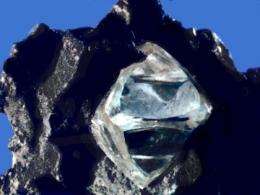
Nearly octahedral diamond crystal in matrix. Image: Wikimedia Commons

(PhysOrg.com) -- Two new types of ultra-hard carbon crystals have been found by researchers investigating the ureilite class Haverö meteorite that crashed to Earth in Finland in 1971. Ureilite meteorites are carbon-rich and known to contain graphite and diamonds.

The super-hard were created when graphite in the experienced the intense heat and pressure of entering the Earth’s atmosphere and crashing into the ground. The graphite layers would have been heated and shocked enough to create bonds between them, in much the same way as humans manufacture diamonds.

The new carbon crystals were too small to test for precise hardness but they are known to be harder than normal diamonds because the researchers found them by using a diamond paste to polish a slice of the meteorite. The crystals were raised more than 10 µm above the polished surface, which meant they were harder than the diamonds in the polishing paste. The researchers had seen carbon crystals that resisted the diamond polishing in one direction before, but the new crystals were unaffected when polished in every direction.

The scientists then used an array of mineralogical instruments, including , and energy-dispersive among others, to study the structure of the crystals. This allowed them to identify them as representing two new carbon polymorphs or diamond polytypes.

One is an ultra-hard rhombohedral carbon polymorph similar to diamond, while the other is a 21R diamond polytype ultra-hard diamond. The existence of ultra-hard diamonds had been predicted decades ago, but they have never before been found in nature. The novel form consists of fused sheets similar to artificial diamond.

Professor Tristan Ferroir, leader of the research team from the Université de Lyon in France, said the discovery was accidental, but they had thought an examination of the meteorite would “lead to new findings on the carbon system."

Professor Ferroir said there is currently no way to compare the structure of the new to boron nitride and lonsdaleite, the artificially manufactured ultra-hard diamonds, but the findings help scientists gain a better understanding of carbon polymorphs and give them new materials to investigate and perhaps synthesize. They also show the carbon system is more complex than previously thought.

The findings on the new diamond were published in the Earth and Planetary Science Letters journal on February 15.

More information: http://dx.doi.org/ … .2009.12.015

© 2010 PhysOrg.com

4.7 /5 (39 votes)  

Filter


Move the slider to adjust rank threshold, so that you can hide some of the comments.


Display comments: newest first

danman5000
Feb 03, 2010

Rank: 5 / 5 (2)
It's amazing how many allotropes carbon has, and how very different they are from each other. Graphite, graphene, diamond, buckyballs, and now these two new ones!
Caliban
Feb 03, 2010

Rank: 3.7 / 5 (3)
It would be nice to see what structural properties(in terms of ductility, malleability, and shear-strength, for starters) these materials would have at larger scales. If these properties do scale up, then think of how their use could revolutionize materials science. But more to the point- exploration of the deep oceans and outer space.
Rank 4.7 /5 (39 votes)
Related Stories
Relevant PhysicsForums posts
  • Stoichiometry
    created19 hours ago
  • Boiling and melting point of impure substances
    created20 hours ago
  • Safe nitrogen compound to decompose a 500 deg C in a furnace?
    createdFeb 09, 2012
  • [ask]electron inside drinking water
    createdFeb 08, 2012
  • How to avoid formation of Lithium Chromate ???
    createdFeb 08, 2012
  • how to choose a reduced or oxidated form in a redox
    createdFeb 08, 2012
  • More from Physics Forums - Chemistry

More news stories

Fool's gold may prove an unlikely alternative to overexploited catalytic materials

Catalytic materials, which lower the energy barriers for chemical reactions, are used in everything from the commercial production of chemicals to catalytic converters in car engines. However, with current catalytic materials ...

Chemistry / Materials Science

created 11 hours ago | popularity 4.3 / 5 (6) | comments 3 | with audio podcast

Unpicking HIV’s invisibility cloak

Drug researchers hunting for alternative ways to treat human immunodeficiency virus (HIV) infections may soon have a novel target—its camouflage coat. HIV hides inside a cloak unusually rich in a sugar ...

Chemistry / Biochemistry

created 11 hours ago | popularity 5 / 5 (4) | comments 0

No entry without protein recycling: Researchers discover new coherence in enzyme transport

The group of Prof. Dr. Ralf Erdmann at the Ruhr-Universität Bochum, Germany, discovered a connection of peroxisomal protein import and receptor export. In the Journal of Biological Chemistry, they disclo ...

Chemistry / Biochemistry

created 11 hours ago | popularity not rated yet | comments 0

Under the microscope #7

In this video Dr Ingrid Graz shows us a thin layer of gold on top of rubber. Cracks in the gold allow it to stretch and we can use this for stretchable electronics.

Chemistry / Other

created 13 hours ago | popularity not rated yet | comments 0

Hydrogen from acidic water: Researchers develop potential low cost alternative to platinum for splitting water

A technique for creating a new molecule that structurally and chemically replicates the active part of the widely used industrial catalyst molybdenite has been developed by researchers with the Lawrence Berkeley ...

Chemistry / Materials Science

created Feb 09, 2012 | popularity 5 / 5 (12) | comments 13 | with audio podcast


Google users warned of threat to smartphone wallets

Users of Google smartphone wallets were being warned on Friday that there is a way to crack pass codes intended to thwart thieves from going on illicit shopping sprees.

Anonymous knocks CIA website offline (Update)

The website of the Central Intelligence Agency was inaccessible on Friday after the hacker group Anonymous claimed to have knocked it offline.

Complex wiring of the nervous system may rely on a just a handful of genes and proteins

Researchers at the Salk Institute have discovered a startling feature of early brain development that helps to explain how complex neuron wiring patterns are programmed using just a handful of critical genes. ...

New error-correcting codes guarantee the fastest possible rate of data transmission

Error-correcting codes are one of the triumphs of the digital age. They’re a way of encoding information so that it can be transmitted across a communication channel — such as an optical fiber o ...

The power of estrogen -- male snakes attract other males

A new study has shown that boosting the estrogen levels of male garter snakes causes them to secrete the same pheromones that females use to attract suitors, and turned the males into just about the sexiest ...

Putting the squeeze on planets outside our solar system

(PhysOrg.com) -- Using high-powered lasers, scientists at Lawrence Livermore National Laboratory and collaborators discovered that molten magnesium silicate undergoes a phase change in the liquid state, abruptly ...