The Stars behind the Curtain (w/ Video)
February 3, 2010
The Stars behind the Curtain

Enlarge

Credit: ESO

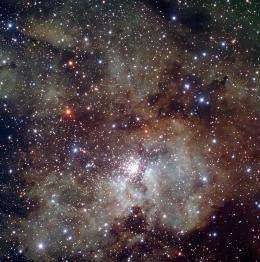
(PhysOrg.com) -- ESO is releasing a magnificent VLT image of the giant stellar nursery surrounding NGC 3603, in which stars are continuously being born. Embedded in this scenic nebula is one of the most luminous and most compact clusters of young, massive stars in our Milky Way, which therefore serves as an excellent “local” analogue of very active star-forming regions in other galaxies. The cluster also hosts the most massive star to be "weighed" so far.

NGC 3603 is a starburst region: a cosmic factory where form frantically from the nebula's extended clouds of gas and dust. Located 22 000 light-years away from the Sun, it is the closest region of this kind known in our galaxy, providing astronomers with a local test bed for studying intense processes, very common in other galaxies, but hard to observe in detail because of their great distance from us.

The nebula owes its shape to the intense light and winds coming from the young, massive stars which lift the curtains of gas and clouds revealing a multitude of glowing suns. The central cluster of stars inside NGC 3603 harbours thousands of stars of all sorts (eso9946): the majority have masses similar to or less than that of our Sun, but most spectacular are several of the very massive stars that are close to the end of their lives.

This video is not supported by your browser at this time.

Zooming in on NGC 3603, the cosmic factory where stars form frantically from the nebula’s extended clouds of gas and dust. Located 22 000 light-years away from the Sun, it is the closest region of this kind known in our galaxy, providing astronomers with a local test bed for studying intense star formation processes, very common in other galaxies, but hard to observe in detail because of their large distance. Credit: ESO/A. Fujii/Digitized Sky Survey 2. Music by John Dyson.

Several blue supergiant stars crowd into a volume of less than a cubic light-year, along with three so-called Wolf-Rayet stars — extremely bright and that are ejecting vast amounts of material before finishing off in glorious explosions known as . Using another recent set of observations performed with the SINFONI instrument on ESO's Very Large Telescope (VLT), astronomers have confirmed that one of these stars is about 120 times more massive than our Sun, standing out as the most massive star known so far in the .

The star, NGC 3603-A1, is an eclipsing system of two stars orbiting around each other in 3.77 days. The most massive star has an estimated mass of 116 solar masses, while its companion has a mass of 89 solar masses.

The clouds of NGC 3603 provide us with a family picture of stars in different stages of their life, with gaseous structures that are still growing into stars, newborn stars, adult stars and stars nearing the end of their life. All these stars have roughly the same age, a million years, a blink of an eye compared to our five billion year-old Sun and Solar System. The fact that some of the stars have just started their lives while others are already dying is due to their extraordinary range of masses: high-mass stars, being very bright and hot, burn through their existence much faster than their less massive, fainter and cooler counterparts.

The newly released image, obtained with the FORS instrument attached to the VLT at Cerro Paranal, Chile, portrays a wide field around the stellar cluster and reveals the rich texture of the surrounding clouds of gas and dust.

Provided by ESO (news : web)


Rank 5 /5 (8 votes)
Related Stories
Relevant PhysicsForums posts
  • Titan's lack of impact craters
    createdFeb 09, 2012
  • Real pictures of black hole eating a star?
    createdFeb 08, 2012
  • Hypothetical way to travel faster than light, but not technically exceed lightspeed
    createdFeb 06, 2012
  • How do scientists monitor the Sun's activity?
    createdFeb 05, 2012
  • Search patterns in observational studies
    createdFeb 05, 2012
  • Derivation of Pogson's law
    createdFeb 03, 2012
  • More from Physics Forums - General Astronomy

More news stories

Could Venus be shifting gear?

(PhysOrg.com) -- ESA’s Venus Express spacecraft has discovered that our cloud-covered neighbour spins a little slower than previously measured. Peering through the dense atmosphere in the infrared, the ...

Space & Earth / Space Exploration

created 4 hours ago | popularity 5 / 5 (4) | comments 6 | with audio podcast

Humans may have helped the decline of African rainforests 3000 years ago

(PhysOrg.com) -- Large areas of rainforests in Central Africa mysteriously disappeared over three thousand years ago, to be replaced by savannas. The prevailing theory has been that the cause was a change ...

Space & Earth / Environment

created 8 hours ago | popularity 5 / 5 (3) | comments 8 | with audio podcast report

Mars Science Laboratory computer issue resolved

(PhysOrg.com) -- Engineers have found the root cause of a computer reset that occurred two months ago on NASA's Mars Science Laboratory and have determined how to correct it.

Space & Earth / Space Exploration

created 5 hours ago | popularity 5 / 5 (5) | comments 3 | with audio podcast

Clam fields found at deep, low-temperature Mariana vents

(PhysOrg.com) -- Scientists have marveled at the unusual life forms thriving at high temperature hydrothermal vents of the deep ocean.

Space & Earth / Earth Sciences

created 4 hours ago | popularity not rated yet | comments 0 | with audio podcast

Two new moons for Jupiter

Advances in technology have lead to the discovery of new planets outside of our Solar System, and now even new moons in our own backyard.

Space & Earth / Space Exploration

created 4 hours ago | popularity not rated yet | comments 2


Hovering not hard if you're top-heavy, researchers find

Top-heavy structures are more likely to maintain their balance while hovering in the air than are those that bear a lower center of gravity, researchers at New York University's Courant Institute of Mathematical Sciences ...

Grass to gas: Researchers' genome map speeds biofuel development

Researchers at the University of Georgia have taken a major step in the ongoing effort to find sources of cleaner, renewable energy by mapping the genomes of two originator cells of Miscanthus x giganteus, a large perenn ...

Drug halts organ damage in inflammatory genetic disorder

A new study shows that Kineret (anakinra), a medication approved for the treatment of rheumatoid arthritis, is effective in stopping the progression of organ damage in people with neonatal-onset multisystem inflammatory disease ...

Cochlear implants may be safe, effective for organ transplant patients

Cochlear implants may be a safe, effective option for some organ transplant patients who've lost their hearing as an unfortunate consequence of their transplant-related drug regime, researchers report.

Researchers develop new method for creating tissue engineering scaffolds

Researchers at Northwestern University have developed a new method for creating scaffolds for tissue engineering applications, providing an alternative that is more flexible and less time-intensive than current technology.

Molecular profiling reveals differences between primary and recurrent ovarian cancers

There is a need to analyze tumor specimens at the time of ovarian cancer recurrence, according to a new study published in Molecular Cancer Therapeutics. Researchers used a diagnostic technology called molecular profiling to examine ...