Merging galaxies create a binary quasar (w/ Video)
February 3, 2010
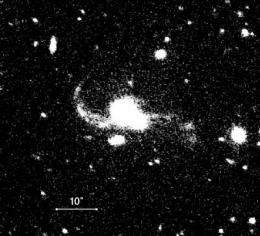
This optical image of SDSS J1254+0846 obtained May 22, 2009, on the IMACS camera at the Magellan/Baade telescope at Las Campanas Observatory in Chile shows the two bright quasar nuclei as well as the tidal arms of the host galaxy merger. Scale bar is 10 arcseconds. Credit: Credit: Carnegie Institution
Astronomers have found the first clear evidence of a binary quasar within a pair of actively merging galaxies. Quasars are the extremely bright centers of galaxies surrounding super-massive black holes, and binary quasars are pairs of quasars bound together by gravity. Binary quasars, like other quasars, are thought to be the product of galaxy mergers.
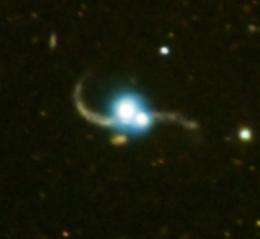
Until now, however, binary quasars have not been seen in galaxies that are unambiguously in the act of merging. But images of a new binary quasar from the Carnegie Institution's Magellan telescope in Chile show two distinct galaxies with "tails" produced by tidal forces from their mutual gravitational attraction.
"This is really the first case in which you see two separate galaxies, both with quasars, that are clearly interacting," says Carnegie astronomer John Mulchaey who made observations crucial to understanding the galaxy merger.
This video is not supported by your browser at this time.
This movie of a numerical simulation shows a galaxy merger similar to SDSS J1254+0846 over a time span of 3.6 billion years (Gyr). At 2.33 Gyr the two model galaxies and their quasars resemble the image observed with the Magellan telescope. Credit: T.J. Cox/Carnegie Institution
Most, if not all, large galaxies, such as our galaxy the Milky Way, host super-massive black holes at their centers. Because galaxies regularly interact and merge, astronomers have assumed that binary super-massive black holes have been common in the Universe, especially during its early history. Black holes can only be detected as quasars when they are actively accreting matter, a process that releases vast amounts of energy. A leading theory is that galaxy mergers trigger accretion, creating quasars in both galaxies. Because most of such mergers would have happened in the distant past, binary quasars and their associated galaxies are very far away and therefore difficult for most telescopes to resolve.The binary quasar, labeled SDSS J1254+0846, was initially detected by the Sloan Digital Sky Survey, a large scale astronomical survey of galaxies and over 120,000 quasars. Further observations by Paul Green of the Harvard-Smithsonian Center for Astrophysics and colleagues using NASA's Chandra's X-ray Observatory and telescopes at Kitt Peak National Observatory in Arizona and Palomar Observatory in California indicated that the object was likely a binary quasar in the midst of a galaxy merger. Carnegie's Mulchaey then used the 6.5 meter Baade-Magellan telescope at the Las Campanas observatory in Chile to obtain deeper images and more detailed spectroscopy of the merging galaxies.
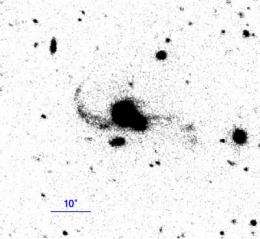
This optical image of SDSS J1254+0846 obtained May 22, 2009, on the IMACS camera at the Magellan/Baade telescope at Las Campanas Observatory in Chile shows the two bright quasar nuclei as well as the tidal arms of the host galaxy merger. Scale bar is 10 arcseconds. Credit: Carnegie Institution
"Just because you see two galaxies that are close to each other in the sky doesn't mean they are merging," says Mulchaey. "But from the Magellan images we can actually see tidal tails, one from each galaxy, which suggests that the galaxies are in fact interacting and are in the process of merging."Thomas Cox, now a fellow at the Carnegie Observatories, corroborated this conclusion using computer simulations of the merging galaxies. When Cox's model galaxies merged, they showed features remarkably similar to what Mulchaey observed in the Magellan images. "The model verifies the merger origin for this binary quasar system," he says. "It also hints that this kind of galaxy interaction is a key component of the growth of black holes and production of quasars throughout our universe."
Enlarge
Credits: X-ray: NASA/CXC/SAO/P. Green et al. Optical: Carnegie Obs./Magellan/W. Baade Telescope/J.S. Mulchaey et al.
More information: The research paper has been published in the Astrophysical Journal. Link to paper: http://stacks.iop. … 37X/710/1578
Provided by Carnegie Institution
-
Galaxy 'hunting' made easy
Sep 14, 2007 |
not rated yet |
0
-
Chandra finds evidence for quasar ignition
Mar 23, 2006 |
not rated yet |
0
-
Hidden Population of Powerful Black Holes Revealed in Large Sky Survey
Jan 09, 2008 |
not rated yet |
0
-
Astronomers find triple interactions of supermassive black holes to be common in early universe
Jan 08, 2007 |
not rated yet |
0
-
Astronomers discover a trio of quasars
Jan 08, 2007 |
not rated yet |
0
-
Engineers build first sub-10-nm carbon nanotube transistor
Feb 01, 2012 |
4.9 / 5 (30) |
30
-
Something old, something new: Evolution and the structural divergence of duplicate genes
Jan 31, 2012 |
4.6 / 5 (7) |
1
-
The hidden nanoworld of ice crystals: Revealing the dynamic behavior of quasi-liquid layers
Jan 30, 2012 |
5 / 5 (3) |
1
-
Stock market network reveals investor clustering
Jan 27, 2012 |
3.9 / 5 (23) |
8
-
Of microchemistry and molecules: Electronic microfluidic device synthesizes biocompatible probes
Jan 26, 2012 |
5 / 5 (1) |
0
-
Titan's lack of impact craters
16 hours ago
-
Real pictures of black hole eating a star?
Feb 08, 2012
-
Hypothetical way to travel faster than light, but not technically exceed lightspeed
Feb 06, 2012
-
How do scientists monitor the Sun's activity?
Feb 05, 2012
-
Search patterns in observational studies
Feb 05, 2012
-
Derivation of Pogson's law
Feb 03, 2012
- More from Physics Forums - General Astronomy
More news stories
New views show old NASA Mars landers
(PhysOrg.com) -- The High Resolution Imaging Science Experiment (HiRISE) camera on NASA's Mars Reconnaissance Orbiter recorded a scene on Jan. 29, 2012, that includes the first color image from orbit showing ...
Space & Earth / Space Exploration
19 hours ago |
4.9 / 5 (7) |
7
|
Deconstructing a mystery: What caused Snowmaggedon?
In the quiet after the storms, streets and cars had all but disappeared under piles of snow. The U.S. Postal Service suspended service for the first time in 30 years. Snow plows struggled to push the evidence ...
Space & Earth / Earth Sciences
11 hours ago |
4.7 / 5 (3) |
1
|
Black holes and star formation
(PhysOrg.com) -- It has long been recognized that galaxy mergers or even close interactions can play a vital role in shaping the morphology of galaxies. One way they can do so, it is thought, is by triggering ...
18 hours ago |
4.1 / 5 (7) |
5
|
Ocean microbe communities changing, but long-term environmental impact is unclear
As oceans warm due to climate change, water layers will mix less and affect the microbes and plankton that pump carbon out of the atmosphere but researchers say it's still unclear whether these processes ...
Space & Earth / Earth Sciences
13 hours ago |
5 / 5 (2) |
2
|
Researchers create 3-D laser maps that show how earthquake changes landscape
Geologists have a new tool to study how earthquakes change the landscape down to a few inches, and it's giving them insight into how earthquake faults behave. In the Feb. 10 issue of the journal Science, a team ...
Space & Earth / Earth Sciences
13 hours ago |
5 / 5 (4) |
0
|
'Dark plasmons' transmit energy
Microscopic channels of gold nanoparticles have the ability to transmit electromagnetic energy that starts as light and propagates via "dark plasmons," according to researchers at Rice University.
FDA-approved drug rapidly clears amyloid from the brain, reverses Alzheimer's symptoms in mice
Neuroscientists at Case Western Reserve University School of Medicine have made a dramatic breakthrough in their efforts to find a cure for Alzheimer's disease. The researchers' findings, published in the journal Science, show t ...
Hydrogen from acidic water: Researchers develop potential low cost alternative to platinum for splitting water
A technique for creating a new molecule that structurally and chemically replicates the active part of the widely used industrial catalyst molybdenite has been developed by researchers with the Lawrence Berkeley ...
Ultraviolet protection molecule in plants yields its secrets
Lying around in the sun all day is hazardous not just for humans but also for plants, which have no means of escape. Ultraviolet (UV) radiation from the sun can damage proteins and DNA inside cells, leading ...
Soraa LED light may dim 50-watt halogen rivals
(PhysOrg.com) -- Soraa, a Fremont, California company founded in 2008, this week launched its first product, a light that uses LEDS (light emitting diodes). The "Soraa LED MR16 lamp" is the "perfect" replacement ...
Anyone can learn to be more inventive, cognitive researcher says
There will always be a wild and unpredictable quality to creativity and invention, says Anthony McCaffrey, a cognitive psychology researcher at the University of Massachusetts Amherst, because an "Aha moment" is rare and ...

Feb 03, 2010
Rank: 5 / 5 (1)
Feb 03, 2010
Rank: 5 / 5 (1)
Seems their is Zero room for these doubt?
Feb 04, 2010
Rank: 3.7 / 5 (3)
Feb 05, 2010
Rank: 5 / 5 (1)
Feb 05, 2010
Rank: not rated yet
Imagine a solar-system based off a red dwarf, with terrestrial planets (at least one or two). Now place it at some distance from an AGN such that the amount of energy coming from the AGN could create a "habitable zone" for the entire planetary system.
I know it is a wild conjecture, but still I enjoy the imagination exercise.