New technique helps search for another Earth (Update)
The quest to find another world that sustains life has been boosted by a technique that should let less expensive ground-based telescopes join the search, a study said on Wednesday.
Astronomers have discovered a new ground-based technique to study the atmospheres of planets outside our Solar System, accelerating our search for Earth-like planets with life-related molecules. Their work is reported today (3rd Feb 2010) in the journal Nature.
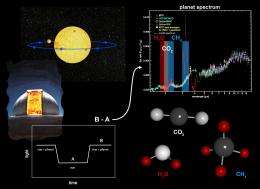
The scientists developed the new technique by using NASA’s relatively small Earth-based Infrared telescope to identify an organic molecule in the atmosphere of a Jupiter-sized planet nearly 63 light-years away. Using a novel calibration method to remove systematic observation errors, they obtained a measurement revealing details of the exoplanet’s atmospheric composition and conditions, an unprecedented achievement from an Earth-based observatory.
Dr Giovanna Tinetti from University College London (UCL), whose work on the project was funded by the Science and Technology Facilities Council (STFC), said, “The final goal is to observe the atmosphere of a planet with the capability to support life. We’re not there yet, but the possibility to use ground-based telescopes in combination with space-based observatories, will speed up the work of studying exoplanet atmospheres.”
Lead author Mark Swain, an astronomer at NASA’s Jet Propulsion Laboratory, added, “The fact that we have used a relatively small, ground-based telescope is exciting because it implies that the largest telescopes on the ground, using this technique, may be able to characterize terrestrial exoplanet targets.”
Currently, more than 400 exoplanets are known. Most are gaseous like Jupiter, but some "super-Earths" are thought to be large terrestrial, or rocky, worlds. A true Earth-like planet the same size as our planet and distance from its star has yet to be discovered. NASA's Kepler mission is searching from space now, and is expected to find several of these earthly worlds.
On Aug. 11, 2007, Swain and his team turned the infrared telescope to the hot, Jupiter-size planet HD 189733b in the constellation Vulpecula. Every 2.2 days, the planet orbits a K-type main sequence star slightly cooler and smaller than our Sun. HD189733b had already yielded breakthrough advances in exoplanet science, including detections of water vapour, methane and carbon dioxide using space telescopes. Using the new technique, the astronomers successfully detected carbon dioxide and methane in the atmosphere of HD 189733b with a spectrograph, which splits light into its components to reveal the distinctive spectral signatures of different chemicals. Their key work was development of the novel calibration method to remove systematic observation errors caused by the variability of Earth’s atmosphere and instability due to the movement of the telescope system as it tracks its target.
“As a consequence of this work, we now have the exciting prospect that other suitably equipped yet relatively small ground-based telescopes should be capable of characterizing exoplanets,” said John Rayner, the NASA Infrared Telescope Facility support scientist who built the SpeX spectrograph used for these measurements. “On some days we can't even see the Sun with the telescope, and the fact that on other days we can now obtain a spectrum of an exoplanet 63 light-years away is astonishing.”
In the course of their observations, the team found unexpected bright infrared emission from methane that stands out on the day side of HD198733b. This could indicate some kind of activity in the planet’s atmosphere which could be related to the effect of ultraviolet radiation from the planet’s parent star hitting the planet’s upper atmosphere, but more detailed study is needed.
“An immediate goal for using this technique is to more fully characterize the atmosphere of this and other exoplanets, including detection of organic and possibly prebiotic molecules” like those that preceded the evolution of life on Earth, said Swain. “We’re ready to undertake that task.” Some early targets will be the super-Earths. Used in synergy with observations from NASA’s Hubble, Spitzer and the future James Webb Space Telescope, the new technique “will give us an absolutely brilliant way to characterize super-Earths,” Swain said.
Provided by Science and Technology Facilities Council


