Darwin descended from Cro-Magnon man: scientists
February 4, 2010
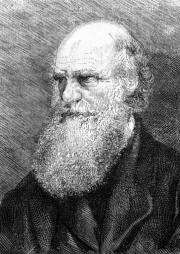
This undated engraving shows English naturalist Charles Darwin. The father of evolution was a direct descendant of the Cro-Magnon people, whose entry into Europe 30,000 years ago heralded the demise of Neanderthals, scientists revealed in Australia Thursday.
The father of evolution Charles Darwin was a direct descendant of the Cro-Magnon people, whose entry into Europe 30,000 years ago heralded the demise of Neanderthals, scientists revealed in Australia Thursday.
Darwin, who hypothesised that all humans evolved from common ancestors in his seminal 1859 work "On the Origin of Species", came from Haplogroup R1b, one of the most common European male lineages, said genealogist Spencer Wells.
"Men belonging to Haplogroup R1b are direct descendants of the Cro-Magnon people who, beginning 30,000 years ago, dominated the human expansion into Europe and heralded the demise of the Neanderthal species," Wells said.
Director of the Genographic Project, an international study mapping the migratory history of the human species, Wells said they took a DNA sample from Darwin's great-great grandson Chris Darwin, 48, who lives on the outskirts of Sydney.
A trace of Darwin's "deep ancestry" showed his forefathers left Africa around 45,000 years ago, splitting into a new lineage 5,000 years later in Iran or southern Central Asia, Wells said.
"Before heading west towards Europe, the next mutation, which defined a new lineage, appeared in a man around 35,000 years ago,' he said.
"Approximately 70 percent of men in southern England belong to Haplogroup R1b, and in parts of Ireland and Spain that number exceeds 90 percent", he added.
Chris Darwin, whose great-grandfather was Darwin's astronomer son George, is a tour guide and adventurer in the Blue Mountains west of Sydney.
He migrated to Australia in 1986 and tests of his maternal DNA showed he was likely directly descended from the women who crossed the rugged Caucasus Mountains in southern Russia to reach the steppes of the Black Sea.
"The Genographic Project is incredibly important," Darwin said.
"The project is one way to show us the true story of humanity, of how we migrated across the world and that we are all related, tracing back to a small group of men and women who lived in Africa".
Wells was presenting the findings ahead of the project's annual scientific conference, bringing together representatives from 11 regional teams to discuss their work in Sydney.
There are currently 265,000 members of the public taking part in the project, which is an initiative of National Geographic, IBM and the California-based Waitt Family Foundation charity.
Participation kits can be bought online for 100 US dollars, and proceeds go towards the research and to indigenous language and cultural projects.
(c) 2010 AFP
-
Rare Charles Darwin book found on toilet bookshelf
Nov 22, 2009 |
not rated yet |
0
-
Study shows 28,000 year-old Europeans' DNA was like ours
Jul 16, 2008 |
not rated yet |
0
-
Early human populations evolved separately for 100,000 years
Apr 24, 2008 |
not rated yet |
0
-
Did modern humans eat Neanderthals?
May 18, 2009 |
not rated yet |
0
-
Globetrotting black rat genes reveal spread of humans and diseases
Feb 01, 2008 |
not rated yet |
0
-
Engineers build first sub-10-nm carbon nanotube transistor
Feb 01, 2012 |
4.9 / 5 (28) |
26
-
Something old, something new: Evolution and the structural divergence of duplicate genes
Jan 31, 2012 |
4.6 / 5 (7) |
1
-
The hidden nanoworld of ice crystals: Revealing the dynamic behavior of quasi-liquid layers
Jan 30, 2012 |
5 / 5 (3) |
1
-
Stock market network reveals investor clustering
Jan 27, 2012 |
4 / 5 (22) |
8
-
Of microchemistry and molecules: Electronic microfluidic device synthesizes biocompatible probes
Jan 26, 2012 |
5 / 5 (1) |
0
-
What are the limits of learning?
5 hours ago
-
Neuroscientists: What is a Principal Cell Layer?
16 hours ago
-
How does slime mould grow?
Feb 04, 2012
-
Why are mosquitoes and bedbugs successful?
Feb 04, 2012
-
Amazon fungi found to eat plastic
Feb 01, 2012
-
Tips Picking up TEM grids?
Feb 01, 2012
- More from Physics Forums - Biology
More news stories
Study of diving beetles suggest sperm evolution may be driven by changes in female reproductive organs
Studying female reproductive tracts and sperm in diving beetles (Dytiscidae), researchers from the University of Arizona and Syracuse University have obtained a glimpse into a bizarre and amazing world of spe ...
13 hours ago |
not rated yet |
0
|
New insight from whole-genome sequencing of Europe's 2011 E. coli outbreaks
Using whole-genome sequencing, a team led by researchers from Harvard School of Public Health (HSPH) and the Broad Institute has traced the path of the E. coli outbreak that sickened thousands and killed over 50 people in Ger ...
13 hours ago |
4 / 5 (2) |
0
|
Redder ladybirds more deadly, say scientists
A ladybird's colour indicates how well-fed and how toxic it is, according to an international team of scientists. Research led by the Universities of Exeter and Liverpool directly shows that differences between ...
9 hours ago |
4 / 5 (4) |
0
|
New study makes key finding in stem cell self-renewal
A University of Minnesota-led research team has proposed a mechanism for the control of whether embryonic stem cells continue to proliferate and stay stem cells, or differentiate into adult cells like brain, liver or skin.
15 hours ago |
4.7 / 5 (3) |
0
|
Researchers examine consequences of non-intervention for infectious disease in African great apes
Infectious disease has joined poaching and habitat loss as a major threat to the survival of African great apes as they have become restricted to ever-smaller populations. Despite the work of dedicated conservationists, efforts ...
15 hours ago |
5 / 5 (1) |
1
|
Long-term study shows epilepsy surgery improves seizure control and quality of life
While epilepsy surgery is a safe and effective intervention for seizure control, medical therapy remains the more prominent treatment option for those with epilepsy. However, a new 26-year study reveals that following epilepsy ...
Nicira promises virtual networks will transform networking
(PhysOrg.com) -- For the past four years, founders of the start-up company Nicira have been developing cutting-edge software that they predict will transform the networking technology underlying the Internet. ...
Navy to begin tests on electromagnetic railgun prototype launcher
The Office of Naval Research (ONR)'s Electromagnetic (EM) Railgun program will take an important step forward in the coming weeks when the first industry railgun prototype launcher is tested at a facility ...
Fossil cricket: Jurassic love song reconstructed
Some 165 million years ago, the world was host to a diversity of sounds. Primitive bushcrickets and croaking amphibians were among the first animals to produce loud sounds by stridulation (rubbing certain body parts together). ...
After Megaupload closure, BTJunkie shuts down
BTJunkie, a popular file-sharing indexing site, said Monday it was voluntarily shutting down, less than three weeks after the US closure of Megaupload in a crackdown on piracy of music, films and other materials.
Russia 'drills into' Antarctic subglacial lake
A Russian team has succeeded in drilling through four kilometres (2.5 miles) of ice to the surface of a mythical subglacial Antarctic lake which could hold as yet unknown life forms, reports said Monday.