First germanium laser brings us closer to 'optical computers'

February 4, 2010 by Larry Hardesty
First germanium laser

Enlarge

Graphic: Christine Daniloff

(PhysOrg.com) -- MIT researchers have demonstrated the first laser built from germanium that can produce wavelengths of light useful for optical communication. It’s also the first germanium laser to operate at room temperature. Unlike the materials typically used in lasers, germanium is easy to incorporate into existing processes for manufacturing silicon chips. So the result could prove an important step toward computers that move data -- and maybe even perform calculations -- using light instead of electricity. But more fundamentally, the researchers have shown that, contrary to prior belief, a class of materials called indirect-band-gap semiconductors can yield practical lasers.

As chips’ computational capacity increases, they need higher-bandwidth connections to send data to memory. But conventional electrical connections will soon become impractical, because they’ll require too much power to transport data at ever higher rates. Transmitting data with lasers — devices that concentrate light into a narrow, powerful beam — could be much more power-efficient, but it requires a cheap way to integrate optical and on chips.

Chip assembly is a painstaking process in which layers of different materials are deposited on a wafer of silicon, and patterns are etched into them. Inserting a new material into this process is difficult: it has to be able to chemically bond to the layers above and below it, and depositing it must be possible at the temperatures and in the chemical environments suitable to the other materials.

The materials used in today’s lasers, such as , are “all tough fits,” says Tremont Miao, a marketing director at Massachusetts-based Analog Devices Semiconductor. “They’re all challenging integrations.” As a consequence, the lasers have to be constructed separately and then grafted onto the chips, which is more expensive and time-consuming than building them directly on silicon would be. Moreover, gallium arsenide is much more expensive than silicon in the first place.

Integrating germanium into the manufacturing process, however, is something that almost all major chip manufacturers have already begun to do, since the addition of germanium increases the speed of silicon chips. “We and lots of other people know how to do that,” Miao says.

Unchanneled energies

Gallium arsenide, silicon, and germanium are all examples of semiconductors, the type of material used in virtually all modern electronics. Lasers made from semiconductors convert the energy of electrons — particles of charge — into photons — particles of light. Semiconductors come in two varieties: those with direct band gaps, like gallium arsenide, and those with indirect band gaps, like germanium and silicon. According to Jurgen Michel, principal research associate in the Electronic Materials Research Group and primary investigator on the germanium-laser project, “There was an opinion in the scientific area that indirect-band-gap semiconductors will never lase” — that is, produce laser light. “That’s just what you teach in classes,” says Lionel Kimerling, the Thomas Lord Professor of Materials Science and Engineering, who leads the group.

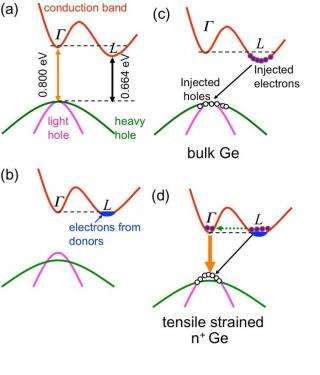
In a semiconductor crystal, an excited electron — one that’s had energy added to it — will break free and enter the so-called , where it can move freely around the crystal. But in fact, an electron in the conduction band can be in one of two states. If it’s in the first state, and it falls out of the conduction band, it will release its extra energy as a photon. If it’s in the second state, it will release its energy in other ways, such as heat.

In direct-band-gap materials, the first state — the photon-emitting state — is a lower-energy state than the second state; in indirect-band-gap materials, it’s the other way around. An excited electron will naturally occupy the lowest-energy state it can find. So in direct-band-gap materials, excited electrons tend to go into the photon-emitting state, and in indirect-band-gap materials, they don’t.
First germanium laser brings us closer to 'optical computers'
Enlarge

(a) In a semiconductor crystal, an excited electron — one with added energy — will leap from the valence band (green) to the conduction band (red), where it can move freely around the crystal. In the conduction band, it will occupy the lowest-energy state it can find (right-hand well). In an indirect-band-gap material like germanium, the momentum of the lowest-energy state is misaligned with that of the valence band (yellow and black arrows). As a result, the electron will not emit a photon when it loses energy. (b) MIT researchers fill up the lower-energy state with extra electrons from phosphorous atoms, which they add to the germanium. (c) When an electron leaps into the conduction band, it leaves behind a “hole” in the valence band. The researchers inject pairs of electrons and holes into the germanium. (d) When the injected electrons find the lower-energy state occupied, they spill over into the other state; realigned with their holes, they release their extra energy as photons.

Bridging the gap

In a forthcoming paper in the journal Optics Letters, Kimerling, Michel and three other researchers in the group —postdoc Jifeng Liu, the lead author on the paper, and grad students Xiaochen Sun and Rodolfo Camacho-Aguilera — describe how they coaxed excited germanium electrons into the higher-energy, photon-emitting state.

Their first strategy is a technique, common in chip manufacturing, called “doping,” in which atoms of some other element are added to a semiconductor crystal. The group doped its germanium with phosphorous, which has five outer electrons. Germanium has only four outer electrons, “so each phosphorous gives us an extra electron,” Kimerling says. The extra electron fills up the lower-energy state in the conduction band, causing excited electrons to, effectively, spill over into the higher-energy, photon-emitting state.

According to the group’s theoretical work, phosphorous doping “works best at 1020 atoms per cubic centimeter” of germanium, Kimerling explains. So far, the group has developed a technique that can add 1019 phosphorous atoms to each cubic centimeter of germanium, “and we already begin to see lasing,” Kimerling says.

The second strategy was to lower the energy difference between the two conduction-band states so that excited electrons would be more likely to spill over into the photon-emitting state. The researchers did that by adapting another technique common in the chip industry: they “strained” the germanium — or pried its atoms slightly farther apart than they would be naturally — by growing it directly on top of a layer of silicon. Both the silicon and the germanium were deposited at high temperatures. But silicon doesn’t contract as much as germanium when it cools. The atoms of the cooling germanium tried to maintain their alignment with the silicon atoms, so they ended up farther apart than they would ordinarily be. Changing the angle and length of the bonds between germanium atoms also changed the energies required to kick their electrons into the conduction band. “The ability to grow germanium on silicon is a discovery of this group,” says Kimerling, “and the ability to control the strain of those germanium films on silicon is a discovery of this group.”

“High-speed optical circuits like germanium in general,” says Miao. “That’s a good marriage and a good combination. So their research is very, very promising.” Miao points out that the germanium lasers need to become more power-efficient before they’re a practical source of light for optical communications systems. “But on the other hand,” he says, “the promise is exciting, and the fact that they got to lase at all is very exciting.”

More information: Optics Letters Paper: http://www.opticsi … fm?id=121712

Provided by Massachusetts Institute of Technology (news : web)

4.8 /5 (27 votes)  

Filter


Move the slider to adjust rank threshold, so that you can hide some of the comments.


Display comments: newest first

gmurphy
Feb 04, 2010

Rank: 1 / 5 (1)
1020 atoms per cubic centimeter?, is that figure correct?, that's like throwing a few peas onto a pebble beach to get better surf, I am highly dubious
trekgeek1
Feb 04, 2010

Rank: not rated yet
They may have meant 10^20 atoms.Though that sounds high considering the intrinsic carrier concentration is ~10^13 cm^-3
poi
Feb 04, 2010

Rank: not rated yet
they got the figure from this source: Physics of Group IV Elements and III-V Compounds, edited by O. Mdelung, Landolt-Bornstein: Numerial Data and Functional Relationships in Science and Technology (Springer, Berlin, 1982), vol.22b, pp448
guiding_light
Feb 05, 2010

Rank: not rated yet
It's optically pumped at uJ level..that is not acceptable to integrate monolithically for fast circuits.
JoshuaW
Feb 05, 2010

Rank: not rated yet
@gmurphy
Doping usually involves only a few atoms per billion, so the value of 1020 may well be correct.
uraxs
Feb 07, 2010

Rank: 1 / 5 (1)
I never knew Britney Spears was so intelligent. But, as usual, her hypothesis has been proven wrong...she now has two little boys. I guess she could maybe get time to go back to school now? Somewhere like MIT perhaps? http://britneyspe...rect.htm
RealScience
Feb 08, 2010

Rank: not rated yet
Clearly 1020 = 10^20 and 1019 = 10^19. This very often happens when a source that uses a superscript for the exponent is copied as unformatted text.

That is indeed a very high doping level compared to that typically used in transistors, but this is a different use.
seneca
Feb 13, 2010

Rank: not rated yet
In indirect-gap semiconductors the dislocations and/or impurities are serving like traps of electrons, which are increasing their recombination speed. And the strained germanium is just very rich to such dislocations in analogous way, like so called amorphous silicon (which exhibits an electroluminiscence or even three-photon emission, too). The dense mesh of dislocations in strained germanium is behaving like quantum dots array, i.e. like new sparse metamaterial embedded into lattice of direct and higher energy gap, then the compact germanium has - so it can lase at shorter wavelength, then absorption threshold corresponding the width of band gap.

http://www.usyd.e...yid=3204
Rank 4.8 /5 (27 votes)
Relevant PhysicsForums posts
  • A grandfather pulls his granddaughter, whose mass is 20.5 kg
    created2 hours ago
  • what is significance of torque
    created2 hours ago
  • Difference between volume displaced fluid and volume of the object
    created3 hours ago
  • Questions about Galileo statement?
    created3 hours ago
  • Question on Kirchoff's Laws
    created7 hours ago
  • Changes in Water Weight
    created9 hours ago
  • More from Physics Forums - General Physics

More news stories

Borexino Collaboration succeeds in spotting pep neutrinos emitted from the sun

(PhysOrg.com) -- To learn more about how the sun works, scientists study particles that are emitted from it into space due to thermonuclear reactions that occur inside; by applying known physics principles, ...

Physics / General Physics

created 16 hours ago | popularity 4.6 / 5 (7) | comments 0 | with audio podcast report

Explained: Sigma

It's a question that arises with virtually every major new finding in science or medicine: What makes a result reliable enough to be taken seriously? The answer has to do with statistical significance -- but ...

Physics / General Physics

created 16 hours ago | popularity 5 / 5 (10) | comments 29

Physics research suggests new pathways for cancer progression

Observing that certain cancer cells may exhibit greater flexibility than normal cells, some scientists believe that this capability promotes rapid tumor growth. Now computer simulations developed by Boston University Biomedical ...

Physics / General Physics

created 14 hours ago | popularity 5 / 5 (1) | comments 0

Quantum physicist explains $100K offer for proof scaled-up quantum computing is impossible

(PhysOrg.com) -- MIT researcher Scott Aaronson has certainly riled the physics community with his offer this past Friday, of $100,000 to anyone who can prove that scaled-up quantum computing is impossible. ...

Physics / Quantum Physics

created Feb 08, 2012 | popularity 4.1 / 5 (11) | comments 31 | with audio podcast weblog

Physicists 'record' magnetic breakthrough

An international team of scientists has demonstrated a revolutionary new way of magnetic recording which will allow information to be processed hundreds of times faster than by current hard drive technology.

Physics / General Physics

created Feb 07, 2012 | popularity 4.5 / 5 (39) | comments 14 | with audio podcast


'Dark plasmons' transmit energy

Microscopic channels of gold nanoparticles have the ability to transmit electromagnetic energy that starts as light and propagates via "dark plasmons," according to researchers at Rice University.

FDA-approved drug rapidly clears amyloid from the brain, reverses Alzheimer's symptoms in mice

Neuroscientists at Case Western Reserve University School of Medicine have made a dramatic breakthrough in their efforts to find a cure for Alzheimer's disease. The researchers' findings, published in the journal Science, show t ...

Hydrogen from acidic water: Researchers develop potential low cost alternative to platinum for splitting water

A technique for creating a new molecule that structurally and chemically replicates the active part of the widely used industrial catalyst molybdenite has been developed by researchers with the Lawrence Berkeley ...

Ultraviolet protection molecule in plants yields its secrets

Lying around in the sun all day is hazardous not just for humans but also for plants, which have no means of escape. Ultraviolet (UV) radiation from the sun can damage proteins and DNA inside cells, leading ...

Anyone can learn to be more inventive, cognitive researcher says

There will always be a wild and unpredictable quality to creativity and invention, says Anthony McCaffrey, a cognitive psychology researcher at the University of Massachusetts Amherst, because an "Aha moment" is rare and ...

New method makes culture of complex tissue possible in any lab

Scientists at the University of California, San Diego have developed a new method for making scaffolds for culturing tissue in three-dimensional arrangements that mimic those in the body. This advance, published online in ...