Robonaut 2: NASA, GM Create Cutting Edge Robotic Technology
February 4, 2010
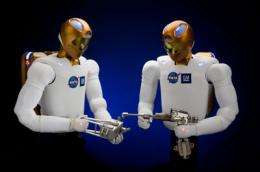
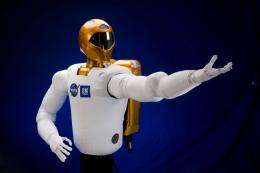
Robonaut2 - or R2 for short - is the next generation dexterous robot, developed through a Space Act Agreement by NASA and General Motors. It is faster, more dexterous and more technologically advanced than its predecessors and able to use its hands to do work beyond the scope of previously introduced humanoid robots.
(PhysOrg.com) -- Robonaut is evolving. NASA and General Motors are working together to accelerate development of the next generation of robots and related technologies for use in the automotive and aerospace industries.
Engineers and scientists from NASA and GM worked together through a Space Act Agreement at the agency's Johnson Space Center in Houston to build a new humanoid robot capable of working side by side with people. Using leading edge control, sensor and vision technologies, future robots could assist astronauts during hazardous space missions and help GM build safer cars and plants.
The two organizations, with the help of engineers from Oceaneering Space Systems of Houston, developed and built the next iteration of Robonaut. Robonaut 2, or R2, is a faster, more dexterous and more technologically advanced robot. This new generation robot can use its hands to do work beyond the scope of prior humanoid machines. R2 can work safely alongside people, a necessity both on Earth and in space.
"This cutting-edge robotics technology holds great promise, not only for NASA, but also for the nation," said Doug Cooke, associate administrator for the Exploration Systems Mission Directorate at NASA Headquarters in Washington. "I'm very excited about the new opportunities for human and robotic exploration these versatile robots provide across a wide range of applications."
This video is not supported by your browser at this time.
"For GM, this is about safer cars and safer plants," said Alan Taub, GM's vice president for global research and development. "When it comes to future vehicles, the advancements in controls, sensors and vision technology can be used to develop advanced vehicle safety systems. The partnership's vision is to explore advanced robots working together in harmony with people, building better, higher quality vehicles in a safer, more competitive manufacturing environment."The idea of using dexterous, human-like robots capable of using their hands to do intricate work is not new to the aerospace industry. The original Robonaut, a humanoid robot designed for space travel, was built by the software, robotics and simulation division at Johnson in a collaborative effort with the Defense Advanced Research Project Agency 10 years ago. During the past decade, NASA gained significant expertise in building robotic technologies for space applications. These capabilities will help NASA launch a bold new era of space exploration.
"Our challenge today is to build machines that can help humans work and explore in space," said Mike Coats, Johnson's center director. "Working side by side with humans, or going where the risks are too great for people, machines like Robonaut will expand our capability for construction and discovery."
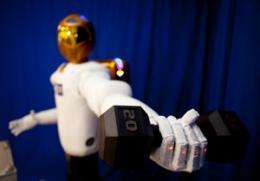
Robonaut2 surpasses previous dexterous humanoid robots in strength, yet it is safe enough to work side-by-side with humans. It is able to lift, not just hold, this 20-pound weight (about four times heavier than what other dexterous robots can handle) both near and away from its body.

Enlarge
NASA and General Motors have come together to develop the next generation dexterous humanoid robot. The robots - called Robonaut2 - were designed to use the same tools as humans, which allows them to work safely side-by-side humans on Earth and in space.
NASA and GM have a long, rich history of partnering on key technologies, starting in the 1960s with the development of the navigation systems for the Apollo missions. GM also played a vital role in the development of the Lunar Rover Vehicle, the first vehicle to be used on the moon.-
Liverpool scientists to develop space robots with NASA
Jul 19, 2005 |
not rated yet |
0
-
NASA Ames Leads Robotic Lunar Exploration Program
Nov 17, 2005 |
not rated yet |
0
-
Ames Hopes To Get A Chance To Help Dig Up Moon
Nov 22, 2005 |
not rated yet |
0
-
NASA To Show Intelligent Space Robots In Action At Ames "Marscape"
Sep 28, 2005 |
not rated yet |
0
-
NASA's Centennial Challenges Collaborates With Foundation
Oct 12, 2005 |
not rated yet |
0
-
Engineers build first sub-10-nm carbon nanotube transistor
Feb 01, 2012 |
4.9 / 5 (30) |
30
-
Something old, something new: Evolution and the structural divergence of duplicate genes
Jan 31, 2012 |
4.6 / 5 (7) |
1
-
The hidden nanoworld of ice crystals: Revealing the dynamic behavior of quasi-liquid layers
Jan 30, 2012 |
5 / 5 (3) |
1
-
Stock market network reveals investor clustering
Jan 27, 2012 |
3.9 / 5 (23) |
8
-
Of microchemistry and molecules: Electronic microfluidic device synthesizes biocompatible probes
Jan 26, 2012 |
5 / 5 (1) |
0
-
Calling function with no input argument
2 hours ago
-
Force free body diagram problem on gym equipment
3 hours ago
-
Empirical data regarding shower heads and water
11 hours ago
-
feed hold button on CNC lathe
Feb 09, 2012
-
RFAC in Fortran
Feb 09, 2012
-
dynamics 2/32
Feb 08, 2012
- More from Physics Forums - General Engineering
More news stories
Japan scientist makes 'Avatar' robot
A Japanese-developed robot that mimics the movements of its human controller is bringing the Hollywood blockbuster "Avatar" one step closer to reality.
8 hours ago |
5 / 5 (5) |
4
Google to make home entertainment system: report
Google will mirror Apple's winning hardware-software formula with an Android-powered entertainment system that wirelessly streams content through homes, the Wall Street Journal reported on Thursday.
Electronics / Consumer & Gadgets
20 hours ago |
4.5 / 5 (2) |
0
Barriers fall between TV, Internet
You say TV, I say Internet. Toe-mate-o, toe-mah-to.
Electronics / Consumer & Gadgets
22 hours ago |
not rated yet |
0
Intel packs performance and reliability into its latest SSD 520 series
Intel Corporation announced today its fastest, most robust client/consumer solid-state drive (SSD) to date, the Intel Solid-State Drive 520 Series (Intel SSD 520), a 6 gigabit-per-second (gbps) SATA III SSD ...
Feb 07, 2012 |
5 / 5 (1) |
4
Google rumored to have built Heads-Up-Display glasses prototype
(PhysOrg.com) -- 9to5Google is reporting that they have received a tip from someone they believe to be a reliable source saying that Google is working on a Heads-Up-Display (HUD) pair of eye-glasses. The per ...
Hovering not hard if you're top-heavy, researchers find
Top-heavy structures are more likely to maintain their balance while hovering in the air than are those that bear a lower center of gravity, researchers at New York University's Courant Institute of Mathematical Sciences ...
Grass to gas: Researchers' genome map speeds biofuel development
Researchers at the University of Georgia have taken a major step in the ongoing effort to find sources of cleaner, renewable energy by mapping the genomes of two originator cells of Miscanthus x giganteus, a large perenn ...
Drug halts organ damage in inflammatory genetic disorder
A new study shows that Kineret (anakinra), a medication approved for the treatment of rheumatoid arthritis, is effective in stopping the progression of organ damage in people with neonatal-onset multisystem inflammatory disease ...
Cochlear implants may be safe, effective for organ transplant patients
Cochlear implants may be a safe, effective option for some organ transplant patients who've lost their hearing as an unfortunate consequence of their transplant-related drug regime, researchers report.
Researchers develop new method for creating tissue engineering scaffolds
Researchers at Northwestern University have developed a new method for creating scaffolds for tissue engineering applications, providing an alternative that is more flexible and less time-intensive than current technology.
Molecular profiling reveals differences between primary and recurrent ovarian cancers
There is a need to analyze tumor specimens at the time of ovarian cancer recurrence, according to a new study published in Molecular Cancer Therapeutics. Researchers used a diagnostic technology called molecular profiling to examine ...

Feb 04, 2010
Rank: not rated yet
I'll bet their profits will be safer too once they replace their entire workforce.
Feb 04, 2010
Rank: not rated yet
After all, the auto-maker only makes "money" if there are humans who want to buy the autos....and people can't buy autos if they don't have jobs doing "something". If robots do 99.9% of all manual labor, then there won't be "blue collar" workers of any kind, and there may not even be "white collar" workers other than programmers, engineers, and other scientists.
Which means that "money" and "wealth" would be worthless and pointless concepts.
Feb 05, 2010
Rank: not rated yet
Feb 08, 2010
Rank: not rated yet
A smart nation would allocate as many as possible of the smartest, to science and education. This serves both the nation, and mankind as a whole, on the side.
Feb 09, 2010
Rank: 5 / 5 (1)
Feb 09, 2010
Rank: not rated yet
Ruh roh...
Feb 09, 2010
Rank: not rated yet
I'm sure replacing the entire human workforce with these robots would require no capital or operating costs.
Feb 09, 2010
Rank: not rated yet
Say an assembly robot costs $100k and can equal a human's workload on an hourly basis. It runs 24/7, so it's preforming the work of 3 humans. One maintenance human can keep 50 of them going, so you have upkeep but it's low.
It's easy to imagine how fast that initial investment is repaid.
Feb 10, 2010
Rank: not rated yet
They also wouldn't be able to replace the entire human workforce because robots lack human judgement. As it said in the article these would work side by side with humans. If the task were simple and monotonous enough for a machine to do it, a cheaper, specialized machine is probably already doing it. If the task is complex enough that human dexterity is required to complete the task it is also likely that a human's judgement will be required to ensure the task was completed properly. If not, QA would likely fall through the floor.
Feb 11, 2010
Rank: not rated yet
Feb 28, 2010
Rank: 4 / 5 (1)
I think the spread of robots will not begin in full force, until the robot is created, that can clean a house. At that point, they will become ubiquitous.