Forming the present-day spiral galaxies
February 4, 2010
Forming the present-day spiral galaxies

Enlarge

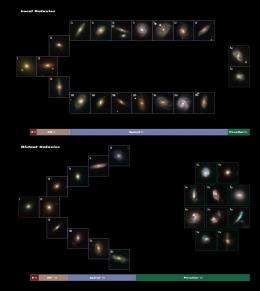
This image created from data taken from both the NASA/ESA Hubble Space Telescope and the Sloan Digital Sky Survey demonstrates that the Hubble sequence six billion years ago was very different from the one that astronomers see today. The two sections show how many more peculiar shaped galaxies (marked Pec) are seen among distant galaxies, as opposed to among local galaxies. The data organization follows the Hubble tuning-fork classification scheme invented in 1926 by the same Edwin Hubble in whose honor the space telescope is named. Credit: NASA, ESA, Sloan Digital Sky Survey, R. Delgado-Serrano and F. Hammer (Observatoire de Paris)

(PhysOrg.com) -- Using data from the NASA/ESA Hubble Space Telescope, astronomers have created a demographic census of galaxy types and shapes from a time before the Earth and the sun existed, to the present day. The results show that more than half of the present-day spiral galaxies had peculiar shapes only six billion years ago, which, if confirmed, highlights the importance of collisions and mergers in the recent past of many galaxies. It also provides clues for the unique status of our own galaxy.

Galaxy morphology, or the study of the shapes and formation of galaxies, is a critical and much-debated topic in astronomy. An important tool for this is the Hubble sequence or Hubble tuning-fork diagram [1], a classification scheme invented in 1926 by the same Edwin Hubble in whose honour the space telescope is named.

A team of European astronomers led by François Hammer of the Observatoire de Paris has, for the first time, completed a demographic census of galaxy types at two different points in the Universe's history — in effect, creating two Hubble sequences — that help explain how galaxies form [2]. In this survey, researchers sampled 116 local galaxies and 148 distant galaxies.

Contrary to previous thought, the astronomers showed that the Hubble sequence six billion years ago was very different from the one that astronomers see today.

"Six billion years ago, there were many more peculiar galaxies than now — a very surprising result," says Rodney Delgado-Serrano, lead author of the related paper recently published in and highlighted on the cover of Astronomy & Astrophysics. "This means that in the last six billion years, these peculiar galaxies must have become normal spirals, giving us a more dramatic picture of the recent Universe than we had before."

The astronomers think that these peculiar galaxies did indeed become spirals through collisions and merging. Tracing the history of galaxy formation leads us to the way our Universe presently looks. Like any review of a life, there are chaotic, tumultuous times and more dormant periods and, like many teenagers, developing galaxies often collide with those in their way. Crashes between galaxies give rise to enormous new galaxies and, although it was commonly believed that galaxy mergers decreased significantly eight billion years ago, the new result implies that mergers were still occurring frequently after that time — up to as recently as four billion years ago.

"Our aim was to find a scenario that would connect the current picture of the Universe with the morphologies of distant, older galaxies — to find the right fit for this puzzling view of galaxy evolution", says Hammer.

Also contrary to the widely held opinion that galaxy mergers result in the formation of elliptical galaxies, Hammer and his team support a scenario in which these cosmic clashes result in spiral galaxies. In a parallel paper published in Astronomy & Astrophysics [3], Hammer and his team delve further into their "spiral rebuilding" hypothesis, which proposes that peculiar affected by gas-rich mergers are slowly reborn as giant spirals with discs and central bulges.

Although our own Milky Way galaxy is a , it seems to have been spared much of the teenage drama; its formation history has been rather quiet and it has avoided violent collisions in astronomically recent times. However, the large Andromeda galaxy from our neighbourhood has not been so lucky and fits well into the "spiral rebuilding" scenario. Researchers continue to seek out explanations for this.

More information:
[1] Hubble's scheme divides regular galaxies into three broad classes — ellipticals, lenticulars and spirals — based on their visual appearance (originally on photographic plates). A fourth class contains galaxies with an irregular appearance.

[2] R. Delgado-Serrano, et al, 2010, How was the Hubble Sequence, 6 Giga-years ago?, Astronomy & Astrophysics, 509, A78

[3] F. Hammer et al., 2009, The Hubble Sequence: just a vestige of merger events?, Astronomy & Astrophysics, 507, 1313

[4] Over eight years of operations, the Sloan Digital Sky Survey (SDSS) obtained deep, multicolour images covering more than a quarter of the sky and created three-dimensional maps containing more than 930 000 galaxies and more than 120 000 quasars. The SDSS used a dedicated 2.5-metre telescope at Apache Point Observatory, New Mexico, equipped with two powerful special purpose instruments. The 120-megapixel camera imaged 1.5 square degrees of sky at a time, about eight times the area of the full Moon. A pair of spectrographs fed by optical fibres measured spectra of (and hence distances to) more than 600 galaxies and quasars in a single observation.

-- Hammer, et al. paper: http://arxiv.org/abs/0903.3962
-- Delgado-Serrano, et al. paper: http://arxiv.org/abs/0906.2805

Provided by ESA/Hubble Information Centre (news : web)

4.9 /5 (9 votes)  

Filter


Move the slider to adjust rank threshold, so that you can hide some of the comments.


Display comments: newest first

El_Nose
Feb 04, 2010

Rank: not rated yet
I offer one more option for the creation of spirals --- Most of the peculiar galaxies were on there way to becoming spirals no matter waht and we have not worked out the dynamic that is actually creating the spirals from a blob.

-- I am no astronomer, obviously

Maybe we are missing a drag in rotation of the outer stars.. or are gravitationally bound systems having a bigger effect that previously supposed? It will be a long time before we can put a spacecraft a few 100 lys from earth and look at galaxies from a slightly, very slight at 100ly, different angle.
barakn
Feb 04, 2010

Rank: 3 / 5 (3)
Spiral galaxies have what's known as a flat rotation curve, meaning the stars on the outside are moving faster than they ought to, and thus we have an anti-drag, not a drag, and attribute it to dark matter, whatever that is.
omatumr
Feb 04, 2010

Rank: 1 / 5 (2)
The cosmos is characterized by fragmentation - from repulsive nuclear forces - despite popular claims that the cosmos is powered by nuclear fusion (coalescence).

With kind regards,
Oliver K. Manuel
Emeritus Professor of
Nuclear & Space Studies
Former NASA PI for Apollo
Caliban
Feb 10, 2010

Rank: 1 / 5 (2)
It isn't a new idea, but I've recently read a bit about the so-called "Electric Universe" that develops structurally through fractal iterations driven by differences in electromagnetic potential. Fascinating stuff. Perhaps operative here?
Rank 4.9 /5 (9 votes)
Relevant PhysicsForums posts
  • Titan's lack of impact craters
    created20 hours ago
  • Real pictures of black hole eating a star?
    createdFeb 08, 2012
  • Hypothetical way to travel faster than light, but not technically exceed lightspeed
    createdFeb 06, 2012
  • How do scientists monitor the Sun's activity?
    createdFeb 05, 2012
  • Search patterns in observational studies
    createdFeb 05, 2012
  • Derivation of Pogson's law
    createdFeb 03, 2012
  • More from Physics Forums - General Astronomy

More news stories

Humans may have helped the decline of African rainforests 3000 years ago

(PhysOrg.com) -- Large areas of rainforests in Central Africa mysteriously disappeared over three thousand years ago, to be replaced by savannas. The prevailing theory has been that the cause was a change ...

Space & Earth / Environment

created 2 hours ago | popularity 5 / 5 (2) | comments 0 | with audio podcast report

NASA budget will axe Mars deal with Europe: scientists

US President Barack Obama's budget proposal to be submitted next week for 2013 will cut NASA's budget by 20 percent and eliminate a major partnership with Europe on Mars exploration, scientists said Thursday.

Space & Earth / Space Exploration

created 1 hour ago | popularity 5 / 5 (1) | comments 2

Black holes and star formation

(PhysOrg.com) -- It has long been recognized that galaxy mergers or even close interactions can play a vital role in shaping the morphology of galaxies. One way they can do so, it is thought, is by triggering ...

Space & Earth / Astronomy

created 23 hours ago | popularity 4.1 / 5 (7) | comments 5 | with audio podcast

Ocean microbe communities changing, but long-term environmental impact is unclear

As oceans warm due to climate change, water layers will mix less and affect the microbes and plankton that pump carbon out of the atmosphere – but researchers say it's still unclear whether these processes ...

Space & Earth / Earth Sciences

created 18 hours ago | popularity 5 / 5 (2) | comments 2 | with audio podcast

Deconstructing a mystery: What caused Snowmaggedon?

In the quiet after the storms, streets and cars had all but disappeared under piles of snow. The U.S. Postal Service suspended service for the first time in 30 years. Snow plows struggled to push the evidence ...

Space & Earth / Earth Sciences

created 16 hours ago | popularity 3.8 / 5 (4) | comments 1 | with audio podcast


New error-correcting codes guarantee the fastest possible rate of data transmission

Error-correcting codes are one of the triumphs of the digital age. They’re a way of encoding information so that it can be transmitted across a communication channel — such as an optical fiber o ...

High school students test best with 7 hours' rest

(Medical Xpress) -- Whether or not you know any high school students that actually get nine hours of sleep each night, that’s what federal guidelines currently prescribe.

Soccer -- the link between managers and captains

Soccer managers regard their captains as an extension of themselves, according to new research from Northumbria University, which could explain why Fabio Capello quit as England manager following the FA row ...

Using economic evaluations for drug reimbursement decisions - what have we achieved?

Researchers at the University of York perform evaluations of the clinical and cost-effectiveness of drugs for the National Institute for Health and Clinical Excellence (NICE).

Japan scientist makes 'Avatar' robot

A Japanese-developed robot that mimics the movements of its human controller is bringing the Hollywood blockbuster "Avatar" one step closer to reality.

Protein libraries in a snap

(PhysOrg.com) -- A Rice University undergraduate will depart with not only a degree but also a possible patent for his invention of an efficient way to create protein libraries, an important component of biomolecular ...