Scientists complete color palette of a dinosaur for the first time
(PhysOrg.com) -- Deciphering microscopic clues hidden within fossils, scientists have uncovered the vibrant colors that adorned a feathered dinosaur extinct for 150 million years, a Yale University-led research team reports online Feb. 4 in the journal Science.
Unlike recently published work from China that inferred the existence of two types of melanin pigments in various species of feathered dinosaurs, the Science study analyzed color-imparting structures called melanosomes from an entire fossil of a single animal, a feat which enabled researchers to reveal rich color patterns of the entire animal.
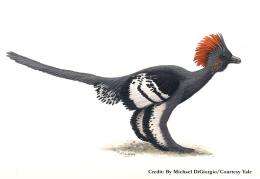
In fact, the analysis of melanosomes conducted by Yale team was so precise that the team was able to assign colors to individual feathers of Anchiornis huxleyi, a four-winged troodontid dinosaur that lived during the late Jurassic period in China. This dinosaur sported a generally gray body, a reddish-brown, Mohawk-like crest and facial speckles, and white feathers on its wings and legs, with bold black-spangled tips.
"This was no crow or sparrow, but a creature with a very notable plumage," said Richard O. Prum, chair and the William Robertson Coe Professor of Ornithology, Ecology and Evolutionary Biology at Yale and a co-author of the study. "This would be a very striking animal if it was alive today."
The color patterns of the limbs, which strongly resemble those sported by modern day Spangled Hamburg chickens, probably functioned in communication and may have helped the dinosaur to attract mates, suggested Prum.
The transformation of mankind's view of dinosaurs from dull to flamboyant was made possible by a discovery by Yale graduate student Jakob Vinther in the Department of Geology and Geophysics. Vinther was studying the ink sac of an ancient squid and realized that microscopic granular-like features within the fossil were actually melanosomes - a cellular organelle that contains melanin, a light-absorbing pigment in animals, including birds.
While some scientists thought these granules were remnants of ancient bacteria, Vinther, Prum and Derek E.G. Briggs, the Frederick William Beinecke Professor of Geology and Geophysics and director of the Yale Peabody Museum of Natural History, disagreed. First, they tested Vinther's theory on a 112 million year old feather from Brazil and later inferred the colors of an extinct 47 million-year-old bird.
The latest research team — which also included scientists from the University of Texas at Austin, University of Akron, Peking University and the Beijing Museum of Natural History — decided to use the same procedures to closely examine a fossil of Anchiornis huxleyi, recently described in Liaoning Province, People's Republic of China. The area has been a gold mine for paleontologists and, among other things, provided abundant evidence confirming a once-controversial theory that modern birds are descendants of theropod dinosaurs.
The Yale team and Julia Clarke, an associate professor of paleontology at the University of Texas at Austin's Jackson School of Geosciences, worked closely with Gao Keqin of Peking University and Li Quanguo and Meng Qingjin of the Beijing Museum of Natural History to select, sample and evaluate the anatomy and feathering of Anchiornis huxleyi, important in its own right as a new feathered dinosaur. The team's effort was funded by a special grant from the National Geographic Society and by the National Science Foundation.
The team closely examined 29 feather samples from the dinosaur and did an exhaustive measurement and location of melanosomes within the feathers. The team then did a statistical analysis of how those melanosomes compared to the types of melanosomes known to create particular colors in living birds, using data compiled by Matt Shawkey and colleagues at the University of Akron. The analysis allowed scientists to discern with 90 percent certainty the colors of individual feathers and, therefore, the colorful patterns of an extinct animal.
The research adds significant weight to the idea that dinosaurs first evolved feathers not for flight but for some other purposes.
"This means a color-patterning function — for example, camouflage or display — must have had a key role in the early evolution of feathers in dinosaurs, and was just as important as evolving flight or improved aerodynamic function," Clarke said.
The new discoveries provide a wealth of insights into the compelling history of feather evolution in dinosaurs prior to the origin of modern birds. The study documents that color patterning within feathers and among feathers evolved earlier than previously believed. Further, these results indicate dinosaur feathers may have evolved for communication.
"Writing the first scientifically-based 'field guide' description of the appearance of an extinct dinosaur was a exciting and unforgettable experience — the ultimate dream of every kid who was ever obsessed with dinosaurs," Prum said. "Now that dream is really possible."
Provided by Yale University


.jpg)


