First Internet, now bay window at space station
February 4, 2010 By MARCIA DUNN , AP Aerospace Writer
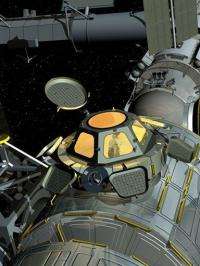
This illustration provided by NASA shows a view of the new Cupola which will be installed on the International Space Station. Life has never been so good off the planet, and it's about to get better. Just two weeks after the arrival of the Internet, the space station astronauts are getting an observation deck that will offer panoramic views of Earth. (AP Photo/NASA)
(AP) -- Life has never been so good off the planet, and it's about to get better.
Just two weeks after the arrival of the Internet, the space station astronauts are getting an observation deck that will offer panoramic views of Earth.
Space shuttle Endeavour will deliver the seven-windowed dome to the International Space Station next week, along with more living space in a chamber called Tranquility.
Endeavour's planned Sunday morning launch with six astronauts - at the wee hour of 4:39 a.m. - comes just days after President Barack Obama's big space station plug in his proposed budget for the coming fiscal year. The countdown clocks began ticking Thursday.
While the White House scrapped NASA's moonward-ho Constellation program, the space station got an extension until at least 2020, with the promise of more relevant research. NASA Administrator Charles Bolden said the goal is to make full use of the space station as "the national lab it was envisioned to be."
"There's so much we need to know before we can venture safely out of low-earth orbit for the long term," Bolden, a former shuttle commander, said after the budget was released Monday.
The dome going up on Endeavour - like a big bay window - should greatly improve the quality of life aboard the space station.
When astronauts exercise in the Italian-built Tranquility, for instance, they will be able to gaze out the nearby dome windows whenever the shutters are open. And when the day's work is done, they will be able to pop their heads and shoulders into the 5-foot-tall cupola, beholding the universe.
The lookout also will provide 360-degree views of the space station, allowing the crew to see directly outside during robotic work. Until now, they've had to rely on TV cameras when they use the robot arm to move or install big-ticket items.
"Looking out on the Earth is just inspiring," said space station resident Timothy "TJ" Creamer. In fact, it's the crew's No. 1 pastime in the off hours - at least it was before the Internet came aboard.
Now, "we can actually surf the Internet and find diversions," Creamer told schoolchildren in a TV hookup this week.
The five space station residents - two Americans, two Russians and one Japanese - finally got Internet access late last month, nearly a decade after the first bunch of guys moved in.
"First thing I did on internet? Order my wife some flowers," commander Jeffrey Williams wrote in his online Twitter account. "It was a hit. Commerce from space!"
The dome - nearly 10 feet in diameter and also made in Italy - will ride up in the shuttle attached to Tranquility, but in the wrong place. It will be moved to its proper location once Tranquility is connected to the space station.
During the third and final spacewalk of the mission, two of the astronauts will be outside looking in, while the nine others will be crowded inside, gazing out. They will pop their heads and shoulders into the dome, with their legs floating down into Tranquility.
With weightlessness, shuttle commander George Zamka said, it should be much easier and comfortable than the old how-many-can-fit-into-a-phone booth gag.
The main circular window - 31-inches across - is the biggest window ever bound for space. The six windows on the perimeter are trapezoid-shaped. For now, NASA wants to keep them shuttered most of the time to protect the fused silica glass from orbital debris. The glass is 1 inch to 1 1/2 inches thick and has four panes.
The name of the 23-foot-long Tranquility chamber pays homage to the Apollo 11 moon landing. The dusty Sea of Tranquility is where Neil Armstrong and Buzz Aldrin landed on July 20, 1969.
Actually, the new space station room should have been named Colbert. TV comedian Stephen Colbert campaigned and won an online vote to have the chamber named after him, but NASA much preferred the historic moniker. Colbert made due with his name on a treadmill that flew up last summer.
The Colbert treadmill will wind up in Tranquility, along with some extraordinary rocks mounted on a plaque aboard Endeavour. The chips of moon rock were collected by the Apollo 11 crew and carried to the top of Mount Everest last spring by a former shuttle astronaut, Scott Parazynski. Also on the plaque: a big rock gathered on the summit of Everest during that same expedition.
After Endeavour's 13-day mission, the space station will be 98 percent complete, with only four shuttle trips remaining. Shuttle flights are supposed to conclude by the end of September, but the White House said they can slip into 2011 if NASA needs to take more time and care.
©2010 The Associated Press. All rights reserved. This material may not be published, broadcast, rewritten or redistributed.
-
Space shuttle moved to launch pad on freezing morn
Jan 06, 2010 |
not rated yet |
0
-
Moon Rock Gains Traveling Companion for Historic Return to Space
Jan 04, 2010 |
not rated yet |
0
-
Astronauts pack trash, surplus gear for ride home
Sep 07, 2009 |
not rated yet |
0
-
Space shuttle Atlantis, 7 astronauts back on Earth
Nov 27, 2009 |
not rated yet |
0
-
Endeavour to bring high-tech 'sunroom' to ISS
Jan 29, 2010 |
not rated yet |
0
-
Engineers build first sub-10-nm carbon nanotube transistor
Feb 01, 2012 |
4.9 / 5 (30) |
30
-
Something old, something new: Evolution and the structural divergence of duplicate genes
Jan 31, 2012 |
4.6 / 5 (7) |
1
-
The hidden nanoworld of ice crystals: Revealing the dynamic behavior of quasi-liquid layers
Jan 30, 2012 |
5 / 5 (3) |
1
-
Stock market network reveals investor clustering
Jan 27, 2012 |
3.9 / 5 (23) |
8
-
Of microchemistry and molecules: Electronic microfluidic device synthesizes biocompatible probes
Jan 26, 2012 |
5 / 5 (1) |
0
-
Titan's lack of impact craters
8 hours ago
-
Real pictures of black hole eating a star?
Feb 08, 2012
-
Hypothetical way to travel faster than light, but not technically exceed lightspeed
Feb 06, 2012
-
How do scientists monitor the Sun's activity?
Feb 05, 2012
-
Search patterns in observational studies
Feb 05, 2012
-
Derivation of Pogson's law
Feb 03, 2012
- More from Physics Forums - General Astronomy
More news stories
Deconstructing a mystery: What caused Snowmaggedon?
In the quiet after the storms, streets and cars had all but disappeared under piles of snow. The U.S. Postal Service suspended service for the first time in 30 years. Snow plows struggled to push the evidence ...
Space & Earth / Earth Sciences
4 hours ago |
4.7 / 5 (3) |
1
|
NASA's TRMM satellite sees Cyclone Jasmine in 3-D
Data from NASA's TRMM satellite was used to create a 3-Dimensional look at Cyclone Jasmine, currently moving through the South Pacific Ocean.
Space & Earth / Earth Sciences
2 hours ago |
not rated yet |
0
Researchers create 3-D laser maps that show how earthquake changes landscape
Geologists have a new tool to study how earthquakes change the landscape down to a few inches, and it's giving them insight into how earthquake faults behave. In the Feb. 10 issue of the journal Science, a team ...
Space & Earth / Earth Sciences
6 hours ago |
5 / 5 (2) |
0
|
Ocean microbe communities changing, but long-term environmental impact is unclear
As oceans warm due to climate change, water layers will mix less and affect the microbes and plankton that pump carbon out of the atmosphere but researchers say it's still unclear whether these processes ...
Space & Earth / Earth Sciences
6 hours ago |
not rated yet |
0
|
NASA sees Tropical Storm 12S - a possible threat to Madagascar
The twelfth tropical depression formed in the Southern Indian Ocean today and quickly became a tropical storm, dubbed Tropical Storm 12S. NASA's Aqua satellite passed over the storm and captured infrared data that revealed ...
Space & Earth / Earth Sciences
4 hours ago |
not rated yet |
0
'Dark plasmons' transmit energy
Microscopic channels of gold nanoparticles have the ability to transmit electromagnetic energy that starts as light and propagates via "dark plasmons," according to researchers at Rice University.
Anyone can learn to be more inventive, cognitive researcher says
There will always be a wild and unpredictable quality to creativity and invention, says Anthony McCaffrey, a cognitive psychology researcher at the University of Massachusetts Amherst, because an "Aha moment" is rare and ...
Ultraviolet protection molecule in plants yields its secrets
Lying around in the sun all day is hazardous not just for humans but also for plants, which have no means of escape. Ultraviolet (UV) radiation from the sun can damage proteins and DNA inside cells, leading ...
New method makes culture of complex tissue possible in any lab
Scientists at the University of California, San Diego have developed a new method for making scaffolds for culturing tissue in three-dimensional arrangements that mimic those in the body. This advance, published online in ...
Cell biologists describes mechanism by which some people may be more susceptible to colon cancer
An international research team led by cell biologists at the University of California, Riverside has uncovered a new insight into colon cancer, the third leading cause of cancer-related deaths in the United ...
Hydrogen from acidic water: Researchers develop potential low cost alternative to platinum for splitting water
A technique for creating a new molecule that structurally and chemically replicates the active part of the widely used industrial catalyst molybdenite has been developed by researchers with the Lawrence Berkeley ...
Feb 04, 2010
Rank: 4.5 / 5 (2)