Google Has More Than Android On Its Platform
February 5, 2010 by Ted Goodman
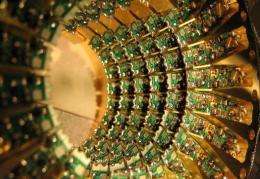
D-wave Quantum 2 (Image credit: D-Wave/M. Thom)
(PhysOrg.com) -- In the last several weeks, we've read a bit about how Google is getting restless just being the world’s largest search engine and a proud cloud computing parent. In fact, Googleland is growing by quantum leaps and bounds.
Behind the scenes, in fact, Google has been working with a D-Wave quantum computer that seems to be able to spot images of cars from among 20,000 photos faster than any other Google computer. Though there are reports of skepticism among higher math experts that D-Wave really is a quantum computer, it’s clear that Google is going to be the first to use the quantumest computer available to its fullest capacity.
Fast and accurate sorting capability is a must, and not just for Internet browsers. Think about the jobs of radiologists, for example, looking for a diseased cell or two in a mass of tissue. Or a baggage screener looking for a gun, a knife, or a bomb in someone’s carry-on bag. Recently published research on “visual attention," prepared by Harvard professor Jeremy Wolfe, demonstrates that the more we [humans!] look for that “needle in a haystack,” the less likely it is that we will find it. Now, how does that make you feel when you take a mammogram or get on an airplane?
But what if a quantum computer could detect the diseased cell? And not only that. What if that super computer could determine which antibody might kill that cell without harming the surrounding cells? Think about how much time that would save researchers in testing various drugs, and how much time it would save in getting approval for potential life-saving drugs.
It’s highly likely that Google Venture’s recent investment into Adimab was made with a computer antibody identifier in mind. Adimab, a New Hampshire-based biotech company, has already developed a simulated human immune system, composed of engineered yeast cells, that produces antibodies in response to drug molecules. This process obviates the need for testing engineered mice, as well as other animal testing, and produces therapeutic outcomes in less than eight weeks.
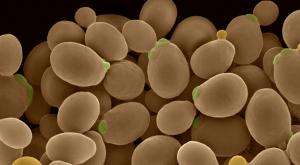
Antibody producing human yeast cells (Image credit: Adimab)
Already having a leg up on other biotech firms with its proprietary technology, Adimab has attracted investments from Polaris Venture Partners, SV Life Sciences, OrbiMed Advisors, and Borealis Ventures. But Adimab COO Errik Anderson admitted that Google's investment was not just financial. In an interview with Xconomy, Anderson said that “...it was clear that Google Ventures immediately understood our value proposition—that a prolific discovery platform can drive even greater productivity when integrated with advanced computational tools.”Some interesting times ahead for supercomputing and for Google; that’s for sure.
More information: -- Adimab http://www.adimab. … m/index.html
-- Google Collaborates with D-Wave on Possible Quantum Image Search http://www.physorg … 0107947.html
-- Google demonstrates quantum computer image search http://www.newscie … -search.html
-- Google Pours “Incredible” Computing Power into Antibody Drug Discovery With Adimab http://www.xconomy … le_page=true
-- Guns, Tumors And The Limits Of The Human Eye http://www.npr.org … Id=122561355
© 2010 PhysOrg.com
-
Google Collaborates with D-Wave on Possible Quantum Image Search
Dec 15, 2009 |
not rated yet |
0
-
Google launches venture capital fund (Update)
Mar 31, 2009 |
not rated yet |
0
-
Google Announces the Google Pack
Jan 08, 2006 |
not rated yet |
0
-
Google provides peek into new search engine
Aug 11, 2009 |
not rated yet |
0
-
Google refines searches for pictures and news
Apr 21, 2009 |
not rated yet |
0
-
Engineers build first sub-10-nm carbon nanotube transistor
Feb 01, 2012 |
4.9 / 5 (29) |
30
-
Something old, something new: Evolution and the structural divergence of duplicate genes
Jan 31, 2012 |
4.6 / 5 (7) |
1
-
The hidden nanoworld of ice crystals: Revealing the dynamic behavior of quasi-liquid layers
Jan 30, 2012 |
5 / 5 (3) |
1
-
Stock market network reveals investor clustering
Jan 27, 2012 |
3.9 / 5 (23) |
8
-
Of microchemistry and molecules: Electronic microfluidic device synthesizes biocompatible probes
Jan 26, 2012 |
5 / 5 (1) |
0
-
feed hold button on CNC lathe
4 hours ago
-
Mechanics of Solids ( Final exam question) plz help!
6 hours ago
-
RFAC in Fortran
9 hours ago
-
dynamics 2/32
14 hours ago
-
dynamics
14 hours ago
-
Vibration Absorbtion Problem
20 hours ago
- More from Physics Forums - General Engineering
More news stories
Oracle to pay $1.9B for Taleo, extends SAP rivalry
(AP) -- Oracle Corp. is escalating its rivalry with German business-software maker SAP AG and plans to pay $1.9 billion for Taleo Corp., a company that helps businesses hire and manage their employees.
1 hour ago |
not rated yet |
0
NFC aid for the visually and hearing impaired
As the proportion of senior citizens grows, their special needs are gaining momentum. Human eyesight, for example, weakens with age. VTT Technical Research Centre of Finland has been developing new NFC-based applications ...
15 minutes ago |
not rated yet |
0
Google launches Chrome browser for Android smartphones
With more and more people connecting to the Internet through a phone or a tablet instead of a PC, Google Inc. is bringing its fast-growing browser, Chrome, to the newest Android-powered mobile devices.
1 hour ago |
5 / 5 (2) |
0
Soraa LED light may dim 50-watt halogen rivals
(PhysOrg.com) -- Soraa, a Fremont, California company founded in 2008, this week launched its first product, a light that uses LEDS (light emitting diodes). The "Soraa LED MR16 lamp" is the "perfect" replacement ...
Kodak to stop making cameras, digital frames
Kodak says it will stop making digital cameras, pocket video cameras and digital picture frames in order to focus on its more profitable businesses.
1 hour ago |
not rated yet |
1
Tidal forces could squeeze out planetary water
Alien planets might experience tidal forces powerful enough to remove all their water, leaving behind hot, dry worlds like Venus, researchers said.
Can indigenous insects be used against the light brown apple moth?
The light brown apple moth (LBAM), Epiphyas postvittana (Walker), an invasive insect from Australia, was found in California in 2006. The LBAM feeds on apples, pears, stonefruits, citrus, grapes, berries and many other plants ...
Physics research suggests new pathways for cancer progression
Observing that certain cancer cells may exhibit greater flexibility than normal cells, some scientists believe that this capability promotes rapid tumor growth. Now computer simulations developed by Boston University Biomedical ...
NASA sees Tropical Cyclone Jasmine over Vanuatu and New Caledonia
NASA's Aqua satellite passed over Tropical Cyclone Jasmine on Feb. 8, 2012 as it was passing between Vanuatu and New Caledonia. NASA imagery showed Jasmine had a 20 nautical mile-wide eye.
Physically abused children report higher levels of psychosomatic symptoms
Children who display multiple psychosomatic symptoms, such as regular aches and pains and sleep and appetite problems, are more than twice as likely to be experiencing physical abuse at home than children who do not display ...
Heavy lifting for cancer research
Many patients with advanced cancer suffer from cachexia, a condition also called body-wasting or wasting syndrome, which causes significant weight loss, extreme fatigue and reduces quality of life.

Feb 04, 2010
Rank: 3.7 / 5 (3)
http://www.youtub...TENNiZE0
Feb 05, 2010
Rank: 3 / 5 (2)
Feb 06, 2010
Rank: 5 / 5 (2)