Record-breaking LHC collisions offer first glimpse of physics at new energy frontier
February 5, 2010 Anne Trafton
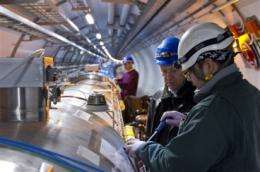
Workers examine a new Quench Protection System at CERN in January. Image courtesy of CERN
(PhysOrg.com) -- In December, the Large Hadron Collider, the world's largest particle accelerator, shattered the world record for highest energy particle collisions.
This week, team led by researchers from MIT, CERN and the KFKI Research Institute for Particle and Nuclear Physics in Budapest, Hungary, completed work on the first scientific paper analyzing the results of those collisions. Its findings show that the collisions produced an unexpectedly high number of particles called mesons — a factor that will have to be taken into account when physicists start looking for more rarer particles and for the theorized Higgs boson.
“This is the very first step in a long road to performing extremely sensitive analyses that can detect particles produced only in one in a billion collisions,” says Gunther Roland, MIT associate professor of physics and an author of the new paper.
Roland and MIT professors Wit Busza and Boleslaw Wyslouch, who are members of the CMS (compact muon solenoid) collaboration, were among the study leaders. The CMS collaboration runs one of four detectors at the collider.
The Large Hadron Collider (LHC), located underground near Geneva, Switzerland, started its latest run in late November. On Dec. 8, the proton beams around the 17-mile ring collided at a peak energy of 2.36 tera electron volts (TeV), breaking the previous record of 1.96 TeV achieved at the Fermi National Accelerator Lab. Because of Einstein’s equation, E=mc2, which correlates mass and energy, higher energy levels should produce heavier particles — possibly including some never seen before.
In the new paper, submitted to the Journal of High Energy Physics by CMS, the physicists analyzed the number of particles produced in the aftermath of the high-energy collisions. When protons collide, their energy is predominantly transformed into particles called mesons — specifically, two types of mesons known as pions and kaons.
To their surprise, the researchers that the number of those particles increased faster with collision energy than was predicted by their models, which were based on results of lower-energy collisions.
Taking the new findings into account, the team is now tuning its predictions of how many of those mesons will be found during even higher energy collisions. When those high-energy experiments are conducted, it will be critical to know how many such particles to expect so they can be distinguished from more rare particles.
“If we’re looking for rare particles later on, these mesons will be in the background,” says Roland. “These results show us that our expectations were not completely wrong, but we have to modify things a bit.”
Using the Large Hadron Collider, physicists hope to eventually detect the Higgs boson, a particle that is theorized to give all other particles their mass, as well as evidence for other physical phenomena such as supersymmetry, extra dimensions of space and the creation of a new form of matter called quark-gluon plasma (QGP). The new data provide an important reference point when CMS will look for signatures of QGP creation in collisions of lead ions at the LHC later this year.
The CMS team, which includes more than 2,000 scientists around the world, has 45 members (including faculty, students and research scientists) from the MIT Laboratory for Nuclear Science’s Particle Physics Collaboration and heavy-ion research groups.
The Large Hadron Collider is capable of creating collisions up to 14 TeV, but scientists are gradually easing the machine up to that level to try to avoid safety issues that have arisen in the past. In September 2008, the collider had to be shut down for several months after a connector joining two of the collider’s magnets failed, causing an explosion and leakage of the liquid helium that cools the magnets.
During the collider’s next run in March, researchers hope to create collisions of 7 TeV, says Roland. The success of the latest effort “makes us extremely optimistic about the detector,” he says. “It performed beautifully during the run.”
Provided by Massachusetts Institute of Technology (news : web)
-
A front-row seat at this summer's physics extravaganza
Jul 02, 2008 |
not rated yet |
0
-
High-energy physics at the highest level
Mar 27, 2006 |
not rated yet |
0
-
Michigan integral to world's largest physics experiment
Sep 05, 2008 |
not rated yet |
0
-
The hunt for the Higgs steps up a gear
Aug 28, 2008 |
not rated yet |
0
-
Atom smasher catches 1st high-energy collisions
Dec 09, 2009 |
not rated yet |
0
-
Engineers build first sub-10-nm carbon nanotube transistor
Feb 01, 2012 |
4.9 / 5 (30) |
30
-
Something old, something new: Evolution and the structural divergence of duplicate genes
Jan 31, 2012 |
4.6 / 5 (7) |
1
-
The hidden nanoworld of ice crystals: Revealing the dynamic behavior of quasi-liquid layers
Jan 30, 2012 |
5 / 5 (3) |
1
-
Stock market network reveals investor clustering
Jan 27, 2012 |
3.9 / 5 (23) |
8
-
Of microchemistry and molecules: Electronic microfluidic device synthesizes biocompatible probes
Jan 26, 2012 |
5 / 5 (1) |
0
-
Dark Energy question
43 minutes ago
-
Wind Turbine Power
2 hours ago
-
Steam Table issues
4 hours ago
-
electrostatic induction in a conductor should be immpossible
8 hours ago
-
Help! Physics Momentum/Impulse problem!
11 hours ago
-
Gauss' law cubes, how to prove
12 hours ago
- More from Physics Forums - General Physics
More news stories
SLAC, Stanford team focuses on high-energy electrons to treat cancer
Accelerator physicists at SLAC and cancer specialists from Stanford are working on a new technology that could dramatically reduce the time needed for cancer radiation treatments. The team ran an initial experiment ...
2 hours ago |
not rated yet |
0
Measurements from high-energy collisions lead to better understanding of why meson particles disappear
For several years, physicists at the Relativistic Heavy Ion Collider (RHIC) at Brookhaven National Laboratory (BNL), USA, have studied an unusual state of matter called the quarkgluon plasma, which they ...
3 hours ago |
not rated yet |
0
Quantum physicist explains $100K offer for proof scaled-up quantum computing is impossible
(PhysOrg.com) -- MIT researcher Scott Aaronson has certainly riled the physics community with his offer this past Friday, of $100,000 to anyone who can prove that scaled-up quantum computing is impossible. ...
Explained: Sigma
It's a question that arises with virtually every major new finding in science or medicine: What makes a result reliable enough to be taken seriously? The answer has to do with statistical significance -- but ...
Feb 09, 2012 |
5 / 5 (13) |
26
Physicists 'record' magnetic breakthrough
An international team of scientists has demonstrated a revolutionary new way of magnetic recording which will allow information to be processed hundreds of times faster than by current hard drive technology.
Feb 07, 2012 |
4.5 / 5 (39) |
14
|
New understanding of DNA repair could eventually lead to cancer therapy
A research group in the Faculty of Medicine & Dentistry at the University of Alberta is hoping its latest discovery could one day be used to develop new therapies that target certain types of cancers.
Zuckerberg's focus drives Facebook's ascent
When Mark Zuckerberg showed up to rent Judy Fusco's Los Altos, Calif., house in the fall of 2004, soon after he'd arrived in Silicon Valley, the landlord was immediately struck by his confidence.
Antidepressants and pregnancy: Women must consider the impact of drugs on baby, and of depression on baby, themselves
Upon learning they are pregnant, most women dutifully nix the alcohol, sushi and caffeine. But what about antidepressants?
Both maternal and paternal age linked to autism
Older maternal and paternal age are jointly associated with having a child with autism, according to a recently published study led by researchers at The University of Texas Health Science Center at Houston (UTHealth).
Night, weekend delivery OK for babies with birth defects
Weekday delivery is no better than night or weekend delivery for infants with birth defects, according to a new study presented today at The Pregnancy Meeting, the Society for Maternal-Fetal Medicine's annual conference. ...
Sonic Cradle lands spot in TED exhibition
A Simon Fraser University graduate student project that melds music, meditation and modern technology has landed a rare spot as an exhibit at TEDActive 2012 in Palm Springs, California this month.
Feb 05, 2010
Rank: 3.9 / 5 (9)
Feb 05, 2010
Rank: 2.3 / 5 (4)
If a particle or wave- was produced that effected local gravity. And if it was accidently produced in large quantities that it masked all other data becuase it was changing the trajectories of the particles that they ar enow ignoring. - Or - Broke the LHC because it changed the focus of the beam being fired and it cut into a surrounding magnet.
Just idle thoughts
Feb 05, 2010
Rank: 4 / 5 (5)
Maybe they should try to understand WHY there are more particles being created than expected instead of simply REVISING their estimates of what will happen next at higher energies? Maybe I misunderstood?
Feb 05, 2010
Rank: 5 / 5 (2)
I totally agree. My first thought was poorer than expected beam quality. Second thought was non-linear processes at work(inevitable as power increases, in many systems). Third thought was that #2 contributes to #1.
Feb 05, 2010
Rank: 2.2 / 5 (5)
Feb 05, 2010
Rank: 4 / 5 (1)
The point that I find most interesting is that they mentioned they based their expectations on E=mc^2. If their predictions are wrong/off and we are working in energies that have never been attained artificially before, could that imply that there may be additional variables, mathematically and physically, that they should attempt to address before ramping up?
I am all for blazing a path into the unknown but we should understand all aspects of the results, as much as possible, before going much further.
My $.02
Feb 05, 2010
Rank: 4 / 5 (1)
Feb 05, 2010
Rank: 5 / 5 (3)
Nope. E=mc^2 is the best way to characterize particles, since it simplifies the math considerably (gets rid of annoying conversion factors). Totally standard for the last century, and no reason whatsoever to think otherwise.
"WHOA. WHOA. WHOA.
Maybe they should try to understand WHY there are more particles being created than expected instead of simply REVISING their estimates of what will happen next at higher energies? Maybe I misunderstood?"
There isn't much point to building a detector if you don't use it. This is just part of the process of understanding the machine, or hopefully new physics.
Feb 05, 2010
Rank: 3.7 / 5 (3)
As for more particles, they're not creating MORE particles than they put energy in for, they're noting that the distribution of particle types is far different than they expected. Pound of granite vs a pound of feathers, which is heavier?
In other words, their models are wrong and require some more refinement when compared to observation.
Feb 05, 2010
Rank: 3 / 5 (1)
This was my point exactly.
Feb 05, 2010
Rank: 5 / 5 (1)
Correct me if I am wrong but isn't the fact that their experimental observations deviate from their expectations mean that there could be new physics at work? Unless they can figure the math was incorrect. But, if it is correct, then that means there is something we cannot account for. And that means, new physics.
The scientists working on this project are some of the brightest individuals on the face of the planet and they have committed their mental faculties to understanding these problems. I highly doubt they miscalculated or used simplified equations to create their estimations. If they needed supercomputers for the effort I am sure they could afford it.
Maybe, before we add more fuel to the fire, we should figure out what kind of fire it is. In a grease fire, throwing water on the flame makes it wor
Feb 06, 2010
Rank: 1 / 5 (9)
http://www.youtub...=related
SEE PROPERTIES OF THESE METALS IN COMMENT SECTION OF LINK BELOW
http://www.physor...94.html#
Feb 07, 2010
Rank: not rated yet
http://arxiv.org/.../0112186
http://arxiv.org/.../0605062
http://www.physor...682.html
http://en.wikiped...ack_hole
http://www.iop.or...2/12/S52
http://tinyurl.com/ycav236
http://www.unisci...1012.htm
http://adsabs.har......6193B
Feb 07, 2010
Rank: 1 / 5 (2)
http://sciencenow...10/122/1
"Curiously, though, nobody had ever shown that the prevailing theory of gravity, Einstein's theory of general relativity, actually predicts that a black hole can be made this way. Now a computer model shows conclusively for the first time that a particle collision really can make a black hole."
They of course never calculated too, if such black hole could swallow Earth, or not - if they never calculated its formation. It's all blind experiments.
Feb 07, 2010
Rank: 1 / 5 (2)
Time for much spending I believe. But will we have time to say we told you so. and if they do create a hole in the space fabric will it continue to expand. Did they say what percentage of extra particles there were that they hadnt allowed for?
Feb 07, 2010
Rank: 5 / 5 (3)
Feb 07, 2010
Rank: 5 / 5 (3)
Feb 07, 2010
Rank: 1 / 5 (3)
Feb 07, 2010
Rank: 1 / 5 (1)
Feb 07, 2010
Rank: 1 / 5 (1)
Feb 07, 2010
Rank: not rated yet
The formation of black hole phenomena like jet suppression or condensation of particles into larger clusters (pentaquark) was observed already at Tevatron. In fact, scientists are pretty sure, they would observe it - why do you mean, article is named "first glimpse of new physics"?
http://adsabs.har......6193B
The problem is, people doesn't understand, what the "new physics" is and what doesn't. When I express my own opinion only, people would rate me low. When I compose my post only from quotations of another articles, people would rate me low as well. Air showers prove anything about LHC safety, because they're always formed by single particle at its very beginning and they've no zero momentum toward Earth. Concerning the Planck energy, what will happen, if two proton rays (each of energy of fast moving train) would collide with speckle of dust inside of accelerator?
Feb 07, 2010
Rank: not rated yet
http://www.telegr...der.html
http://techfreep....erse.htm
Feb 07, 2010
Rank: not rated yet
Well, there still exist possibility, small number of neutron will mix with another particles under formation of quite stable atom nuclei. Inside atom nuclei neutrons aren't stabilized by hydrostatic pressure, but by surface tension, so called strong nuclear force. The strangelet concept is based on similar idea, just with more dense weakly interacting elementary particles. Nobody knows, what can happen, when for example neutrino would condense into dense form of matter - there's no force, which could separate them mutually in similar way, like neutrons.
This is why I believe, the micro-black holes, strangelets and so called WIMPs are stuff of the same category
Feb 07, 2010
Rank: not rated yet
Therefore the secret in strangelet preparation aren't brute force collisions - rather matter of thorough condensation of matter by external fields, for example during collimation of proton jets by supermagnets of collider. Theoretically we could prepare micro-black hole just by careful cooling and condensation of neutrinos.
The formation of such particles during stellar collisions is extremely improbable in similar way, like spontaneous formation of boson condensate made by laser cooling of atoms - but the human intelligence could cheat the Nature and to prepare particles, which could never form in it spontaneously. I'm afraid, scientists never understood LHC stuff in this way.
Feb 08, 2010
Rank: 1 / 5 (1)
Feb 08, 2010
Rank: not rated yet
Some would say we all just mix up things we found elsewhere. How else did we learn to write? ;)
Anyway, why take it so personal? Saying someone has no opinion is pretty rude.
I like it when people include links. If I'm interested in what they said I can follow a link to see what else there is on the subject.
Feb 08, 2010
Rank: not rated yet
Feb 08, 2010
Rank: not rated yet
Feb 08, 2010
Rank: 4 / 5 (2)
Feb 08, 2010
Rank: not rated yet
Feb 09, 2010
Rank: not rated yet
Huh? is this english? Perhaps it must be too late and I'm tired? Either I can't get the sentence structure right in my head, or it's just not formed correctly?
Feb 09, 2010
Rank: not rated yet
Feb 10, 2010
Rank: not rated yet
Or, maybe they only detect the ones that scatter too much energy to create black holes...
Feb 10, 2010
Rank: not rated yet
http://adsabs.har......6193B
CERN guys know very well, what they could observe, because they observed it already - my problem is, that these stuffs aren't quite safe.
Feb 10, 2010
Rank: not rated yet
http://sciencenow...10/122/1
Feb 10, 2010
Rank: not rated yet
http://focus.aps....y/v9/st3
The somewhat funny thing is, some scientists are repeating "LHC is safe, because no black holes could be formed from cosmic rays neither", because they want to get grants for LHC collisions ... while another scientists are already spending another grants for their detection in stratosphere.
The analogy with global warming hoax is quite obvious here: scientists doesn't care about controversies of theories, some safety concerns the less - only for money for their research.
Current situation is, every argument of LHC defenders regarding LHC safety could be objected by some other peer-reviewed theory, which predicts exactly the opposite.
Feb 10, 2010
Rank: not rated yet
The article you linked to was interesting, as it gave an explanation of why non-paired jets would be produced during black hole evaporation.
On a different note, I found the paper this article refers to on arxiv (I found it via the MIT website, so the link was somewhat helpful.): http://xxx.lanl.g...002.0621
Feb 10, 2010
Rank: not rated yet
http://www.aps.or...form.jpg
http://bymyart.fi...big1.jpg
It means, black holes inside of galaxies decay like oriented cobalt atom nuclei, on which parity violation was observed first in 1954 and black holes prepared in LHC are behaving in the same way.
Feb 10, 2010
Rank: not rated yet
Feb 10, 2010
Rank: 3 / 5 (2)
And the atoms in speckle will not be "ripped off", but smashed together by brute force of all colliding protons, because they have nowhere to escape.
Why LHC proponents always see the situation from another, quite opposite perspective, then this one, which everyone could expect? Scientists are payed by us for to predict ALL SITUATIONS - not only these, which would allow them in experiments in safe way.
If they cannot, they're cheaters like Pachauri or incompetent idiots. It's about safety of all of us - not just safety of few dull scientists.
Feb 10, 2010
Rank: 3 / 5 (2)
And we have calculations already, which are proving, stable black hole could be formed during LHC collisions. What you're doubting in or not isn't relevant at all, after then. You can only write another peer-review article with better calculation, that's all.
Richard Feynman once said: "Shut up and calculate!"
Can you understand it? If you're unsure, just calculate the risk exactly - or stop the experiments. This is what the scientific approach to problem of LHC security means.
Feb 10, 2010
Rank: 3 / 5 (2)
Now it's job of scientists to have all calculations prepared for all scenarios possible - not just for these awaited ones. Scientific community isn't apparently prepared to such supersymmetric situation. The LHC case revealed limits of contemporary scientific method - or rather ignorant interpretation of it, because Poppers method is completely symmetric in fact.
Feb 11, 2010
Rank: not rated yet