Scientist make a leap in quantum computing
February 5, 2010 by Kitta MacPherson
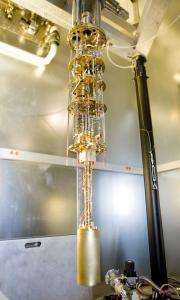
Spin qubits, which could be the core logic elements of quantum computers, are cooled in a device called a dilution refrigerator to temperatures near absolute zero in order to exploit the mysterious rules of quantum mechanics. Photo: Princeton University/Brian Wilson
(PhysOrg.com) -- A major hurdle in the ambitious quest to design and construct a radically new kind of quantum computer has been finding a way to manipulate the single electrons that very likely will constitute the new machines' processing components or "qubits."
Princeton University's Jason Petta has discovered how to do just that -- demonstrating a method that alters the properties of a lone electron without disturbing the trillions of electrons in its immediate surroundings. The feat is essential to the development of future varieties of superfast computers with near-limitless capacities for data.
Petta, an assistant professor of physics, has fashioned a new method of trapping one or two electrons in microscopic corrals created by applying voltages to minuscule electrodes. Writing in the Feb. 5 edition of Science, he describes how electrons trapped in these corrals form "spin qubits," quantum versions of classic computer information units known as bits. Other authors on the paper include Art Gossard and Hong Lu at the University of California-Santa Barbara.
Previous experiments used a technique in which electrons in a sample were exposed to microwave radiation. However, because it affected all the electrons uniformly, the technique could not be used to manipulate single electrons in spin qubits. It also was slow. Petta's method not only achieves control of single electrons, but it does so extremely rapidly -- in one-billionth of a second.
"If you can take a small enough object like a single electron and isolate it well enough from external perturbations, then it will behave quantum mechanically for a long period of time," said Petta. "All we want is for the electron to just sit there and do what we tell it to do. But the outside world is sort of poking at it, and that process of the outside world poking at it causes it to lose its quantum mechanical nature."
When the electrons in Petta's experiment are in what he calls their quantum state, they are "coherent," following rules that are radically different from the world seen by the naked eye. Living for fractions of a second in the realm of quantum physics before they are rattled by external forces, the electrons obey a unique set of physical laws that govern the behavior of ultra-small objects.
Scientists like Petta are working in a field known as quantum control where they are learning how to manipulate materials under the influence of quantum mechanics so they can exploit those properties to power advanced technologies like quantum computing. Quantum computers will be designed to take advantage of these characteristics to enrich their capacities in many ways.
In addition to electrical charge, electrons possess rotational properties. In the quantum world, objects can turn in ways that are at odds with common experience. The Austrian theoretical physicist Wolfgang Pauli, who won the Nobel Prize in Physics in 1945, proposed that an electron in a quantum state can assume one of two states -- "spin-up" or "spin-down." It can be imagined as behaving like a tiny bar magnet with spin-up corresponding to the north pole pointing up and spin-down corresponding to the north pole pointing down.
An electron in a quantum state can simultaneously be partially in the spin-up state and partially in the spin-down state or anywhere in between, a quantum mechanical property called "superposition of states." A qubit based on the spin of an electron could have nearly limitless potential because it can be neither strictly on nor strictly off.
New designs could take advantage of a rich set of possibilities offered by harnessing this property to enhance computing power. In the past decade, theorists and mathematicians have designed algorithms that exploit this mysterious superposition to perform intricate calculations at speeds unmatched by supercomputers today.
Petta's work is using electron spin to advantage.
"In the quest to build a quantum computer with electron spin qubits, nuclear spins are typically a nuisance," said Guido Burkard, a theoretical physicist at the University of Konstanz in Germany. "Petta and coworkers demonstrate a new method that utilizes the nuclear spins for performing fast quantum operations. For solid-state quantum computing, their result is a big step forward."
Petta's spin qubits, which he envisions as the core of future quantum logic elements, are cooled to temperatures near absolute zero and trapped in two tiny corrals known as quantum wells on the surface of a high-purity, gallium arsenide chip. The depth of each well is controlled by varying the voltage on tiny electrodes or gates. Like a juggler tossing two balls between his hands, Petta can move the electrons from one well to the other by selectively toggling the gate voltages.
Prior to this experiment, it was not clear how experimenters could manipulate the spin of one electron without disturbing the spin of another in a closely packed space, according to Phuan Ong, the Eugene Higgins Professor of Physics at Princeton and director of the Princeton Center for Complex Materials.
Other experts agree.
"They have managed to create a very exotic transient condition, in which the spin state of a pair of electrons is in that moment entangled with an almost macroscopic degree of freedom," said David DiVencenzo, a research staff member at the IBM Thomas J. Watson Research Center in Yorktown Heights, N.Y.
Petta's research also is part of the fledgling field of "spintronics" in which scientists are studying how to use an electron's spin to create new types of electronic devices. Most electrical devices today operate on the basis of another key property of the electron -- its charge.
There are many more challenges to face, Petta said.
"Our approach is really to look at the building blocks of the system, to think deeply about what the limitations are and what we can do to overcome them," Petta said. "But we are still at the level of just manipulating one or two quantum bits, and you really need hundreds to do something useful."
As excited as he is about present progress, long-term applications are still years away. "It's a one-day-at-a-time approach," Petta said.
Provided by Princeton University
-
Researchers Design Triple Quantum Dot for Quantum Information Applications
Nov 30, 2009 |
not rated yet |
0
-
Putting a new spin on current research
Nov 15, 2008 |
not rated yet |
0
-
Spin-polarized electrons on demand
Jan 21, 2009 |
not rated yet |
0
-
Spin-polarized electrons on demand
Jan 15, 2009 |
not rated yet |
0
-
Detecting the spin of a single electron in a standard silicon transistor
Aug 10, 2004 |
not rated yet |
0
-
Fast photon control brings quantum photonic technologies closer
9 hours ago |
5 / 5 (4) |
0
-
Engineers build first sub-10-nm carbon nanotube transistor
Feb 01, 2012 |
4.9 / 5 (33) |
30
-
Something old, something new: Evolution and the structural divergence of duplicate genes
Jan 31, 2012 |
4.6 / 5 (7) |
1
-
The hidden nanoworld of ice crystals: Revealing the dynamic behavior of quasi-liquid layers
Jan 30, 2012 |
5 / 5 (5) |
1
-
Stock market network reveals investor clustering
Jan 27, 2012 |
3.9 / 5 (23) |
8
-
Capacitors: How to determine the charge density at each surface?
2 hours ago
-
The workings of a Stirling engine
3 hours ago
-
Using the Joukowski transform to calculate flow around cylinder due to point charges
5 hours ago
-
Calculating volume of an air tank given the compressor delivery rate
6 hours ago
-
please introduce me a book about Classical Non-Markovian dynamics
6 hours ago
-
Complete annihilation of light through polarizers
9 hours ago
- More from Physics Forums - Classical Physics
More news stories
Fast photon control brings quantum photonic technologies closer
(PhysOrg.com) -- Using photons instead of electrons to transmit information could lead to faster and more secure ways to communicate, among other advantages. Now a team of physicists has taken another step toward realizing ...
Tandem polymer solar cells that set record for energy-conversion
(PhysOrg.com) -- In the effort to convert sunlight into electricity, photovoltaic solar cells that use conductive organic polymers for light absorption and conversion have shown great potential. Organic polymers ...
4 hours ago |
5 / 5 (4) |
2
|
Leading the quest to crack cosmological mysteries
Sometimes a scientist can only laugh in the face of a seemingly insurmountable challenge.
3 hours ago |
3.8 / 5 (4) |
0
|
Researchers make better heat sensor based on butterfly wings
(PhysOrg.com) -- Scientists have long known that butterfly wings produce their iridescent colors by bouncing light around and between tiny ridges in structures made of chitin. More recently they’ve discovered ...
Rapunzel, Leonardo and the physics of the ponytail
(PhysOrg.com) -- New research provides the first mathematical understanding of the shape of a ponytail and could have implications for the textile industry, computer animation and personal care products.
13 hours ago |
4.4 / 5 (9) |
1
|
Plants use circadian rhythms to prepare for battle with insects
In a study of the molecular underpinnings of plants' pest resistance, Rice University biologists have shown that plants both anticipate daytime raids by hungry insects and make sophisticated preparations to ...
Sensing self and non-self: New research into immune tolerance
At the most basic level, the immune system must distinguish self from non-self, that is, it must discriminate between the molecular signatures of invading pathogens (non-self antigens) and cellular constituents that usually ...
Missing dark matter located: Intergalactic space is filled with dark matter
Researchers at the University of Tokyos Institute for the Physics and Mathematics of the Universe (IPMU) and Nagoya University used large-scale computer simulations and recent observational data of gravitational ...
Scientists discover reason for Mt. Hood's non-explosive nature
(PhysOrg.com) -- For a half-million years, Mount Hood has towered over the landscape, but unlike some of its cousins in Oregons Cascade Mountains and many other volcanoes around the Pacific Rim ...
Radiation treatment transforms breast cancer cells into cancer stem cells
Breast cancer stem cells are thought to be the sole source of tumor recurrence and are known to be resistant to radiation therapy and don't respond well to chemotherapy.
Cut your Valentine some slack
If the one you love usually forgets Valentine's Day, but this year makes a romantic effort, you should give him credit for trying.
Feb 05, 2010
Rank: 4.3 / 5 (7)
The glass is full, half full, half empty, and empty all at the same time!
Feb 05, 2010
Rank: 2.1 / 5 (8)
The one fallacy that Western cultural & scientific dogma betrays of itself is its dogged assumption that all the constituent parts that comprise our reality are absolute: God either is or isn't, true or false, can or can't. However, it seems inevitable now that we cannot escape the undeniable fact: all states are possible simultaneously, & consciousness is the sheeit.
Feb 05, 2010
Rank: 4.3 / 5 (7)
Feb 05, 2010
Rank: 1.3 / 5 (4)
Nevertheless, there is actually a strong similarity between quantum mechanics and Eastern philosophy/religion. So strong, that it is worth investigating.
Feb 05, 2010
Rank: 1.3 / 5 (4)
Remember that we are still taking for granted much of how today's technologies, including even light bulbs, really work, and as such we place faith in the continued operation of such voodoo.
This conversation brings to the mind of this particular responder the bouncing of theorist brains between the realities of quanta and consciousness.
Feb 06, 2010
Rank: 2.4 / 5 (5)
Scientist make a leap in quantum computing.
Scientists?
Feb 06, 2010
Rank: 1.7 / 5 (7)
Feb 06, 2010
Rank: 1.7 / 5 (6)
Feb 06, 2010
Rank: 2.3 / 5 (8)
Feb 06, 2010
Rank: 5 / 5 (5)
From what I could glean, they've confirmed a pin-point method of modifying an electron's spin by using quantum wells. Still needs super-cooling, complicated fabrication and is far from doing actual computation. Yet somehow the phrasing of the article makes it seem as if these guys alone thought up the marvellous concept of quantum computing and will have a prototype ready in a few years.
I really think it's safe to assume that the majority of Physorg readers have the knowledge required to understand basic technicalities and would appreciate them more than pop-science buzz wording. The vagueness of the latter tends to stir up long-winded, pointless, off-topic, "philosophical" discussions, as one can see.
Feb 06, 2010
Rank: 5 / 5 (5)
@skand1nsky: When you feel something you aren't actually feeling it, you're feeling the signals from the pressure receptors in your skin. We know we are conscious because consciousness is all we are conscious of. Everything else we have to deduce through empirical reasoning because we are separated from the physical world by nature of our design. What you are doing is merely putting that separation on some ridiculous pedestal because god knows why. Get off your "high" horse and take your condescending religiobabble to erowid.
Feb 07, 2010
Rank: 2 / 5 (8)
We all come from the same Omega point source, that immense, impossible nothingness from which the material universe sprang forth. All matter was once connected. That awakening is an intimation of the wonder of universal oneness, of transcending our dualistic definitions to achieve a state of unity. Separation is your ego's way of keeping it's identity, and it will cling desperately to all notions of being 'apart'. This isn't religiobabble either, it's what saints and mystics have been postulating ever since the earliest tribes sampled natural hallucinogens, to have their first realisations of a higher intelligence and expanded consciousness. This isn't a high horse upon which I place myself, I'm only trying to unseat your fervent science-based zealotry.
Feb 07, 2010
Rank: 4.2 / 5 (6)
If you had really thought carefully about the two subjects, you would've realised that by attempting that, you're failing at both. By their definition they're two fundamentally different ways of looking at things, one rational-analytic, the other intuitive-synthetic.
Religion, as you understand it, demands the cessation of rational, dividing thought, while science is based exclusively on differentiation and categorisation. By looking for scientific proofs of religion, you're negating its very essence, while unfalsifiable religious tenets cannot form the basis of a scientific theory.
So, to sum it up in a zen fashion, you can talk science and you can feel religion, but it doesn't work the other way around.
Feb 07, 2010
Rank: 3 / 5 (4)
However, I firmly believe that science, if it looks inwardly as well as at the whole holistic picture of reality, can validate the deepest, most profound mystical / metaphysical / philosophical / spiritual truths. Ultimately, differentiation is only a construct, a vestige of the human mind, programmed to compartmentalise and pigeonhole. Really, there is no distinction between these apparently distinctive explanations for our reality. Science and religion (as you describe) aren't mutually exclusive. Bill Hicks, the famous stand up comic, said it best: "Matter is merely energy condensed to a slow vibration, & we are all one consciousness experiencing itself subjectively. There's no such thing as death, life is only a dream and we are the imagination of ourselves."
Feb 07, 2010
Rank: 3 / 5 (3)
Oh crap, read the title wrong.
Feb 07, 2010
Rank: 4.5 / 5 (4)
He's wrong there - If one applies particle wave duality to matter (protons, electrons, etc) - compared to electromagnetic waves matter has extremely short wavelengths and thus very high frequency.
http://en.wikiped..._duality
It does. But to understand the gestalt you need to analyze and understand the underlying parts. Once you do that you can step back and see the whole.
I think I grok your posts now (or at least where they are coming from).
Word of advice:
Meditation works a whole lot better for understanding than using psycho-active drugs ("natural" or otherwise) - the latter disrupts the natural flow of information in your brain. Said substances tend to make one more close-minded than open-minded.
Feb 08, 2010
Rank: 3 / 5 (2)
Feb 09, 2010
Rank: 3 / 5 (2)
Feb 13, 2010
Rank: 1 / 5 (1)
but then again, it's never about the money. when one immerses oneself into the spiritual realm, you realise the fallacy of the reality around us -- war, politics, financial institutions, power, greed and fake life incentives. money happens to be the foremost example of the latter, the archetypal anomaly that creates only the most abhorrent feelings within a human. i could never strive for the prize, for the simple reason that it betrays my sense of doing what's right.
so, the other alternative would be to change people's lives in a more subtle way, by firstly introducing them to themselves.
Feb 19, 2010
Rank: 1 / 5 (1)