Super material will make lighting cheaper and fully recyclable
February 5, 2010
Super material will make lighting cheaper and fully recyclable

Enlarge

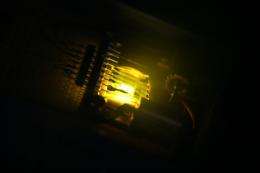
With the use of the new super material graphene, Swedish and American researchers have succeeded in producing a new type of lighting component. It is inexpensive to produce and can be fully recycled.

The invention, which paves the way for glowing wallpaper made entirely of plastic, is published in the scientific journal by scientists at Linköping University and Umea University, in Sweden, and Rutgers, The State University of New Jersey.

Ultra-thin and electricity-saving organic light diodes, so-called OLEDs, have recently been introduced commercially in mobile phones, cameras, and super-thin TVs. An OLED consists of a light-generating layer of plastic placed between two electrodes, one of which must be transparent. Today’s OLEDs have two drawbacks - they are relatively expensive to produce, and the transparent electrode consists of the metal alloy indium tin oxide. The latter presents a problem because indium is both rare and expensive and moreover is complicated to recycle. Now researchers at Linköping and Umeľ universities, working with American colleagues, are presenting an alternative to OLEDs, an organic light-emitting electrochemical cell (LEC). It is inexpensive to produce, and the transparent electrode is made of the carbon material graphene.

“This is a major step forward in the development of organic lighting components, from both a technological and an environmental perspective. Organic electronics components promise to become extremely common in exciting new applications in the future, but this can create major recycling problems. By using graphene instead of conventional metal electrodes, components of the future will be much easier to recycle and thereby environmentally attractive,” says one of the scientists, Nathaniel Robinson from Linköping University.

Since all the LEC’s parts can be produced from liquid solutions, it will also be possible to make LECs in a roll-to-roll process on, for example, a printing press in a highly cost-effective way.

“This paves the way for inexpensive production of entirely plastic-based lighting and display components in the form of large flexible sheets. This kind of illumination or display can be rolled up or can be applied as wallpaper or on ceilings,” says another of the scientists, Ludvig Edman from Umeľ University.

Graphene consists of a single layer of carbon atoms and has many attractive properties as an electronic material. It has high conductivity, is virtually transparent, and can moreover be produced as a solution in the form of graphene oxide.

Researchers all over the world have been trying to replace indium tin oxide for more than 15 years. Indium is in short supply, and the alloy has a complicated life cycle. The raw material for the fully organic and metal-free LEC, on the other hand, is inexhaustible and can be fully recycled - as fuel, for example.

More information: The study is published in the journal ACS Nano and is titled “Graphene and mobile ions: the key to all-plastic, solution-processed light-emitting devices.” http://pubs.acs.or … 21/nn9018569

Provided by Umea University

4.9 /5 (25 votes)  

Filter


Move the slider to adjust rank threshold, so that you can hide some of the comments.


Display comments: newest first

plasticpower
Feb 05, 2010

Rank: 4.5 / 5 (2)
This is great news. OLED screens have unmatched picture quality, and I would love to see the day when my walls are made out of the stuff! Brings a whole new meaning to the words "xbox 360" :D
mrlewish
Feb 06, 2010

Rank: 4 / 5 (1)
A word of caution. I remember reading about OLED research back in the 90s. They said it would be much cheaper to produce once they got the production down... and the technicalities worked out. You can see how that turned out. inexpensive they said.
dan42day
Feb 07, 2010

Rank: 4 / 5 (3)
dirk -
You need to read the article about liquid glass, you'd almost have to assume that if you mixed it with graphene you would get fusion power AND warp drive.
Rank 4.9 /5 (25 votes)
Relevant PhysicsForums posts

More news stories

New kind of solar cell could capture significantly more energy than current cells

New solar cells could increase the maximum efficiency of solar panels by over 25%, according to scientists from the University of Cambridge.

Nanotechnology / Nanophysics

created 12 hours ago | popularity 4.8 / 5 (5) | comments 13 | with audio podcast

Revealing how a battery material works

Since its discovery 15 years ago, lithium iron phosphate (LiFePO4) has become one of the most promising materials for rechargeable batteries because of its stability, durability, safety and ability to deliver ...

Nanotechnology / Nanomaterials

created 17 hours ago | popularity 5 / 5 (5) | comments 0 | with audio podcast

'Shish kebab' structure provides improved form of 'buckypaper'

Scientists are reporting development of a new form of buckypaper, which eliminates a major drawback of these sheets of carbon nanotubes -- 50,000 times thinner than a human hair, 10 times lighter than steel, ...

Nanotechnology / Nanomaterials

created 10 hours ago | popularity not rated yet | comments 0 | with audio podcast

Will bubble-powered microrockets zoom through the human stomach?

Scientists have developed a new kind of tiny motor — which they term a "microrocket" — that can propel itself through acidic environments, such as the human stomach, without any external energy source, ...

Nanotechnology / Nanomaterials

created 11 hours ago | popularity not rated yet | comments 0

Nanoshell whispering galleries improve thin solar panels

Visitors to Statuary Hall in the U.S. Capitol Building may have experienced a curious acoustic feature that allows a person to whisper softly at one side of the cavernous, half-domed room and for another on ...

Nanotechnology / Nanomaterials

created Feb 07, 2012 | popularity 4.2 / 5 (5) | comments 6 | with audio podcast


Astronomy team discovers nearby dwarf galaxy

(PhysOrg.com) -- A team led by UCLA research astronomer Michael Rich has used a unique telescope to discover a previously unknown companion to the nearby galaxy NGC 4449, which is some 12.5 million light years ...

Amasia: As next supercontinent forms, Arctic Ocean, Caribbean will vanish first

(PhysOrg.com) -- Geologists at Yale University have proposed a new theory to describe the formation of supercontinents, the epic process by which Earth’s major continental blocks combine into a single ...

Why are there so few fish in the Earth's oceans?

(PhysOrg.com) -- A Stony Brook University researcher has found that, contrary to popular belief, there are not plenty of fish in the sea.

Transparent iron? For the first time, an experiment shows that atomic nuclei can become transparent

At the high-brilliance synchrotron light source PETRA III, a team of DESY scientists headed by Dr. Ralf Röhlsberger has succeeded in making atomic nuclei transparent with the help of X-ray light. At the ...

Physicists build highly efficient 'no-waste' laser

A team of University of California, San Diego researchers has built the smallest room-temperature nanolaser to date, as well as an even more startling device: a highly efficient, "thresholdless" laser that ...

Scientists strengthen memory by stimulating key site in brain

Ever gone to the movies and forgotten where you parked the car? New UCLA research may one day help you improve your memory.