IBM Scientists Demonstrate World's Fastest Graphene Transistor
February 5, 2010
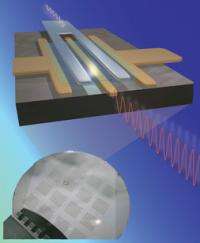
(PhysOrg.com) -- In a just-published paper in the magazine Science, IBM researchers demonstrated a radio-frequency graphene transistor with the highest cut-off frequency achieved so far for any graphene device - 100 billion cycles/second (100 GigaHertz).
This accomplishment is a key milestone for the Carbon Electronics for RF Applications (CERA) program funded by DARPA, in an effort to develop next-generation communication devices.
The high frequency record was achieved using wafer-scale, epitaxially grown graphene using processing technology compatible to that used in advanced silicon device fabrication.
"A key advantage of graphene lies in the very high speeds in which electrons propagate, which is essential for achieving high-speed, high-performance next generation transistors," said Dr. T.C. Chen, vice president, Science and Technology, IBM Research. "The breakthrough we are announcing demonstrates clearly that graphene can be utilized to produce high performance devices and integrated circuits."
Graphene is a single atom-thick layer of carbon atoms bonded in a hexagonal honeycomb-like arrangement. This two-dimensional form of carbon has unique electrical, optical, mechanical and thermal properties and its technological applications are being explored intensely.
Uniform and high-quality graphene wafers were synthesized by thermal decomposition of a silicon carbide (SiC) substrate. The graphene transistor itself utilized a metal top-gate architecture and a novel gate insulator stack involving a polymer and a high dielectric constant oxide. The gate length was modest, 240 nanometers, leaving plenty of space for further optimization of its performance by scaling down the gate length.
It is noteworthy that the frequency performance of the graphene device already exceeds the cut-off frequency of state-of-the-art silicon transistors of the same gate length (~ 40 GigaHertz). Similar performance was obtained from devices based on graphene obtained from natural graphite, proving that high performance can be obtained from graphene of different origins. Previously, the team had demonstrated graphene transistors with a cut-off frequency of 26 GigaHertz using graphene flakes extracted from natural graphite.
More information: Carbon Based Chips May One Day Replace Silicon Transistors: http://www.physorg … 4420861.html
Provided by IBM
-
Next generation devices get boost from graphene research
Jan 22, 2010 |
not rated yet |
0
-
AMO Manufactures First Graphene Transistors
Feb 08, 2007 |
not rated yet |
0
-
Carbon Based Chips May One Day Replace Silicon Transistors
Feb 03, 2010 |
not rated yet |
0
-
Unzipping Carbon Nanotubes Can Make Graphene Ribbons
Apr 20, 2009 |
not rated yet |
0
-
Fujitsu Develops Technology for Low-Temperature Full-Service Direct Formation of Graphene Transistors on Large-Scale Sub
Nov 27, 2009 |
not rated yet |
0
-
Engineers build first sub-10-nm carbon nanotube transistor
Feb 01, 2012 |
4.9 / 5 (31) |
30
-
Something old, something new: Evolution and the structural divergence of duplicate genes
Jan 31, 2012 |
4.6 / 5 (7) |
1
-
The hidden nanoworld of ice crystals: Revealing the dynamic behavior of quasi-liquid layers
Jan 30, 2012 |
5 / 5 (3) |
1
-
Stock market network reveals investor clustering
Jan 27, 2012 |
3.9 / 5 (23) |
8
-
Of microchemistry and molecules: Electronic microfluidic device synthesizes biocompatible probes
Jan 26, 2012 |
5 / 5 (1) |
0
-
Strength of induced magnetic field inside an inductor
2 hours ago
-
Physical laws .... are they material?!!
3 hours ago
-
increasing time of daylight
3 hours ago
-
Light & Sight
4 hours ago
-
Wind Turbine Power
7 hours ago
-
Steam Table issues
9 hours ago
- More from Physics Forums - General Physics
More news stories
What lies beneath: Mapping hidden nanostructures
The ability to diagnose and predict the properties of materials is vital, particularly in the expanding field of nanotechnology. Electron and atom-probe microscopy can categorize atoms in thin sheets of material, ...
6 hours ago |
5 / 5 (1) |
1
'Dark plasmons' transmit energy
Microscopic channels of gold nanoparticles have the ability to transmit electromagnetic energy that starts as light and propagates via "dark plasmons," according to researchers at Rice University.
23 hours ago |
5 / 5 (6) |
1
|
New kind of solar cell could capture significantly more energy than current cells
New solar cells could increase the maximum efficiency of solar panels by over 25%, according to scientists from the University of Cambridge.
Feb 08, 2012 |
4.5 / 5 (12) |
14
|
Nanoshell whispering galleries improve thin solar panels
Visitors to Statuary Hall in the U.S. Capitol Building may have experienced a curious acoustic feature that allows a person to whisper softly at one side of the cavernous, half-domed room and for another on ...
Nanotechnology / Nanomaterials
Feb 07, 2012 |
4.3 / 5 (6) |
6
|
Nanotube therapy takes aim at breast cancer stem cells
Wake Forest Baptist Medical Center researchers have again proven that injecting multiwalled carbon nanotubes (MWCNTs) into tumors and heating them with a quick, 30-second laser treatment can kill them.
Nanotechnology / Bio & Medicine
Feb 09, 2012 |
5 / 5 (1) |
0
|
Complex wiring of the nervous system may rely on a just a handful of genes and proteins
Researchers at the Salk Institute have discovered a startling feature of early brain development that helps to explain how complex neuron wiring patterns are programmed using just a handful of critical genes. ...
CIA website offline, Anonymous takes credit
The website of the Central Intelligence Agency was unresponsive on Friday after the hacker group Anonymous claimed to have knocked it offline.
Q&A: Obama and the birth control controversy
(AP) -- What birth control debate? A half-century after the introduction of the pill, acceptance of birth control by American women is virtually universal.
The power of estrogen -- male snakes attract other males
A new study has shown that boosting the estrogen levels of male garter snakes causes them to secrete the same pheromones that females use to attract suitors, and turned the males into just about the sexiest ...
New error-correcting codes guarantee the fastest possible rate of data transmission
Error-correcting codes are one of the triumphs of the digital age. Theyre a way of encoding information so that it can be transmitted across a communication channel such as an optical fiber o ...
Humans may have helped the decline of African rainforests 3000 years ago
(PhysOrg.com) -- Large areas of rainforests in Central Africa mysteriously disappeared over three thousand years ago, to be replaced by savannas. The prevailing theory has been that the cause was a change ...
Feb 05, 2010
Rank: 2.7 / 5 (3)
...ok...who needs quantum computers?!?
Feb 05, 2010
Rank: 3.8 / 5 (4)
Remember when the 486 was way faster than anything we needed? Now my 2.4 GHz computer is SOOOOOO slow!
Feb 05, 2010
Rank: 4.5 / 5 (2)
What a performance improvement. In 1995 100MHz was good, now is 2010 a 3GHz Quad core is good but to have 100GHz! It really looks as though Moore's Law really is starting to accelerate to infinity...
I love technology!
Feb 05, 2010
Rank: 4.8 / 5 (5)
Feb 05, 2010
Rank: 5 / 5 (4)
Feb 05, 2010
Rank: 4.5 / 5 (4)
Feb 05, 2010
Rank: 2.2 / 5 (5)
Feb 05, 2010
Rank: not rated yet
I wonder what is the tensil strengh of a 1 atom thick flake???
Feb 05, 2010
Rank: 1.3 / 5 (4)
Yeah, I don't know why every new version of Windows seems to require about 10 times more RAM than the previous version, even though it doesn't even "do" anything new.
Feb 05, 2010
Rank: 4.5 / 5 (4)
Don't confuse core clocks with transistor speeds. A CPU's core clock is determined by the execution time of the CPU's slowest pipeline stage. Each pipeline stage consists of thousands of transistors, many of them connected in series. Thus, the overall clock speed is governed by a collective performance of the entire transistor chain, rather than any single transistor.
Even with 100 GHz transistors, core clock speeds probably won't exceed 10 GHz or so (e.g. if the longest pipeline stage is 10 transistors deep.)
And this is before even considering other slowdowns, due to "cable effects" (capacitance and inductance) of the interconnects between transistors (i.e. the "wires" in the circuit.) Light-based circuits may help somewhat with long-distance connections, but not over shorter distances. Plus there will be delays in optical/electric trans-modulation...
Feb 05, 2010
Rank: 2 / 5 (1)
Feb 05, 2010
Rank: 2.2 / 5 (5)
Feb 05, 2010
Rank: 2.5 / 5 (4)
Ideally, everything would be written at the lowest level, but it takes a one in a million genius to do that even for programs that would be relatively small for our modern standards.
Creating this bulletin board from scratch in php or a similar scripting language is a very large project for any one person or even small group of people.
Making this thing in machine code directly, without compilers and interpreters, would be well...completely unfathomable...It's hard enough to comprehend in a "fifth generation" language...
Feb 05, 2010
Rank: 3 / 5 (1)
Feb 06, 2010
Rank: 3.7 / 5 (3)
Quantum computers can solve certain classes of problems much faster than today's computers. In fact, there is no polynomial expression you can write that is larger than the potential speedup from quantum computers. Ten to the one-hundredth power (a google) is a polynomial, so is ten to the google.
You might think that this is hyperbole, and no one would want to solve such a problem. Wrong! Even for very simple computer programs, the question of whether they will halt for any input may be in this class. Technically the general halting problem is unsolvable. But it is possible to write programs that are not expected to crash. Proving that though, in any reasonable time for a large program such as an operating system, will take a quantum computer. (And, yes you want to avoid livelocks as well as deadlocks and other types of crashes. Fine. The problem is that theorem proving for non-toy programs takes way too long.)
Feb 06, 2010
Rank: 4 / 5 (2)
Feb 06, 2010
Rank: 2.5 / 5 (2)
Feb 06, 2010
Rank: 2 / 5 (1)
So far, I have yet to see a "quantum algorithm" that gives a truly reliable computation.
You see these articles talking about "well, the result has a 90% chance of being right," and things like this. Further, most of the algorithms I've seen amount to gimmick algorithms that only work if you already know the output, and only on a specialized machine designed to run just that algorithm...which is largely useless for practical computing purposes. (see next post I address this further.)
In our modern electronic computers, the result of a computation is always 100% correct, and the only source of error is either from bad human input or a mechanical malfunction(something broke down.)
The other thing is, the principle of superposition is not "magic". No matter how many quantum states a particle has, you still need detectors to "read" those states without influencing the other state(s) the particle has, else you destroy your data every time you check your data.
Feb 06, 2010
Rank: 2 / 5 (1)
Suppose we have a "Quantum Server".
We might place different types of quantum processors on the "motherboard" for different purposes, and then the CPU queries a different type of processor depending on the algorithm or portion of an algorithm it needs computed...
Even this would leave the computer only able to solve problems which can be reduced to a specific set of algorithms.
Next, in terms of data storage (RAM and ROM,) a "Qubit" is only better than a "bit" if the space required for the data storage itself and the detectors and logic to read it remain smaller than the space required for a normal transistor or magnetic dot on a disk.
While in theory, "Base 3" from Qubits could allow exponentially more data storage per unit of space, this is of course only considering an "ideal" spintronic RAM or ROM device. A real device would have much space used by detectors to read and transmit data.
Feb 07, 2010
Rank: 5 / 5 (1)
The biggest benefit of quantum computing will be in simulating quantum systems - things like molecules, nanoparticles and biological processes. It will take time for quantum computers to be powerful enough to do this, but then, ENIAC wouldn't be much use doing today's CAD.
Feb 08, 2010
Rank: not rated yet
This article adds support for graphene as worthy of further research is all. All they succeeded in doing was proving that it would be possible and likely efficient to make transistors on graphene. That's a good reason to invest in science to study it further, but a very long ways from sitting on your desktop.
Feb 08, 2010
Rank: not rated yet
You need to better keep up with recent developments =)
Check this out:
http://www.physor...407.html
Feb 09, 2010
Rank: not rated yet
And lets say you are AMD and don;t use a frontside bus -- you still need RAM to be aviable at close to 40Ghz right???
Feb 09, 2010
Rank: not rated yet
Feb 09, 2010
Rank: not rated yet
Feb 10, 2010
Rank: not rated yet