US publishers smile again as Kindle rivals emerge
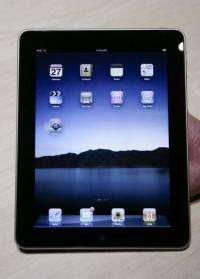
February 7, 2010 by Charlotte Raab Apple Inc.'s new iPad, which doubles as a full-color e-reader of books, newspapers and magazines

Enlarge

Apple Inc.'s new iPad, which doubles as a full-color e-reader of books, newspapers and magazines. US book publishers are smiling again, after years of watching digital versions of their titles sell for below what they thought they were worth.

US book publishers are smiling again, after years of watching digital versions of their titles sell for below what they thought they were worth.

A host of rivals to the market-dominating Kindle has given newfound hope to publishers that they will finally be able to dictate their own terms after being at the mercy of Amazon.

, whose . stable includes publisher Harper-Collins, could hardly contain his glee during an earnings call last week.

"Without content, the ever larger and flatter screens, the tablets, the e-readers and the increasingly sophisticated mobile phones would be lifeless," Murdoch said. "Without content these ingenious and wonderful devices would be unloved and unsold."

One new arrival in particular has Murdoch and other publishers excited -- Apple's iPad , which doubles as a full-color e-reader of books, newspapers and magazines.

"We're at a happy point, not just with Apple, but with Barnes & Noble and the 'Nook,' the 23 devices that have been launched, and Google Books seems to be just around the corner," a source in the publishing industry said.

"Now we have that many more distribution outlets coming," said the source, who requested anonymity out of fear of antagonizing Amazon, which may be facing competition but remains the undisputed e-book leader.

Although the iPad will not be available to consumers until the end of March, Apple is shaking up the digital book market like it did the music industry with the iPod and iTunes music store.

Unveiling the iPad, Apple chief executive Steve Jobs announced deals with five major publishers and an agreement that allows publishers to set higher prices while Apple settles for a 30-percent cut.

The so-called "agency model" is a departure from the way Amazon has been doing business with .

Since the release of the Kindle two years ago, Amazon has sold digital versions of hardcover new releases and bestsellers for 9.99 dollars, a move primarily aimed at driving sales of the online retail giant's e-reader.

Publishers were generally opposed, believing the price too low, but were not in a position to argue while Amazon was the only game in town.

That is no longer the case and the revolt against Amazon was immediate.

Just days after the wraps were taken off the iPad, Macmillan informed Amazon it wanted to begin charging between 12.99 and 14.99 dollars for e-book versions of most hardcover new releases and bestsellers.

Macmillan said it would give Amazon a 30-percent cut, as with Apple.

Amazon protested, temporarily pulling Macmillan titles -- both print and e-books -- from its online bookstore, but acknowledged that "ultimately, however, we will have to capitulate and accept Macmillan's terms."

Another major publisher, Hachette Book Group, quickly followed Macmillan.

"It's important to note that we are not looking to the agency model as a way to make more money on e-books," Hachette chairman and chief executive David Young said in a letter to literary agents.

"In fact, we make less on each e-book sale under the new model," he said. "We're willing to accept lower return for e-book sales as we control the value of our product -- books, and content in general.

"We're taking the long view on e-book pricing, and this new model helps protect the long-term viability of the book marketplace," Young said.

Gartner analyst Allen Weiner said it remains to be seen whether consumers, having gotten used to paying 9.99 dollars for a bestseller or a new release, will pay more.

"The precedent may have already been set," Weiner said. "Consumers may not pay more than 12 dollars."

"The damage that Amazon has done may be irreparable," he said. "The cow is out of the barn. I don't know how you get the cow back in the barn."

At the same time though, "we're in the process of having all distribution lines and pricing models redrawn," Weiner said. "It's Chapter One in all of this, but it may or may not dictate what happens at the end."

(c) 2010 AFP


Rate this story - 1 /5 (1 vote)

Rank Filter

Move the slider to adjust rank threshold, so that you can hide some of the comments.


Display comments: newest first

  • GLynn - Feb 07, 2010
    • Rank: not rated yet
    Pure greed, with electronic books there is no printing cost or distribution costs, only royalities and editing costs,(perhaps advertising costs.)
  • Noumenon - Feb 07, 2010
    • Rank: not rated yet
    Untrue. Clearly Amazon and Apple are taking a major % cut from publishers for doing nothing but allowing publishers to DISTRIBUTE on their devices. Also, it appears Amazon even dictates what publishers can even charge. I'd rather support the content providers than the redundant device makers.
  • Noumenon - Feb 07, 2010
    • Rank: not rated yet
    Publishers should band together and sell their books in a non-proprietary format at their own web sites instead of accepting the terms of the e-book format scam. Secondly, why on earth pay Apple anything,.. the iPad will be capable of displaying a multitude of formats, and iTunes is only one speck on the Internet.
  • mdulcey - Feb 07, 2010
    • Rank: 5 / 5 (1)
    The basic problem is that ebooks aren't WORTH more than the $10 that Amazon wants to charge. They deliver less value to the reader because they can't be resold or given away, and because the reader needs cooperation from the ebook provider (because of DRM) to be able to read the book. Furthermore, at the $10 price the publisher is making nearly as much money as they make on a $25 hardcover sale (they get $7 out of the $10 and incur no costs, whereas they get only 50-60% of the price of a hardcover and then also have to print, warehouse, and deliver the book).

    What this is really about is publishers trying to slow down the growth of ebooks by overpricing them. Publishers don't want ebooks to take over because they will be disintermediated... writers will contract with Amazon and Apple directly and the current publishers will be history.
  • Noumenon - Feb 08, 2010
    • Rank: not rated yet
    I agree with your analysis for the most part, but find it necessary to support the publishers in this, as they provide a service by determining which books are worthy of publication to their standards of quality, they put their name of approval on it. Amazon and Apple would allow any dipstick and his uncle to "publish" a book and flood the e-book market making it a nightmare for consumers; see iPhone Apps for proof.

    E-books have their place for say cheap throw away novels or one-read text books, but publishers are not going away IMO.
  • Intheory - Feb 08, 2010
    • Rank: not rated yet

February 7, 2010 all stories

Comments: 6

1 /5 (1 vote)

  • hide
  • Related Stories

  • Amazon.com to capitulate to Macmillan price demand
    created Feb 01, 2010 | popularity not rated yet | comments 0
  • Macmillan books coming back to Amazon
    created Feb 06, 2010 | popularity not rated yet | comments 0
  • Books pulled from Amazon.com in pricing dispute
    created Jan 30, 2010 | popularity not rated yet | comments 0
  • Amazon shares slip; Macmillan titles still missing
    created Feb 01, 2010 | popularity not rated yet | comments 0
  • Amazon offers new royalty program for Kindle books
    created Jan 20, 2010 | popularity not rated yet | comments 0


  • hide
  • Relevant PhysicsForums posts

  • The first and second law of thermodynamics
    created 21 hours ago
  • sensor fusion using extended kalman filter
    created 22 hours ago
  • Pressure Vessel End Cap Velocity
    created Sep 07, 2010
  • Learn a language
    created Sep 07, 2010
  • What's the meaning of this equation
    created Sep 07, 2010
  • 12 volt generation of a sustained arc
    created Sep 07, 2010
  • More from Physics Forums - General Engineering

Other News

Hyundai Motor unveiled South Korea's first full-speed electric car

Hyundai unveils South Korea's first electric car

Technology / Energy

created 7 minutes ago | popularity not rated yet | comments 0

Hyundai Motor Thursday unveiled South Korea's first full-speed electric car, designed to tap into the increasingly competitive electric auto market, hailed as the industry's future.


Quick Hit football video game gets NFL makeover (AP)

Quick Hit football video game gets NFL makeover

Technology / Software

created 23 minutes ago | popularity not rated yet | comments 0

(AP) -- Thursday marks the kickoff of the 2010 NFL season, and along with it, a renewed interest in fantasy leagues and video games that let Monday-morning quarterbacks feel as if they're part of the action.


Google search accelerates with 'instant' results (AP)

Google unveils faster Internet search (Update 2)

Technology / Internet

created 15 hours ago | popularity 4 / 5 (4) | comments 7

Internet powerhouse Google is giving Web searchers the thrill of speed with a turbocharged engine that displays suggested Web links as fast as a person can type.


Microsoft gets legal might to take down spam botnets

Technology / Internet

created 19 hours ago | popularity 4.8 / 5 (10) | comments 6

With a judicial assist, Microsoft has perfected a new superweapon to shoot down botnets, the engines cybergangs use to deliver malicious Internet attacks.


Research predicts path of lost hikers

Computer models predicts path of lost hikers

Technology / Computer Sciences

created 13 hours ago | popularity not rated yet | comments 2 | with audio podcast

(PhysOrg.com) -- The next time a Boy Scout is lost in the wilderness, search and rescue teams could have better statistics on their side in deciding where to look.