Space shuttle blasts off on last night flight
February 8, 2010 By MARCIA DUNN , AP Aerospace Writer
NASA fuels space shuttle 2nd time, clouds back (AP)

Enlarge

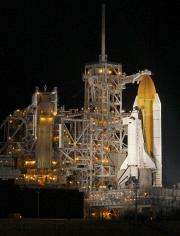
Space shuttle Endeavour stands ready on launch pad 39A as preparations for it's launch are finalized at the Kennedy Space Center in Cape Canaveral, Fla., Saturday, Feb. 6, 2010. Endeavour, with a crew of six astronauts is set to launch early Sunday to the International Space Station.(AP Photo/John Raoux)

(AP) -- Endeavour and six astronauts rocketed into orbit Monday on what's expected to be the last nighttime launch for the shuttle program, hauling a new room and observation deck for the International Space Station.

The space shuttle took flight before dawn, igniting the sky with a brilliant flash seen for miles around. The weather cooperated at the last minute; Sunday morning's try was thwarted by thick, low clouds that returned and almost caused another delay.

"Looks like the weather came together tonight," launch director Mike Leinbach told the astronauts right before liftoff. "It's time to go fly."

"We'll see you in a couple weeks," replied commander George Zamka. He repeated: "It's time to go fly."

Endeavour's destination - the space station, home to five men - was soaring over Romania at the time of liftoff. The shuttle is set to arrive at the station early Wednesday.

Zamka and his crew will deliver and install Tranquility, a new room that will eventually house life-support equipment, exercise machines and a toilet, as well as a seven-windowed dome. The lookout has the biggest window ever sent into space, a circle 31 inches across.

It will be the last major construction job at the space station. No more big pieces like that are left to fly.

Both the new room and dome - together exceeding $400 million - were supplied by the European Space Agency.

NASA began fueling Endeavour on Sunday night just as the Super Bowl was kicking off to the south in Miami. The shuttle crew did not watch the game - neither did the launch team - but it was beamed up to the space station in case anyone there wanted to watch it.

The coin used in the opening toss flew to the space station in November, aboard Atlantis.

Endeavour's launch also was broadcast to the space station residents, who got to watch it live.

Monday morning's countdown ended up being uneventful, except for a last-minute run to the launch pad. Astronaut Stephen Robinson forgot the binder holding all his flight data files, and the emergency red team had to rush it out to him, just before he climbed aboard. The launch team couldn't resist some gentle teasing.

The 13-day shuttle mission comes at one of the most agonizing times for NASA. Exactly one week ago, the space agency finally got its marching orders from President Barack Obama: Ditch the back-to-the-moon Constellation program and its Ares rockets, and pack on the research for an as-yet-unspecified rocket and destination.

NASA's boss, ex-astronaut Charles Bolden, favors Mars. But he, too, is waiting to hear how everything will play out.

The space station came out a winner in the Obama plan. The president's budget would keep the outpost flying until at least 2020, a major extension.

The spectacle of the night launch illuminating the sky attracted a crowd, including some members of Congress and federal big shots. Endeavour shot through some thin clouds on its way into orbit, and its bright flame was visible for several minutes from the launch site.

But the roads weren't nearly as jammed as they were the night before. More than 100 Europeans also were on hand because of the Italian-built Tranquility and domed cupola.

Within 15 minutes of taking off, the astronauts were enjoying "a beautiful sunrise" from orbit, with the moon as a backdrop. "Wish you could be here," Zamka called down. "Great show, Endeavour," replied Mission Control.

The four remaining shuttle flights to the station - in March, May, July and September - have daytime departures, at least for now. A significant delay could bump any of the launches into darkness. NASA has Obama's permission to bump a mission or two into 2011 if safety needs arise.

Given all the changes coming, the mood around the launching site was bittersweet.

The manager in charge of preparing Endeavour for launch, Dana Hutcherson, said everyone was excited to be part of the first launch of the new year.

"But let's face it, our KSC (Kennedy) team is going to have a challenging year ahead of us as the space shuttle is ending," she said. "It's not going to be easy for us."

Three spacewalks are planned during Endeavour's flight to hook up the new station compartments, beginning Thursday. The shuttle crew - five men and one woman, all Americans - will team up with the station residents to get the job done. Aboard the station are two Americans, two Russians and one Japanese.

Bolden sees that same blend of nations in NASA's future exploration efforts, whatever they are.

©2010 The Associated Press. All rights reserved. This material may not be published, broadcast, rewritten or redistributed.

Filter


Move the slider to adjust rank threshold, so that you can hide some of the comments.


Display comments: newest first

joefarah
Feb 08, 2010

Rank: 5 / 5 (1)
The Space Shuttle is Great! Running with almost no problems these days... But the Ares V is what NASA needs - nothing less. ARES V IS A MUST! Look at cargo capacities below. It's fine to move manned flight to commercial, once it has been demonstrated. Transfer to larger vessels for Trans Lunar/Mars Injection can happen after Ares V lofts those crafts/bases. Cargo Capacity:

Cargo Capacity (Metric Tons):
Space Shuttle
LEO 25
GTO 4

Space X Falcon 9
LEO 10.5
GTO 4.5

Space X Falcon 9 Heavy
LEO 32
GTO 19.5

Ares V
LEO 188 / 148
TLI 71 / 61

Delta IV Heavy
LEO 26
GTO 11

Atlas V Heavy
LEO 29.5
GTO 13

Saturn V
LEO 118
Lunar Vicinity 47

Energia (Russian)
LEO 100
GSO 20

Space Station Mass (LEO 200mi): 345 Metric Tons

To put in perspective, Ares V could lift the entire ISS in two launches, including extra supplies. Sad day if Congress cancels this program.
freethinking
Feb 08, 2010

Rank: 1 / 5 (2)
I'm not a fan of the space shuttle as it is based on 60/70's technologies. But it is a sad day in the US when it is retired and the US has no means to put anyone into orbit.

For those of you who think Government is the answer to problems, NASA is an example of the problems with government. They may every once and a while succeed at something, but they cannot plan ahead, you cant trust them to improve things, and they will leave you high and dry.

Once the shuttle is grounded, it wouldn't supprise me that India launches a person into space before the US does.
Sanescience
Feb 08, 2010

Rank: 3 / 5 (2)
I would be more interested in a cost to weight ratio than just raw lifting power. Ginormous payloads also have the potential for more catastrophic failure. Imagine if half the ISS was lost with one Ares V failure, incremental lifting has definite benefits.
Rank 5 /5 (2 votes)
Related Stories
Relevant PhysicsForums posts
  • Titan's lack of impact craters
    created23 hours ago
  • Real pictures of black hole eating a star?
    createdFeb 08, 2012
  • Hypothetical way to travel faster than light, but not technically exceed lightspeed
    createdFeb 06, 2012
  • How do scientists monitor the Sun's activity?
    createdFeb 05, 2012
  • Search patterns in observational studies
    createdFeb 05, 2012
  • Derivation of Pogson's law
    createdFeb 03, 2012
  • More from Physics Forums - General Astronomy

More news stories

Sandy streets over the Atlantic

Thick dust from the Sahara blowing over the ocean off the western coast of Africa encounters the islands of Cape Verde, forming a wake of swirling “vortex streets” visible by satellite.

Space & Earth / Earth Sciences

created 48 minutes ago | popularity not rated yet | comments 0

Domestic consumption main contributor to Africa's growing e-waste

West Africa faces a rising tide of e-waste generated by domestic consumption of new and used electrical and electronic equipment, according to a new United Nations report. Domestic consumption makes up the majority (up to ...

Space & Earth / Environment

created 20 minutes ago | popularity not rated yet | comments 0

Could Venus be shifting gear?

(PhysOrg.com) -- ESA’s Venus Express spacecraft has discovered that our cloud-covered neighbour spins a little slower than previously measured. Peering through the dense atmosphere in the infrared, the ...

Space & Earth / Space Exploration

created 1 hour ago | popularity 5 / 5 (3) | comments 2 | with audio podcast

Humans may have helped the decline of African rainforests 3000 years ago

(PhysOrg.com) -- Large areas of rainforests in Central Africa mysteriously disappeared over three thousand years ago, to be replaced by savannas. The prevailing theory has been that the cause was a change ...

Space & Earth / Environment

created 5 hours ago | popularity 5 / 5 (2) | comments 1 | with audio podcast report

Clam fields found at deep, low-temperature Mariana vents

(PhysOrg.com) -- Scientists have marveled at the unusual life forms thriving at high temperature hydrothermal vents of the deep ocean.

Space & Earth / Earth Sciences

created 1 hour ago | popularity not rated yet | comments 0 | with audio podcast


The power of estrogen -- male snakes attract other males

A new study has shown that boosting the estrogen levels of male garter snakes causes them to secrete the same pheromones that females use to attract suitors, and turned the males into just about the sexiest ...

Experts reveal how plants don't get sunburn

(PhysOrg.com) -- Experts at the University of Glasgow have discovered how plants survive the harmful rays of the sun.

Team isolates nerve cells involved in storing long term memory and gene proteins associated with them

(Medical Xpress) -- A research team in Taiwan has succeeded in isolating two nerve cells in fruit fly brains that are believed to be the major players in allowing for the formation of long term memories. Furthermore, ...

Fool's gold may prove an unlikely alternative to overexploited catalytic materials

Catalytic materials, which lower the energy barriers for chemical reactions, are used in everything from the commercial production of chemicals to catalytic converters in car engines. However, with current catalytic materials ...

SLAC, Stanford team focuses on high-energy electrons to treat cancer

Accelerator physicists at SLAC and cancer specialists from Stanford are working on a new technology that could dramatically reduce the time needed for cancer radiation treatments. The team ran an initial experiment ...

News of plaque-clearing drug tops week of major advances against Alzheimer's disease

In the last eight days, scientists have delivered a powerful one-two punch in the fight to defeat Alzheimer's disease. At the same time, the White House and members of Congress are proposing increases in Alzheimer's research ...