Freezing point of supercooled water varies with electric charge
February 8, 2010 by Lin Edwards ice

Enlarge

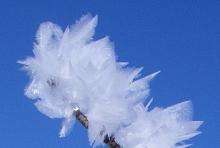
'Feather' ice. Image: Craig Thom, via Wikipedia

(PhysOrg.com) -- Just as water can be superheated and remain liquid above the boiling point if there is no nucleating surface (such as a surface defect or a speck of dust), it can also become supercooled and remain liquid well below its freezing point of 0°C. Now scientists have found that supercooled water freezes at different temperatures in the presence of a surface with a positive or negative charge.

In the absence of a charged surface supercooled water can freeze at temperatures as low as -40°C, and it has been known for over 150 years that the presence of an can affect the freezing point (a phenomenon known as electrofreezing). The dominant hypothesis for the effect is that because are polar, with a small negative charge at one end and a positive charge at the other, an electric field would align them according to their charge. It has been difficult to study this phenomenon because charged surfaces (such as metals) act as nucleating agents, and therefore trigger freezing.

Igor Lubomirsky and colleagues from the Weizmann Institute of Science in Rehovot, Israel, have solved the dilemma by creating a charge on a non-nucleating pyroelectric material surface, to allow the electrical effects alone to be examined.

The scientists used lithium tantalate (LiTaO3) and thin films of strontium titanate (SrTiO3) as the non-nucleating surfaces, and placed them in a humid room. They then cooled the room until formed on the surfaces and then lowered the temperature even further until the droplets froze.

The results showed that in the absence of an electric field the water droplets froze at an average of -12.5°C. If the surface was negatively charged the freezing point was -18°C, while if the surface was positively charged the droplets froze at -7°C. Lubomirsky said the difference in freezing temperatures was surprising. The exact mechanism is unclear, and the team are investigating.

They also found they could freeze liquid supercooled water by heating it. With the surface of an LiTaO3 crystal negatively charged, the water was kept liquid at -11ºC for around 10 minutes, but after the charge dissipated the temperature was increased to induce a positive charge on the surface, and the water froze at -8 ºC. Powder x-ray diffraction studies showed that freezing on the positive surface began at the solid/water interface, while on the negative surface freezing began at the air/ interface.

The experiments demonstrated that if the surface charge is controlled ice formation can be either enhanced or suppressed, and this could possibly have an application in the cryogenic freezing of tissues and blood, or in cloud seeding.

The study was published on February 5 in the journal Science.

More information: David Ehre, Etay Lavert, Meir Lahav and Igor Lubomirsky, Science, 2010, DOI:10.1126/science.1178085

© 2010 PhysOrg.com


Rate this story - 4.9 /5 (11 votes)

Rank Filter

Move the slider to adjust rank threshold, so that you can hide some of the comments.


Display comments: newest first

  • Mercury_01 - Feb 08, 2010
    • Rank: not rated yet
    Awesome observation! I never would have thought of it. seems like something we would have noticed long ago. Water really is some strange stuff. Its bonds form a kind of mutable structure even in the liquid state. Almost like a liquid crystal.

    and check out this curiosity. The test seems a bit small, but with a p value of .001, the results were highly statistically significant
    http://www.intern..._EXPLORE (2).pdf
  • Husky - Feb 09, 2010
    • Rank: not rated yet
    non-nucleating surfaces and negative charges could find use as ice prevention on airplane wings

February 8, 2010 all stories

Comments: 2

4.9 /5 (11 votes)


  • hide
  • Related Stories


  • hide
  • Relevant PhysicsForums posts

  • Potential energy separation curve
    created Sep 02, 2010
  • Coordination number in triangular lattice
    created Sep 02, 2010
  • Inertia
    created Sep 01, 2010
  • Traverse the brillouin zone
    created Sep 01, 2010
  • More from Physics Forums - Atomic, Solid State, Comp. Physics

Other News

quasar

Variations in fine-structure constant suggest laws of physics not the same everywhere

Physics / General Physics

created 10 hours ago | popularity 4.9 / 5 (30) | comments 20 | with audio podcast report

(PhysOrg.com) -- One of the most controversial questions in cosmology is why the fundamental constants of nature seem fine-tuned for life. One of these fundamental constants is the fine-structure constant, ...


'Slow light' on a chip holds promise for optical communications

Physics / Optics & Photonics

created 12 hours ago | popularity 4.8 / 5 (6) | comments 2 | with audio podcast

A tiny optical device built into a silicon chip has achieved the slowest light propagation on a chip to date, reducing the speed of light by a factor of 1,200 in a study reported in Nature Photonics (published online Septem ...


Glasperlenspiel: NIST scientists propose new test for gravity

Glasperlenspiel: Scientists propose new test for gravity

Physics / General Physics

created Sep 01, 2010 | popularity 4.6 / 5 (34) | comments 97 | with audio podcast

A new experiment proposed* by physicists at the National Institute of Standards and Technology may allow researchers to test the effects of gravity with unprecedented precision at very short distances -- a ...


Researchers discover how to conduct first test of 'untestable' string theory

New study suggests researchers can now test the 'theory of everything'

Physics / General Physics

created Sep 01, 2010 | popularity 4.3 / 5 (54) | comments 42 | with audio podcast

(PhysOrg.com) -- Researchers describe how to carry out the first experimental test of string theory in a paper published tomorrow in Physical Review Letters.


Radioactive decay rates vary with the sun's rotation: research

Physics / General Physics

created Aug 31, 2010 | popularity 4.5 / 5 (39) | comments 35 | with audio podcast

Radioactive decay rates, thought to be unique physical constants and counted on in such fields as medicine and anthropology, may be more variable than once thought.