Democracy put to the test
Developing countries that free themselves from authoritarian governments are often called “experiments in democracy.” But what happens when a researcher runs an actual field experiment in democracy? A novel study by MIT economist Benjamin Olken has provided surprising insights about the impact of democratic government in the developing world.
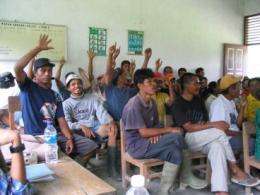
In fieldwork involving 49 Indonesian villages, Olken arranged to have major decisions on public-works projects in some settlements decided by plebiscite — in which all citizens get a vote — rather than by the traditional small councils of village leaders. Unexpectedly, the types of projects selected by majority vote were nearly identical to those picked by village elites; the voting public did not try to redistribute wealth to themselves. And yet when people were allowed to vote, they expressed greater contentment with the results than when decisions were simply handed down by the elites. The conclusion was that even if democracy doesn’t make a material difference in people’s lives, it creates greater civic cohesion.
“I expected more of a change in the outcomes,” says Olken, an associate professor in MIT’s Department of Economics. “But there is more satisfaction and potentially more legitimacy through these direct democratic institutions, as opposed to having a decision made by a small set of people.”
In turn, the study challenges a popular view in development economics: that “elite capture” of politics — the control of government decision-making by a small group — only enriches a select few. “I was thinking that giving more power to everyone could take away elite dominance,” notes Olken. “But that didn’t come out in the data.” Instead the results suggest two plausible ways of looking at local political elites, in Indonesia and elsewhere: “One is that elites are bad guys, trying to steal money for themselves,” says Olken. “The other is that elites are leaders doing a good job of making sure things are allocated the right way.”
Java, unscripted
Indonesia is a logical place to study political development, having thrown off the authoritarian Suharto regime in 1998 after 31 years of rule. Since then, the government has been exploring ways to decentralize politically.
Olken performed his study in 2005 and 2006 in three distinct rural subdistricts: The heavily Muslim area of East Java, the more Christian-populated North Sumatra, and a socially diverse region, Southeast Sulawesi. The median village size was about 1,500 households in Java, and about 230 in the other areas. Each village was given infrastructure projects to implement, often involving roads, sanitation and water. Where the projects were decided by plebiscite, about 80 percent of the village voted — a 20-fold increase in participation compared to the usual village meetings. All the villages are part of an Indonesian program, the Kecamatan Development Project (KDP), funded by the World Bank; Olken is also affiliated with the MIT-based Jameel Abdul Latif Poverty Action Lab, which backs field experiments in development economics.
The results, unveiled in a working paper, “Direct Democracy and Local Public Goods: Evidence from a Field Experiment in Indonesia,” will be published in the American Political Science Review later this year. By an 18 percent margin, villagers who voted were more likely to say the public works in question would benefit them, even when the projects were substantively similar to ones the village councils had chosen. Voting villagers were also more satisfied with the overall KDP program, by a margin of 13 percent, and were even more likely to contribute something of their own — money, labor or food — to the project, by a margin of 17 percent, indicating the greater enthusiasm generated by participatory democracy.
Olken’s study has earned him considerable notice among colleagues, who assert that no social scientist had previously conducted a randomized field experiment altering the political system used by people. “It represents the first effort to study real-world democracy in a natural setting where the stakes mean something to the participants,” says Donald Green, a professor of political science at Yale. And precisely because the villagers and the chiefs approved similar projects, the study uniquely isolates the question of how much democracy matters to people, even if it doesn’t add to their wealth.
In Green’s view, this result “can be taken two ways. If you think direct democracy is a sham, you note that it brings legitimacy without changing the distribution of goods. If you are a supporter of direct democracy, you also note that it brings legitimacy without changing the distribution of goods.” That is, if one’s goal is to change the distribution of wealth in a developing country, the results will appear disappointing and reflect poorly on direct democracy. But if one’s goal is to keep the distribution of wealth intact, the plebiscite system may offer a golden opportunity to do so while maintaining popular support.
Adding data points
Green also believes the issues raised by Olken’s study are “not specific to Indonesia; they apply to all decentralized governments.” That said, Olken himself offers a few caveats about the experiment. Because it was a one-time study, he allows, the small councils, knowing their decision-making would be scrutinized by outsiders, may have made generous decisions in an effort to make themselves look reasonable. Such potential backroom dealing could not be accounted for in the study.
Olken also observes that the usefulness of direct democracy can be affected by the question of what is voted on in the first place; California’s ballot-proposition system, he notes, receives criticism for allowing well-funded organizations to set its agenda. Moreover, plebiscites that clearly benefit or hurt certain subgroups — for instance, if a road were rerouted through existing property — could become bitterly contested. “Direct democracy can be very important in the right context,” says Olken. “But the question is: What exactly is the right context?”
Finally, Olken notes, “elite capture” may well be a real phenomenon in other places, even if it seemed absent in these Indonesian villages. “I don’t think we’ve disproven that elite capture is still a problem,” says Olken. “But maybe in some cases elites are doing good things as well. We’re adding data points to the discussion.”
Provided by Massachusetts Institute of Technology


