Composite nanomaterials show promise for solar hydrogen generation
February 8, 2010 By Tim Stephens
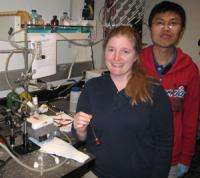
Graduate students Jennifer Hensel and Gongming Wang tested the performance of composite nanomaterials in PEC cells for hydrogen production. Photo by Yat Li.
(PhysOrg.com) -- A novel strategy for engineering semiconductor materials can boost the performance of water-splitting solar cells for hydrogen production, according to a new study by researchers at the University of California, Santa Cruz.
Using sunlight to split water into hydrogen and oxygen is potentially a clean and sustainable way to generate hydrogen for fuel-cell vehicles. Photovoltaic cells use solar energy to generate electricity, and electricity can be used to split water by electrolysis. But a more direct and efficient approach is provided by photoelectrochemical (PEC) cells, which use solar energy to generate hydrogen inside the cell itself.
The UCSC researchers focused on the semiconductor material used as a light-absorbing anode in the PEC cell. They combined two techniques--called elemental doping and quantum dot sensitization--that have been used to improve the performance of metal oxide semiconductors in solar cells. These techniques use nanotechnology to manipulate the structure of a material on the scale of billionths of a meter.
Previous work in the laboratory of Jin Zhang, professor of chemistry and biochemistry at UCSC, showed that this combination of techniques has a synergistic effect, markedly enhancing the performance of photovoltaic cells (see earlier story). In the new study, Zhang teamed up with Yat Li, assistant professor of chemistry and biochemistry, to test the same strategy in a PEC cell.
"Elemental doping and quantum dot sensitization are two different techniques that work well by themselves. We found that we can combine them to get a synergistic effect," Li said. "We not only extended this idea nicely to a photoelectrochemical cell for hydrogen generation, we also proposed a new model to explain the observed experimental data."
Zhang noted that more theoretical work is needed to fully understand the mechanisms involved. "Understanding the mechanisms will allow us to optimize the effects," he said. "The model we proposed in the first paper was very preliminary, but the new results have helped us refine our model."
The researchers reported their findings in the journal Nano Letters in a paper posted online on January 25. Lead authors of the paper were Jennifer Hensel, a graduate student in Zhang's lab, and Gongming Wang, a graduate student in Li's lab.
The researchers synthesized thin films of titanium dioxide nanoparticles, as well as titanium dioxide nanowire arrays vertically aligned in a thin film on a substrate. The titanium dioxide films were doped with nitrogen, and cadmium selenide nanoparticles were used for quantum dot sensitization. The resulting nanostructured composite materials were then used as photoanodes in a PEC cell to compare their performance in carefully controlled experiments.
The results are an important demonstration of the potential to improve the performance of photoelectrochemical cells, as well as photovoltaic solar cells, using carefully designed materials, Zhang said. "The key is that combining different approaches in a rational manner can significantly boost performance," he said.
More information: Paper: http://pubs.acs.or … 21/nl903217w
Provided by University of California - Santa Cruz (news : web)
-
Nanotechnology hold promise for new hydrogen fuel technologies
Jun 29, 2005 |
not rated yet |
0
-
Nanotechnology to Create Green Hydrogen
Sep 24, 2004 |
not rated yet |
0
-
Konarka and Evident to Develop Ultra High Performance Power Plastic
Mar 23, 2005 |
not rated yet |
0
-
Nanostructures for hydrogen production and storage
Nov 03, 2005 |
not rated yet |
0
-
Unprecedented efficiency in producing hydrogen from water
Dec 04, 2006 |
not rated yet |
0
-
Engineers build first sub-10-nm carbon nanotube transistor
Feb 01, 2012 |
4.9 / 5 (30) |
30
-
Something old, something new: Evolution and the structural divergence of duplicate genes
Jan 31, 2012 |
4.6 / 5 (7) |
1
-
The hidden nanoworld of ice crystals: Revealing the dynamic behavior of quasi-liquid layers
Jan 30, 2012 |
5 / 5 (3) |
1
-
Stock market network reveals investor clustering
Jan 27, 2012 |
3.9 / 5 (23) |
8
-
Of microchemistry and molecules: Electronic microfluidic device synthesizes biocompatible probes
Jan 26, 2012 |
5 / 5 (1) |
0
-
Corrosion Tests on Magnesium
4 hours ago
-
polyethylene copper nanocomposite
10 hours ago
-
Output of xrd analysis
Feb 08, 2012
-
Transport phenomena problem based on problems 18.B11 and 19B.6 from Bird, stewart, lw
Feb 06, 2012
-
Help with material selection - Car Piston
Feb 05, 2012
-
Name of the steel alloy?!!?
Feb 02, 2012
- More from Physics Forums - Materials & Chemical Engineering
More news stories
'Dark plasmons' transmit energy
Microscopic channels of gold nanoparticles have the ability to transmit electromagnetic energy that starts as light and propagates via "dark plasmons," according to researchers at Rice University.
39 minutes ago |
5 / 5 (1) |
0
|
Nanotube therapy takes aim at breast cancer stem cells
Wake Forest Baptist Medical Center researchers have again proven that injecting multiwalled carbon nanotubes (MWCNTs) into tumors and heating them with a quick, 30-second laser treatment can kill them.
Nanotechnology / Bio & Medicine
5 hours ago |
5 / 5 (1) |
0
|
Inspired by steel, nanomanufacturing gets wear-resistant carbide tip
(PhysOrg.com) -- Scientists at the University of Pennsylvania, the University of Wisconsin-Madison and IBM Research - Zurich have fabricated an ultrasharp silicon carbide tip possessing such high strength ...
10 hours ago |
5 / 5 (2) |
1
|
New technology platform for molecule-based electronics
Researchers at the Nano-Science Center at the University of Copenhagen have developed a new nano-technology platform for the development of molecule-based electronic components using the wonder material graphene. At the same ...
Nanotechnology / Nanomaterials
7 hours ago |
5 / 5 (2) |
0
Australians risking skin cancer to avoid nanoparticles
More than three in five Australians are concerned enough about the health implications of nanoparticles in sunscreens to want to know more about their impact. And while the initial scientific information released suggests ...
Nanotechnology / Bio & Medicine
9 hours ago |
5 / 5 (1) |
0
Cell biologists describes mechanism by which some people may be more susceptible to colon cancer
An international research team led by cell biologists at the University of California, Riverside has uncovered a new insight into colon cancer, the third leading cause of cancer-related deaths in the United ...
New method makes culture of complex tissue possible in any lab
Scientists at the University of California, San Diego have developed a new method for making scaffolds for culturing tissue in three-dimensional arrangements that mimic those in the body. This advance, published online in ...
Anyone can learn to be more inventive, cognitive researcher says
There will always be a wild and unpredictable quality to creativity and invention, says Anthony McCaffrey, a cognitive psychology researcher at the University of Massachusetts Amherst, because an "Aha moment" is rare and ...
NASA's TRMM satellite sees Cyclone Jasmine in 3-D
Data from NASA's TRMM satellite was used to create a 3-Dimensional look at Cyclone Jasmine, currently moving through the South Pacific Ocean.
New integrated building model may improve fish farming operations
Today's "locavore" movement with its emphasis on eating more locally-produced food is a natural fit for fruits and vegetables in nearly every region, but few entrepreneurs have dared to apply the concept to ...
FBI file: Steve Jobs was considered for govt post
(AP) -- FBI background interviews of some people who knew Apple co-founder Steve Jobs reveal a man driven by power and alienating some of the people who worked with him.
Feb 10, 2010
Rank: not rated yet
I wanted to tell you that I wrote to you on this site.
I hope that this truth do not disturb you but give you pleasant.
kind regards.
Federico (Italy)