No mere pipe dream
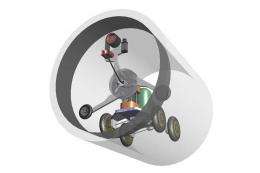
(PhysOrg.com) -- UCI engineers are working on robotic technology to rehabilitate the nation's aging water infrastructure.
The growing U.S. infrastructure crisis involves more than crumbling roads and bridges. Underground and out of sight looms a worsening problem every bit as critical.
Thousands of miles of aging water pipes are breaking down. Each day, according to the American Society of Civil Engineers — which periodically grades the country’s infrastructure — 6 billion gallons of clean, treated drinking water disappears, mostly due to old, leaky pipes and mains. That’s enough water to supply California for a year, according to Maria Feng, civil & environmental engineering professor at UC Irvine.
“This is a nationwide emergency,” she says. “Some pipelines are nearly 100 years old, and the problem is very serious, especially in urban areas, where it’s difficult to access leaking and burst pipes.”
A UCI engineering research team led by Feng is working with two companies to build a prototype robot that could repair and retrofit aging water pipes by applying a tough reinforcement material around their interiors - eliminating the need for costly excavation or replacement.
The public-private partnership also comprises Fibrwrap Construction Inc., a pioneer in the trenchless application of advanced composites for structural renovation, and Fyfe Company LLC, a global leader in the development of fiber-reinforced polymers for civil infrastructure rehabilitation.
“Currently, construction crews must dig trenches to find damaged pipe segments, which is a passive and expensive way of fixing the water system,” Feng says. “In cities, trenching can be impossible.”
It was announced in December that the $17.6 million robot project will receive $8.5 million over five years from the National Institute of Standards & Technology’s very competitive Technology Innovation Program, which supports high-risk, high-reward research addressing critical national needs, such as infrastructure monitoring and repair. Only 20 projects won TIP awards in 2009.
Simple robots have been used to inspect pipes for some time, but the task of robotically applying a carbon-fiber coating to the insides of old pipes with unpredictable flaws, imperfect shapes and uneven surfaces is a far bigger technical challenge, says Feng, whose UCI team includes Masanobu Shinozuka, Distinguished Professor and chair of civil & environmental engineering and a world-renowned expert in structural engineering.
So that the robot can find areas needing reinforcement, researchers are integrating into its design an advanced sensor system to gauge contact pressure against the pipe wall and trigger the application process. In 2008, Shinozuka won a TIP award to develop this water-pipe-damage-detecting technology. UCI is the only institution to have received TIP funding in both 2008 and 2009.
“This robot needs to be intelligent,” says Feng, who is internationally known for her invention of sensors that continually monitor the soundness of bridges, buildings and other structures. “It has to see and feel and constantly adjust to the pipe surface. Smart robots like this are very different from those used in manufacturing.”
She anticipates that the robot ultimately will adapt to various pipe sizes and conditions and be able to lay carbon-fiber coating 11 times faster than human crews.
“If this project is successful,” Feng says, “a commercialized robotic system could potentially save the U.S. economy about $245 billion and give the nation a lead in the growing world market for water infrastructure technology.”
Provided by UC Irvine


