Millimeter-scale, energy-harvesting sensor system developed
February 8, 2010
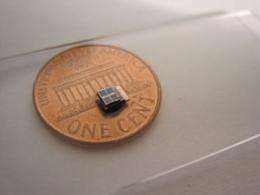
A low-power, sensor system developed at the University of Michigan 1,000 times smaller than comparable commercial counterparts. It could enable new biomedical implants. Photo by: Daeyeon Kim
(PhysOrg.com) -- A 9-cubic millimeter solar-powered sensor system developed at the University of Michigan is the smallest that can harvest energy from its surroundings to operate nearly perpetually.
The U-M system’s processor, solar cells, and battery are all contained in its tiny frame, which measures 2.5 by 3.5 by 1 millimeters. It is 1,000 times smaller than comparable commercial counterparts.
The system could enable new biomedical implants as well as home-, building- and bridge-monitoring devices. It could vastly improve the efficiency and cost of current environmental sensor networks designed to detect movement or track air and water quality.
With an industry-standard ARM Cortex-M3 processor, the system contains the lowest-powered commercial-class microcontroller. It uses about 2,000 times less power in sleep mode than its most energy-efficient counterpart on the market today.
The engineers say successful use of an ARM processor— the industry’s most popular 32-bit processor architecture—is an important step toward commercial adoption of this technology.
Greg Chen, a computer science and engineering doctoral student, will present the research Feb. 9 at the International Solid-State Circuits Conference in San Francisco.
“Our system can run nearly perpetually if periodically exposed to reasonable lighting conditions, even indoors,” said David Blaauw, an electrical and computer engineering professor. “Its only limiting factor is battery wear-out, but the battery would last many years.”
“The ARM Cortex-M3 processor has been widely adopted throughout the microcontroller industry for its low-power, energy efficient features such as deep sleep mode and Wake-Up Interrupt Controller, which enables the core to be placed in ultra-low leakage mode, returning to fully active mode almost instantaneously,” said Eric Schorn, vice president, marketing, processor division, ARM. “This implementation of the processor exploits all of those features to the maximum to achieve an ultra-low-power operation.”
The sensor spends most of its time in sleep mode, waking briefly every few minutes to take measurements. Its total average power consumption is less than 1 nanowatt. A nanowatt is one-billionth of a watt.
The developers say the key innovation is their method for managing power. The processor only needs about half of a volt to operate, but its low-voltage, thin-film Cymbet battery puts out close to 4 volts. The voltage, which is essentially the pressure of the electric current, must be reduced for the system to function most efficiently.
“If we used traditional methods, the voltage conversion process would have consumed many times more power than the processor itself uses,” said Dennis Sylvester, an associate professor in electrical and computer engineering.
One way the U-M engineers made the voltage conversion more efficient is by slowing the power management unit’s clock when the processor’s load is light.
“We skip beats if we determine the voltage is sufficiently stable,” Sylvester said.
The designers are working with doctors on potential medical applications. The system could enable less-invasive ways to monitor pressure changes in the eyes, brain, and in tumors in patients with glaucoma, head trauma, or cancer. In the body, the sensor could conceivably harvest energy from movement or heat, rather than light, the engineers say.
The inventors are working to commercialize the technology through a company led by Scott Hanson, a research fellow in the Department of Electrical Engineering and Computer Science.
The paper is entitled “Millimeter-Scale Nearly Perpetual Sensor System with Stacked Battery and Solar Cells.”
-
Intel Introduces First Dual-Core Low-Voltage Xeon Processor
Mar 14, 2006 |
not rated yet |
0
-
Intel Expands Mobile Processor Offerings For Mainstream And Value Market Segment
Apr 12, 2004 |
not rated yet |
0
-
National Semiconductor Introduces Flexible Power Management Unit for Portable Devices
Jan 05, 2005 |
not rated yet |
0
-
New Low-Power Intel Pentium M And Intel Celeron M Processors
Jul 20, 2004 |
not rated yet |
0
-
ARM Introduces Industry's Fastest Processor For Low-Power Mobile And Consumer Applications
Oct 04, 2005 |
not rated yet |
0
-
Engineers build first sub-10-nm carbon nanotube transistor
Feb 01, 2012 |
5 / 5 (21) |
19
-
Something old, something new: Evolution and the structural divergence of duplicate genes
Jan 31, 2012 |
4.6 / 5 (7) |
1
-
The hidden nanoworld of ice crystals: Revealing the dynamic behavior of quasi-liquid layers
Jan 30, 2012 |
5 / 5 (2) |
1
-
Stock market network reveals investor clustering
Jan 27, 2012 |
4.1 / 5 (21) |
8
-
Of microchemistry and molecules: Electronic microfluidic device synthesizes biocompatible probes
Jan 26, 2012 |
not rated yet |
0
-
Tennis Court Speed Measurement
12 hours ago
-
Fastest way to cool water
20 hours ago
-
Counter-weights
Feb 02, 2012
-
Composite electric glass heating elements
Feb 02, 2012
-
pipe stress analysis
Feb 02, 2012
-
Interested in average household energy consumption in 2011...
Feb 01, 2012
- More from Physics Forums - General Engineering
More news stories
New Nokia phone no standout, but worth a look
The first of Nokia's new generation of smartphones isn't flashy and certainly isn't an iPhone killer. But it's a nice device, and at $40 with a two-year contract, a bargain.
Electronics / Consumer & Gadgets
11 hours ago |
1 / 5 (2) |
2
Researchers find social robots require astute tuning to improve acceptability by the human mind
After years of existing only in fiction, social robots are finally being designed that can more closely emulate how people express themselves, interact and learn and doing so while performing jobs like teaching social ...
8 hours ago |
not rated yet |
0
GPS shoe lets families keep track of elderly relatives
A Teaneck, N.J., shoe maker has joined with a California technology company to create a shoe that uses GPS technology that records where a wearer walks - and can send alerts to caregivers if someone suffering from Alzheimer's ...
Electronics / Consumer & Gadgets
10 hours ago |
not rated yet |
0
Motorola: Some refurbished tablets weren't wiped
Motorola Mobility says about 100 Xoom tablet computers that it refurbished for sale on Woot.com may not have been properly wiped of the previous owners' data.
Electronics / Consumer & Gadgets
9 hours ago |
not rated yet |
1
A boom in smarter baby monitors
The cry has been heard: After 20 years with little change to baby monitoring devices, new designs premiered in January at the Consumer Electronics Show promising Wi-Fi connectivity and high-definition video that streams live ...
Electronics / Consumer & Gadgets
9 hours ago |
not rated yet |
0
Amazon fungi found that eat polyurethane, even without oxygen
(PhysOrg.com) -- Until now polyurethane has been considered non-biodegradable, but a group of students from Yale University in the US has found fungi that will not only eat and digest it, they will do so even in the absence ...
Scientists chart high-precision map of Milky Way's magnetic fields
(PhysOrg.com) -- Scientists at the Naval Research Laboratory (NRL) are part of an international team that has pooled their radio observations into a database, producing the highest precision map to date of ...
Whole exome sequencing identifies cause of metabolic disease
Sequencing a patient's entire genome to discover the source of his or her disease is not routine yet. But geneticists are getting close.
Hearing metaphors activates brain regions involved in sensory experience
When a friend tells you she had a rough day, do you feel sandpaper under your fingers? The brain may be replaying sensory experiences to help understand common metaphors, new research suggests.
Renowned physicist invents microscope that can peer at living brain cells
(PhysOrg.com) -- Ever since scientists began studying the brain, theyve wanted to get a better look at what was going on. Researchers have poked and prodded and looked at dead cells under electron microscopes, ...
New kind of high-temperature photonic crystal could someday power everything from smartphones to spacecraft
A team of MIT researchers has developed a way of making a high-temperature version of a kind of materials called photonic crystals, using metals such as tungsten or tantalum. The new materials which ...
Feb 08, 2010
Rank: not rated yet
"Our system can run nearly perpetually if periodically exposed to reasonable lighting conditions, even indoors"
I doubt it would be exposed to reasonable light if it's implanted in the body; or am I missing something, like a sunroof.
Feb 08, 2010
Rank: 5 / 5 (1)
Well, yes.
Imagine eye implants that are solar powered.
Imagine hearing aids that are solar powered.
Imagine a pace-maker or robotic prosthesis powered by a solar celled hat or jewelry.
So those are just solar, and within reason.
But then imagine implants that are perhaps powered by pH differences or other chemical properties inside your body, instead of solar...
Imagine nano- scale medical robots that use latent excess chemical energy from the patient's body to power themselves while they perform nano-scale surgeries, kill pathogens and cancers, repair bone damage, etc.
The robots might burn energy from fat cells to fuel themselves to do other useful medical tasks, thus killing two birds with one stone, reducing obesity and BMI, and performing a restorative surgery at the same time...
Feb 08, 2010
Rank: not rated yet
Feb 09, 2010
Rank: not rated yet
Feb 09, 2010
Rank: not rated yet
No more chasing the elderly away with Microwaves.