Researchers develop 'lab on a chip' that detects viruses (w/ Video)
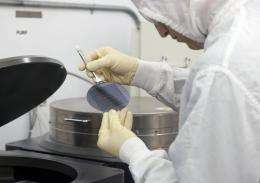
(PhysOrg.com) -- A team of Brigham Young University engineers and chemists has created an inexpensive silicon microchip that reliably detects viruses, even at low concentrations.
It’s another step toward the goal of enabling physicians and lab technicians to use small chips to test their patients’ samples for specific proteins or viruses. The researchers report their progress in Lab on a Chip, the top scientific journal devoted to the creation of chip-based biological tests.
Aaron Hawkins, professor of electrical and computer engineering at BYU and supervisor of the chip design, said that currently, “Most of the tests that you’re given are fairly inaccurate unless you have a really high concentration of the virus.”
But because Hawkins’ chip screens for particles purely by size, it could accumulate many particles over time that otherwise might be missed by other tests. The hope is that, if such chip tests achieve widespread use, early detection in the doctor’s office rather than a lab could allow doctors to respond before symptoms arise and damage sets in.
How the chips work
The chips work like coin sorters, only they are much, much smaller. Liquids flow until they hit a wall where big particles get stuck and small particles pass through a super-thin slot at the bottom. Each chip’s slot is set a little smaller than the size of the particle to be detected. After the particles get trapped against the wall, they form a line visible with a special camera.
“One of the goals in the ‘lab on a chip’ community is to try to measure down to single particles flowing through a tube or a channel,” said Hawkins, who is also writing a book about aspects of lab-on-a-chip development.
Capturing single particles has important applications besides simply knowing if a particular virus or protein is present.
“One of the things I hope to see is for these chips to become a tool for virus purification,” said David Belnap, an assistant professor of chemistry and co-author on the paper.
He explained that a tool like the BYU chip would advance the pace of his research, allowing him and other researchers to consistently obtain pure samples essential for close inspection of viruses.
Overcoming obstacles to make the chips
A huge barrier to making chips that can detect viruses is $100 million - that’s the cost of machinery precise enough to make chips with nano-sized parts necessary for medical and biological applications.
The BYU group developed an innovative solution. First they used a simpler machine to form two dimensions in micrometers — 1,000 times larger than a nanometer. They formed the third dimension by placing a 50 nanometer-thin layer of metal onto the chip, then topping that with glass deposited by gasses. Finally they used an acid to wash away the thin metal, leaving the narrow gap in the glass as a virus trap.
Tomorrow’s chips
So far, the chips have one slot size. Hawkins says his team will make chips soon with progressively smaller slots, allowing a single channel to screen for particles of multiple sizes. Someone “reading” such a chip would easily be able to determine which proteins or viruses are present based on which walls have particles stacked against them.
After perfecting the chips’ capabilities, the next step, Hawkins says, is to engineer an easy-to-use way for a lab technician to introduce the test sample into the chip.
Mark N. Hamblin, who is pursuing a Ph.D. in Hawkins’ lab in BYU’s Fulton College of Engineering and Technology, is the lead author on the paper. Other co-authors are Jie Xuan, Daniel Maynes, H. Dennis Tolley, Adam T. Woolley and Milton L. Lee.
The research team is continuing its work, hoping for the day when tiny medical labs join picture-perfect TVs, fast computers and compact phones in the ranks of useful technologies made possible by microchips.
More information: www.rsc.org/publishing/journals/LC/
Provided by Brigham Young University


