Scientist explore future of high-energy physics
February 9, 2010
Scientist explore future of high-energy physics

Enlarge

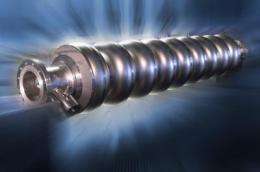
Superconducting radio frequency cavities are a key technology for next-generation accelerators and the future of particle physics. Credit: Fermilab photo

In a 1954 speech to the American Physical Society, the University of Chicago's Enrico Fermi fancifully envisioned a particle accelerator that encircled the globe. Such would be the ultimate theoretical outcome, Fermi surmised, of the quest for the ever-more powerful accelerators needed to discover new laws of physics.

"How much energy you can put into a particle per meter corresponds directly to how big the machine is," says Steven Sibener, the Carl William Eisendrath Professor in Chemistry and the James Franck Institute at UChicago. This means that future accelerators must either grow to inconceivable sizes, at great costs, or they must somehow pump far more energy into each particle per meter of acceleration than modern technology will allow.

Sibener and Lance Cooley, AB'86, of the , are working on the latter option with $1.5 million in funding from the U.S. Department of Energy. They aim to improve the efficiency of superconducting radio frequency (SRF) cavities made of niobium to accelerate beams of subatomic particles in the next generation of experiments.

The result could be accelerators powerful enough to open new frontiers in physics without the need for a massive increase in size.

A key to such efforts is niobium, a metallic element that becomes superconducting at very low temperatures. In fact, niobium's superconducting characteristics are the best among the elements, providing the capacity to carry thousands of times more electric current than normal conductivity through copper. When highly pure, niobium also efficiently sheds any heat generated at flaws and defects to its cryogenic coolant. Niobium SRF cavities thus will comprise the heart of future particle accelerators, including the proposed International Linear Collider.
Scientist explore future of high-energy physics
Enlarge

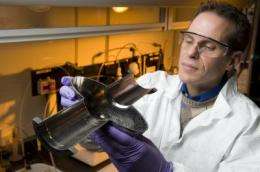
Lance Cooley of the Fermi National Accelerator Laboratory is working with a metallic element called niobium to create the next generation of high-energy physics experiments. Credit: Photo by Reidar Hahn

Enabling collider technology

"The niobium superconducting cavity is enabling technology for anything that is high-power, high-energy, or high-intensity for linear colliders," says Cooley, the SRF Materials Group Leader at Fermilab. Cooley works with niobium cooled to 2 Kelvin (minus-455.8 degrees Fahrenheit) to maximize its superconducting characteristics. "We use superconductors because it's friction-free electricity, which saves on the operating wall-plug power," he says.

As an undergraduate at UChicago in the 1980s, Cooley conducted research for his senior project in the laboratory of Thomas Rosenbaum, Provost and the John T. Wilson Distinguished Service Professor in Physics. It was then that Cooley became interested in superconductivity. His interest in Fermilab and its accelerators was motivated by another UChicago faculty member, Professor Emeritus and Nobel Laureate James Cronin. Cooley arrived at Fermilab in 2007, and soon after, met Sibener to discuss niobium surface chemistry at the recommendation of mutual colleagues.

Pushing particle beams

Niobium has assumed greater importance in plans for the next round of linear colliders. The current generation of ring colliders, including Fermilab's Tevatron and Europe's newly operating Large Hadron Collider, use thousands of niobium-titanium superconducting magnets to steer and focus their beams of charged particles, which travel in great loops before being steered into collisions that can reveal fundamental properties of matter. Cavities are a small part of these machines, providing a momentary push to the particles each time they orbit the ring.

But linear colliders, including Stanford's current linear accelerator, Fermilab's proposed Project X, and the proposed ILC, string together thousands of cavities into one long line. The resulting linear accelerator creates an immense electric field to push the particle beams toward their collision in a single pass, without any need for steering and recirculating them.

The emergence of niobium SRF cavity technology over the past 20 years makes it possible for each resonating cavity to utilize superconductivity to produce high-power output through low-power input, with an estimated gain in quality factor of 100,000 over Stanford's copper cavities. But many aspects of the system are not yet optimal.

Niobium is processed according to laboratory recipes that could benefit from a firm grounding in materials science, Cooley says. "Just how precisely a given recipe is followed depends on laboratory culture, attention to detail by individual operators, arrangement of tasks based on what is perceived to be important, and so on," Cooley says. "The true impact of different processing steps is just beginning to emerge as the university scientists like Steve step in and produce basic understanding."
Scientist explore future of high-energy physics
Enlarge

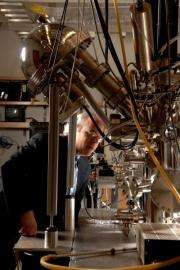
The microscopes in the University of Chicago laboratory of Steven Sibener enable researchers to observe the behavior of individual atoms. Credit: Dan Dry photo

The microscopes in Sibener's laboratory enable researchers to observe the behavior of individual atoms. With the earlier seed grant, Sibener's team found that niobium's reaction with oxygen produced a variety of surface oxides and defects that suggested to Cooley and others explanations of observed changes in real-world SRF cavities.

"This is some of the purest niobium you can find in the world, actually," says Sibener, displaying a mirror-like wafer of the material in his office at the Gordon Center for Integrative Science. His research group will closely examine the material to determine exactly which oxides and defects at the surface of niobium crystals lead to loss of superconductivity under extreme conditions.

"If the Fermilab-UChicago collaboration is successful," says Cooley, "it will allow new types of accelerators to be built at great cost savings."

Provided by University of Chicago (news : web)

4.8 /5 (18 votes)  

Filter


Move the slider to adjust rank threshold, so that you can hide some of the comments.


Display comments: newest first

StarDust21
Feb 09, 2010

Rank: 5 / 5 (2)
What factor actually limits us from accelerating particles over and over in a circle till they get the speed we want? I know they do this at lhc but they only do a couple of loops. So what limits them do make particles do more loops instead of increasing the energy per meter input?
seneca
Feb 09, 2010

Rank: 5 / 5 (4)
Actually it's a magnetic field intensity, required to keep protons in their circular path. Such intensity has its own technological limits with contemporary niobium-titanium based superconductor cables. The old Tevatron magnets reach peak fields of 4.5 Tesla at 4.2 K. The electron-proton collider magnets at the DESY Laboratory in Germany go somewhat higher, to around 5.5 Tesla. To get beyond this, LHC magnets will be operated at 1.9 K above absolute zero temperature. To bend 7 TeV protons around the ring, the LHC dipoles must be able to produce fields of 8.36 Tesla.
michaelick
Feb 09, 2010

Rank: 4 / 5 (1)
I am no expert in physics, but I am able to do some research in the internet and think a bit before asking such silly questions. In circular accelerators the particles are forced by a magnetic field to travel in curved paths. Then they emit the so-called "synchrotron radiation", which means that they lose energy.

Also, when particles are accelerated, they gain kinetic energy. You probably heared of the formula "E = mc˛". It says that energy and mass are the same thing. Consequently, particles travelling almost at the speed of the light don't have only much kinetic energy, but also a great mass and thus are more difficult to accelerate.
michaelick
Feb 09, 2010

Rank: 4.8 / 5 (4)
I am no expert in physics, but I am able to do some research in the internet and think a bit before asking such silly questions. In circular accelerators the particles are forced by a magnetic field to travel in curved paths. Then they emit the so-called "synchrotron radiation", which means that they lose energy.

Also, when particles are accelerated, they gain kinetic energy. You probably heared of the formula "E = mc˛". It says that energy and mass are the same thing. Consequently, particles travelling almost at the speed of the light don't have only much kinetic energy, but also a great mass and thus are more difficult to accelerate.
dan42day
Feb 10, 2010

Rank: not rated yet
michaelick, perhaps you could do a little more research and learn how to not double post.

Why not attach the linear accelerator to the output of the circular one?
brizzadizza
Feb 10, 2010

Rank: not rated yet
I like Michaelicks second post better than his first for some reason.
broglia
Feb 10, 2010

Rank: not rated yet
.they emit the so-called "synchrotron radiation", which means that they lose energy..
OK, but energy lost due the synchrotron radiation is a limit for linear colliders - but not for the circular ones (compare the original question of StarDust21). Sometimes it's better to read question first, then to criticize it.
frajo
Feb 10, 2010

Rank: 3 / 5 (2)
but energy lost due the synchrotron radiation is a limit for linear colliders - but not for the circular ones
It's the other way round.
http://en.wikiped...Collider
broglia
Feb 11, 2010

Rank: 1 / 5 (1)
Nope, it isn't - as the collision energy achievable by ILC (0,5 TeV) is more than one order of magnitude bellow the collision energy of LHC (14 TeV).
daywalk3r
Feb 11, 2010

Rank: 5 / 5 (1)
^^
Some comments can really make me giggle.. like the one just above ;-)

Dear mr.broglia, frajo's correction was correct.
The difference in maximum achievable collision/beam energy at those above mentioned particle accelerators has little to do with synchrotron radiation.
daywalk3r
Feb 11, 2010

Rank: 5 / 5 (1)
And apart from that synchrotron radiation is quite strictly bound to circular (or actually any "non-straight-line" type) accelerators, it comes from electrons, which are either "stripped off" from the accelerated material/particles (atoms,f.e.) or break up from the beam itself (at electron accelerators).

And that might aswell be one of the reasons, why, apart from hadrons, there will be only nuclei with pre-stripped off electrons accelerated on the LHC, because the higher the electrical charge of the accelerated particle, the more efficient the magnetic field at correcting the particle/beam path is. Someone correct me if I'm wrong. Thank you :)
seneca
Feb 11, 2010

Rank: 5 / 5 (1)
Some comments can really make me giggle.. like the one just above Dear mr.broglia, frajo's correction was correct. The difference in maximum achievable collision/beam energy at those above mentioned particle accelerators has little to do with synchrotron radiation.
Broglia is true. In fact, synchrotron radiation is even more limiting at the case of ILC, then for LHC, because of limited acceleration path in linear colliders. Maybe you're believing, synchrotron radiation applies only to centripetal acceleration, not the acceleration as such..?
seneca
Feb 11, 2010

Rank: 5 / 5 (1)
synchrotron radiation is quite strictly bound to circular accelerators
It's a product of any acceleration. For example free electron lasers are linear and they're generating it, too. The rest of comment has no deeper meaning for me, because LHC is designed for acceleration of protons. From where you got "there will be only nuclei with pre-stripped off electrons accelerated on the LHC"?
frajo
Feb 12, 2010

Rank: 3 / 5 (2)
Some comments can really make me giggle.. like the one just above Dear mr.broglia, frajo's correction was correct. The difference in maximum achievable collision/beam energy at those above mentioned particle accelerators has little to do with synchrotron radiation.
Broglia is true. In fact, synchrotron radiation is even more limiting at the case of ILC, then for LHC, because of limited acceleration path in linear colliders. Maybe you're believing, synchrotron radiation applies only to centripetal acceleration, not the acceleration as such..?
Then, the definition of "synchrotron" from Wikipedia should be corrected:
A synchrotron is a particular type of cyclic particle accelerator
And please, inform the guys at Yale about their error on http://ysm.resear...leID=684
Btw, which one of you was formerly known as "Alizee"? And why have both of you abandoned AWT?
daywalk3r
Feb 13, 2010

Rank: not rated yet
Some comments can really make me giggle.. like the one just above Dear mr.broglia, frajo's correction was correct. The difference in maximum achievable collision/beam energy at those above mentioned particle accelerators has little to do with synchrotron radiation.
Broglia is true. In fact, synchrotron radiation is even more limiting at the case of ILC, then for LHC, because of limited acceleration path in linear colliders. Maybe you're believing, synchrotron radiation applies only to centripetal acceleration, not the acceleration as such..?

The catch word here is "synchrotron" - which, by definition, should not be relevant to linear acceleration. The type of radiation generated aswell as the principle involved might be the same, but it still should not be called "synchrotron" in the case of linear acceleration. There is one major difference though: At a linear approach, the generated radiation has same directivity as the accelerated beam (is parallel).
daywalk3r
Feb 13, 2010

Rank: not rated yet
synchrotron radiation is quite strictly bound to circular accelerators
It's a product of any acceleration...
Please refrain from quoting only half of a sentence. I know it might make your objection look more profound, but please :)

For example free electron lasers are linear and they're generating it, too.
Not exactly right.. It is not generated by electron lasers, but rather a by-product of electron laser generation (yes, from the acceleration) :-P and maybe from de-acceleration aswell, like when the beam "hits a wall" :)

From where you got "there will be only nuclei with pre-stripped off electrons accelerated on the LHC"?
Now, thats a pretty easy one.. Or do I need to explain what is meant by "lead ion" in regard to the LHC? Think there is alot of official material flying all over the web regarding this matter :-)
seneca
Feb 13, 2010

Rank: not rated yet
The catch word here is "synchrotron" - which, by definition, should not be relevant to linear acceleration.
Maybe it shouldn't, but in fact it is frequently used so in the same context, like so called Bremsstrahlung, i.e. like when the beam "hits a wall". As you can see, you're admitting the same thing, which you're fighting against in a single post - so that further discussion with you is useless both for me, both for other readers.
daywalk3r
Feb 13, 2010

Rank: not rated yet
By the way,
Nope, it isn't - as the collision energy achievable by ILC (0,5 TeV) is more than one order of magnitude bellow the collision energy of LHC (14 TeV).
The reason I was giggling over it was, because he was comparing the kinetic energy of electrons/positrons to hardons and basing his reasoning on it. Now if that's not funny.. at least 3 orders of magnitude funny :(

And I admit, I was a bit confused at first, mostly because ILC was mentioned, which is meant to be a pure electron/positron accelerator, which is not exactly specified in this acticle, so I was not focused on electron/positron. My bad.

So yea, of course that electron acceleration missbehaviour is a bigger issue at accelerators that are meant to accelerate electrons (ILC), than at accelerators that are meant to accelerate none (LHC).
Rank 4.8 /5 (18 votes)
Relevant PhysicsForums posts
  • A grandfather pulls his granddaughter, whose mass is 20.5 kg
    created2 hours ago
  • what is significance of torque
    created2 hours ago
  • Difference between volume displaced fluid and volume of the object
    created3 hours ago
  • Questions about Galileo statement?
    created4 hours ago
  • Question on Kirchoff's Laws
    created8 hours ago
  • Changes in Water Weight
    created9 hours ago
  • More from Physics Forums - General Physics

More news stories

Borexino Collaboration succeeds in spotting pep neutrinos emitted from the sun

(PhysOrg.com) -- To learn more about how the sun works, scientists study particles that are emitted from it into space due to thermonuclear reactions that occur inside; by applying known physics principles, ...

Physics / General Physics

created 17 hours ago | popularity 4.6 / 5 (7) | comments 0 | with audio podcast report

Explained: Sigma

It's a question that arises with virtually every major new finding in science or medicine: What makes a result reliable enough to be taken seriously? The answer has to do with statistical significance -- but ...

Physics / General Physics

created 17 hours ago | popularity 5 / 5 (10) | comments 29

Physics research suggests new pathways for cancer progression

Observing that certain cancer cells may exhibit greater flexibility than normal cells, some scientists believe that this capability promotes rapid tumor growth. Now computer simulations developed by Boston University Biomedical ...

Physics / General Physics

created 14 hours ago | popularity 5 / 5 (1) | comments 0

Quantum physicist explains $100K offer for proof scaled-up quantum computing is impossible

(PhysOrg.com) -- MIT researcher Scott Aaronson has certainly riled the physics community with his offer this past Friday, of $100,000 to anyone who can prove that scaled-up quantum computing is impossible. ...

Physics / Quantum Physics

created Feb 08, 2012 | popularity 4.1 / 5 (11) | comments 31 | with audio podcast weblog

Physicists 'record' magnetic breakthrough

An international team of scientists has demonstrated a revolutionary new way of magnetic recording which will allow information to be processed hundreds of times faster than by current hard drive technology.

Physics / General Physics

created Feb 07, 2012 | popularity 4.5 / 5 (39) | comments 14 | with audio podcast


'Dark plasmons' transmit energy

Microscopic channels of gold nanoparticles have the ability to transmit electromagnetic energy that starts as light and propagates via "dark plasmons," according to researchers at Rice University.

FDA-approved drug rapidly clears amyloid from the brain, reverses Alzheimer's symptoms in mice

Neuroscientists at Case Western Reserve University School of Medicine have made a dramatic breakthrough in their efforts to find a cure for Alzheimer's disease. The researchers' findings, published in the journal Science, show t ...

Hydrogen from acidic water: Researchers develop potential low cost alternative to platinum for splitting water

A technique for creating a new molecule that structurally and chemically replicates the active part of the widely used industrial catalyst molybdenite has been developed by researchers with the Lawrence Berkeley ...

Ultraviolet protection molecule in plants yields its secrets

Lying around in the sun all day is hazardous not just for humans but also for plants, which have no means of escape. Ultraviolet (UV) radiation from the sun can damage proteins and DNA inside cells, leading ...

Anyone can learn to be more inventive, cognitive researcher says

There will always be a wild and unpredictable quality to creativity and invention, says Anthony McCaffrey, a cognitive psychology researcher at the University of Massachusetts Amherst, because an "Aha moment" is rare and ...

New method makes culture of complex tissue possible in any lab

Scientists at the University of California, San Diego have developed a new method for making scaffolds for culturing tissue in three-dimensional arrangements that mimic those in the body. This advance, published online in ...