Study carried out into biological risks of eating reptiles
February 9, 2010
Study carried out into biological risks of eating reptiles

Enlarge

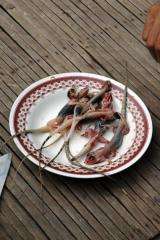
In the picture, a plate of iguanas. Credit: Marshall Astor (Creative Commons).

Reptiles are bred in captivity primarily for their skins, but some restaurants and population groups also want them for their meat. A study shows that eating these animals can have side effects that call into question the wisdom of eating this 'delicacy.'

Parasites, bacteria and viruses, and to a lesser extent contamination from heavy metals and residues of veterinary drugs-- eating reptile meat can cause several problems to health. This is the conclusion of a study published in the International Journal of Food Microbiology, which shows that people can catch certain diseases (trichinosis, pentastomiasis, gnathostomiasis and sparganosis) by eating the meat of reptiles such as crocodiles, turtles, lizards or snakes.

"The clearest microbiological risk comes from the possible presence of , especially Salmonella, and also Shigella, Escherichia coli, Yersinia enterolitica, Campylobacter, and , which can cause illnesses of varying degrees of severity," Simone Magnino, lead author of the study and a researcher for the World Health Organization (WHO), tells SINC.

This expert says the data about risks to public health are still inconclusive, since there is no comparative information about consuming this meat and the prevalence of pathogens. Also, there are few published research articles about cases of illness associated with consuming reptile meat.

"Although the majority of the information published about these risks is in relation to reptiles raised as domestic animals (pets), there are also publications relating to wild species or those bred in captivity", explains Magnino.

Meat should be frozen

The experts advise people to freeze the meat, just as they would with other foods from animal sources, since this deactivates parasites. Industrial processing and proper cooking (not leaving the meat raw) can also kill off pathogens.

The Scientific Panel on Biological Risks of the European Food Safety Authority (EFSA) provides independent scientific advice on issues relating directly or indirectly to food security, including risks associated with eating reptile meat.

The objective of these risk evaluations is to supply the relevant bodies (European Commission, European Parliament, EU Council and member states) with a scientific basis in order to help them draw up legislation to guarantee consumer protection.

Some countries use turtles, crocodiles, snakes and lizards as a source of protein in the human food chain. Frozen imported from , caimans, iguanas and pythons can be found in the EU. These imports, which are on the rise, come mainly from South Africa, the United States and Zimbabwe, and go primarily to Belgium, France, Germany, Holland and the United Kingdom.

More information: Simone Magnino, Pierre Colin, Eduardo Dei-Cas, Mogens Madsen, Jim McLauchlin, Karsten Nöckler, Miguel Prieto Maradona, Eirini Tsigarida, Emmanuel Vanopdenbosch and Carlos Van Peteghem. "Biological risks associated with consumption of reptile products." International Journal of Food Microbiology 134 (2009) 163, September 2009.

Provided by FECYT - Spanish Foundation for Science and Technology

3.3 /5 (3 votes)  

Filter


Move the slider to adjust rank threshold, so that you can hide some of the comments.


Display comments: newest first

fixer
Feb 09, 2010

Rank: not rated yet
Australia has a healthy crocodile meat industry, just make sure it's cooked.
CarolinaScotsman
Feb 09, 2010

Rank: 1 / 5 (1)
ALL meat, reptile, mammal, fowl and fish, should be fully cooked. This is basic health practice. Gourmets who eat sushi and raw or very rare meats risk infection.
Caliban
Feb 09, 2010

Rank: 1 / 5 (1)
How food is processed and prepared is equally as important as how it is grown and harvested. At any time along its journey to your plate, as you can see from this article, it is susceptible(whether intentionally or accidentally) to contamination, regardless of it being animal or vegetable in origin. That's why regulation, truth in labeling, and enforceable standards of Good Manufacturing Processes are absolutely essential for our health. And there is still PLENTY of room for improvement.
LuckyExplorer
Feb 10, 2010

Rank: not rated yet
And what about chicken?
OK, there may be a risk, but for all other meat we need veterinary control to provide a healthy quality.
The facts in the article are absolutely OK, but the headline is not professional and scientific - and - I miss objectivity mentioning the risks of other nutrients (meats or fish)...
Rank 3.3 /5 (3 votes)
Related Stories
Relevant PhysicsForums posts
  • Squishing cells
    created1 hour ago
  • Any books/articles for evolutionary stable strategy models in humans?
    created12 hours ago
  • Science behind the bore feeling?
    created18 hours ago
  • Homo Sapien vs. Chimpanzee - Divergence Timeline
    created23 hours ago
  • a single mRNA strand is attached to sevaral ribosomes?
    createdFeb 08, 2012
  • Oestrogen and FSH
    createdFeb 07, 2012
  • More from Physics Forums - Biology

More news stories

Ultraviolet protection molecule in plants yields its secrets

Lying around in the sun all day is hazardous not just for humans but also for plants, which have no means of escape. Ultraviolet (UV) radiation from the sun can damage proteins and DNA inside cells, leading ...

Biology / Plants & Animals

created 8 hours ago | popularity 5 / 5 (4) | comments 0 | with audio podcast

Deadly bird parasite evolves at exceptionally fast rate

A new study of a devastating bird disease that spread from poultry to house finches in the mid-1990s reveals that the bacteria responsible for the disease evolves at an exceptionally fast rate. What's more, ...

Biology / Biotechnology

created 7 hours ago | popularity 5 / 5 (2) | comments 0 | with audio podcast

Decoding the molecular machine behind E. coli and cholera

Scientists from Queen Mary, University of London have discovered the workings behind some of the bacteria that kill hundreds of thousands every year, possibly paving the way for new antibiotics that could treat infections ...

Biology / Cell & Microbiology

created 7 hours ago | popularity not rated yet | comments 0 | with audio podcast

New research reveals why fishermen keep fishing despite dwindling catches

Half of fishermen would not give up their livelihood in the face of drastically declining catches according to research led by the University of East Anglia (UEA).

Biology / Ecology

created 7 hours ago | popularity not rated yet | comments 0

Deciding to go left or right: Researchers use device to determine that lower animals can navigate too

For decades, scientists have associated binary decision making — opting to go left or right — with higher-ranking animals, including humans. A team of Harvard researchers, however, is rewriting that ...

Biology / Plants & Animals

created 15 hours ago | popularity not rated yet | comments 2 | with audio podcast


'Dark plasmons' transmit energy

Microscopic channels of gold nanoparticles have the ability to transmit electromagnetic energy that starts as light and propagates via "dark plasmons," according to researchers at Rice University.

Hydrogen from acidic water: Researchers develop potential low cost alternative to platinum for splitting water

A technique for creating a new molecule that structurally and chemically replicates the active part of the widely used industrial catalyst molybdenite has been developed by researchers with the Lawrence Berkeley ...

FDA-approved drug rapidly clears amyloid from the brain, reverses Alzheimer's symptoms in mice

Neuroscientists at Case Western Reserve University School of Medicine have made a dramatic breakthrough in their efforts to find a cure for Alzheimer's disease. The researchers' findings, published in the journal Science, show t ...

Anyone can learn to be more inventive, cognitive researcher says

There will always be a wild and unpredictable quality to creativity and invention, says Anthony McCaffrey, a cognitive psychology researcher at the University of Massachusetts Amherst, because an "Aha moment" is rare and ...

New method makes culture of complex tissue possible in any lab

Scientists at the University of California, San Diego have developed a new method for making scaffolds for culturing tissue in three-dimensional arrangements that mimic those in the body. This advance, published online in ...

Cell biologists describes mechanism by which some people may be more susceptible to colon cancer

An international research team led by cell biologists at the University of California, Riverside has uncovered a new insight into colon cancer, the third leading cause of cancer-related deaths in the United ...