Student Builds Spider Robot From Spare Parts (w/ Video)
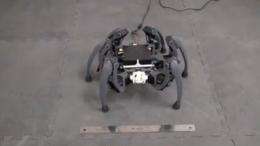
Picture a spider-like robot that teaches itself to walk, can adapt when damaged and watches its maker as he moves around the room. That might sound terrifying.
Add artificial intelligence into the mix and you have all the makings of a science-fiction horror film.
Luckily, the UA electrical engineering senior and creator of the hexapod, Matt Bunting, said he plans to teach the robot only basic emotions.
"I've definitely thought about adding (artificial emotion), but the emotions would be very simplistic -- happy, sad, bored -- just very simple emotions. You can only do so much," he said.
Needless to say, Bunting's project for his spring 2009 cognitive-robotics class is drawing a lot of attention from the robotics world. Major companies have offered free equipment and exposure in exchange for his skills.
Bunting's passion for technology developed early.
When he was 12, he built a Lego car with an attached Web cam that he used to chase his cat around the house.
In high school, his endeavors became more complex -- like adapting a golf cart to be radio-controlled and installing custom alarm systems in his Jeep.
"I've always enjoyed robotics," he said. "It's really been an interest of mine ever since I can remember."
His most ambitious project came after University of Arizona professor Anthony Lewis asked his class to build a robot using class lessons. Bunting's resulting hexapod was a "Frankenstein" of spare parts he had collected from previous endeavors.
It was the most impressive device Lewis can recall a student ever turning in.
"The robot was surprisingly complex and sophisticated for a project," he said. "It was pretty amazing."
After giving his student a grade of A, Lewis offered him a job in his lab. There, Bunting refined his design and posted a video of the upgraded robot on YouTube.
That's how Stewart Christie, a product-marketing engineer at Intel, noticed Bunting's creation.
"It's difficult for us to find where our products end up -- by definition they are embedded in something," Christie said. "Some things are more exciting than others -- having a robot that walks around is really quite something."
It was Bunting's use of Intel's Atom Processor as the hexapod's driving force that caught Christie's eye. He offered Bunting top-of-the-line hardware to build two more hexapods, one of which Intel would use to tour the county showing off potential applications of its devices. Bunting would be free to keep the other for further research.
The mechanical spider also grabbed the attention of a Gilbert robotics business called Crust Crawler. The business sells kits that allow customers to assemble, program and operate robots of their own. After seeing Bunting's robot, owner Alex Dirks contacted Bunting about creating operation codes for the firm's hexapod kit in exchange for free equipment and exposure.
"It's hard to find people like Matt who know their stuff and can really deliver on software to make a really functional, lifelike walking gait for a hexapod," Dirks said. "We've been in this business for almost 10 years now, and he is only the second person in nine years that puts his money where his mouth is and can actually do it."
Perhaps the most impressive aspect of Bunting's hexapod is its ability to "teach" itself to walk by tying vision with legged locomotion. Each time the hexapod is activated, it begins with no prior memory of how to move forward.
As a result, the device begins by experimenting with different positions and motions. If a particular motion moves the hexapod in a forward direction, it is reinforced.
The hexapod judges motion using a simple webcam. As the robot transitions from one position to the next, it takes an image in each stance. It then compares specific features within the images to determine its trajectory.
The experimental quality of the robot also allows it to adapt if it's damaged. If the robot loses a leg, it can re-evaluate its balance and alter its method of motion accordingly. The resilience and experimentation make the design ideal for exploring difficult landscapes such as collapsed buildings or even space exploration, Bunting's professor said.
"It's a nice, stable platform," Lewis said. "It's not going to fall over -- it will remain balanced easily. It's good for going over very rough terrain."
Bunting was recently accepted to the UA's graduate school and also has applied to Carnegie Mellon University.
"Other people have to go through extensive additional years of training before they start building something, but he has a natural talent," Lewis said. "I think he's going to end up being a really outstanding robot designer. I think he's going to have a great future."
Copyright 2010 The Associated Press. All rights reserved. This material may not be published, broadcast, rewritten or redistributed.


