Extra large carbon

February 9, 2010
Extra large carbon

Enlarge

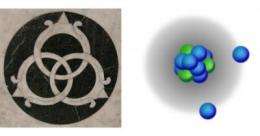
Carbon-22 is now the heaviest observed Borromean nucleus. Borromean nuclei are named after the rings from the 15th century crest of the Borromeo family from Northern Italy. The rings are connected in such a way that the cutting of one ring results in the separation of all three. (Left) Marble representation of the Borromean rings, used as an emblem of Lorenzo de Medici in San Pancrazio, Florence. (Right) Schematic structure of 22C showing the two halo neutrons around a core. Removing any one element makes the entire structure unstable. Credit: APS Physics

An exotic form of carbon has been found to have an extra large nucleus, dwarfing even the nuclei of much heavier elements like copper and zinc, in experiments performed in a particle accelerator in Japan. The discovery is reported in the current issue of Physical Review Letters and highlighted with a Viewpoint by Kirby Kemper and Paul Cottle of Florida State University in the February 8 issue of Physics.

Carbon-22, which has a comprised of 16 neutrons and 6 protons, is the heaviest atom yet discovered to exhibit a "halo nucleus." In such , some of the particles that normally reside inside the nucleus move into orbits outside the nucleus, forming a halo of .

Because atoms like carbon-22 are packed with an excessive number of neutrons, they're unstable and rapidly break apart to form lighter atoms, but they are more stable than scientists had previously expected. The extra stability is a surprise because the three particles-- two neutrons and a nucleus-- that form a halo nucleus interact in a way that is difficult for physicists to model due to the complicated mathematics necessary to describe so-called "three body" problems.

The unexpected stability has led to such halo nucleus atoms being labeled Borromean atoms in reference to an ancient pattern depicting three rings interlocked such that the removal of any one ring would cause all three to be disconnected. Borromean rings were often used to symbolize a stable union of three parts in traditional carvings and family crests.

The detection and analysis of carbon-22 sets a new milestone in challenging nuclear physics, and hails a promising era in the investigation of heavier and even more exotic nuclei as new beam facilities and more sensitive detectors come on line over the next decade. The surprising discovery of carbon-22's halo suggests that nuclear physicists will have plenty of new ground to cover in coming years.

More information: Observation of a Large Reaction Cross Section in the Drip-Line Nucleus 22C, K. Tanaka et al. Phys. Rev. Lett. 104, 062701 (2010) - Published February 08, 2010. Download PDF (free)

Provided by American Physical Society

4.7 /5 (22 votes)  

Filter


Move the slider to adjust rank threshold, so that you can hide some of the comments.


Display comments: newest first

chandram
Feb 09, 2010

Rank: 5 / 5 (1)
It is surprising to see the news item. It appears that even in a three body system the two body forces somehow get strengthened to provide more than the earlier estimates of overall stability. It adds mystery to the nature of 2 and many body nuclear force, as far known presently.
chandram
Feb 09, 2010

Rank: 5 / 5 (1)
It is a path breaking development that makes us rethink about the two body nuclear force that appears to change its nature as extra nucleons get added. The halo of C22 has a different 2-body force than the halo of C20 or C18!
NeilFarbstein
Feb 09, 2010

Rank: not rated yet
I agree wholeheartedly. The C22 nucleus is something to keep in your search engine alerts.
physpuppy
Feb 09, 2010

Rank: 5 / 5 (1)
The article talks about how unexpectedly long lived the 22C nucleus is so that made me curious as to the actual value of the half life of 22C.

The paper doesn't state it directly, but it does give the reference to the value which was published in the paper's citation #11:
http://prc.aps.or.../e014316

where the value of the Beta decay is provided in the abstract, but I don't understand the notation:

6.1 subscript(-1.2) superscript (+1.4) ms

So I infer that the half life is on the order of milliseconds - maybe up to 10's of milliseconds (?) - but what are those subscripts and superscripts ?
Can anyone translate? Thanks!
NeilFarbstein
Feb 09, 2010

Rank: 1 / 5 (2)
its a mystery to me. Do you think laser light could stabilize a nucleus like C22?
frajo
Feb 10, 2010

Rank: 3.7 / 5 (3)
6.1 subscript(-1.2) superscript (+1.4) ms

So I infer that the half life is on the order of milliseconds - maybe up to 10's of milliseconds (?) - but what are those subscripts and superscripts ?
These are the error limits.
Bonkers
Feb 10, 2010

Rank: 5 / 5 (2)
i.e. 4.9 to 7.5 ms - and absolute age as far as nuclear physics is concerned
daywalk3r
Feb 11, 2010

Rank: not rated yet
"Stable" is far too relative of a term. It all comes down to the "duration" part, which is a time component, which has infinite resolution (in my opinion), which in turn means it all comes down to the scale.

So basicaly, we could describe anything as stable, depending solely on the time scale used. But we don't. Mostly because we are humans, bound to our own scales - be it time, size, complexity, etc. - to which everything we perceive is "anchored".

So, (to be more on-topic) in case of the observed C22 stability, it all comes down to the conditions that were present at impact till approx. T+6ms when the nuclei decayed.

Pressure, temperature, density, strength of field (grav/mag), background radiation (interference), cosmic ray particle interference, and many more.. even the most relative parameter of them all, the scale and ratio of them all.

For example,if the collision was done at 1 mil. times greater ambient pressure,the results would quite differ.. :)
physpuppy
Feb 12, 2010

Rank: not rated yet
Yes each field uses terms convenient to the object of study. Eg: Parsecs vs Millimeters. Stability is also a relative term.

From my understanding of currently accepted physics, a nuclei will decay in a time according to its half life probability, governed by the decay mode: the strong or weak force - the only way to cause it to decay any faster would be to provide sufficient energy for change - bombardment by particles or gamma radiation.

To keep it longer, that is done not by "stabilizing the nucleus" but by using relativity - circulate it near the speed of light and in the lab frame of reference the thing hasn't decayed - although in its own reference frame it still decays on time.

Pressure, temperature, density,E&M and gravitational fields, at least the levels in our common experience, should have no effect on the nucleus and not effect on decay time.

Unless there is something different - the neutron halo structure or perhaps something new discovered since I studied physics?
daywalk3r
Feb 13, 2010

Rank: not rated yet
Pressure, temperature, density,E&M and gravitational fields, at least the levels in our common experience, should have no effect on the nucleus and not effect on decay time.
Yes, you are partialy right, except the gravity part. The position in a gravity well, or "how deep" you are inside, will have an effect (relativistic) on the decay time, no matter what - at least to an observer situated at a "different depth".

With all the other mentioned parameters (mag field, etc.) it is a bit more tricky.. Every atom (and nucleus aswell) has its own "sphere of effect" which "shields" it from direct outside influence - simmilar, in principle, to the Heliosphere of our Sun. So yeah - to get some influence past this natural "shield", it would require intensities, levels, frequencies well past "the levels in our common experience" (as you wrote) - but that does not mean it is completely "immune" to them in every case.

So basicaly, we are back at the "scale" point, I mentioned earlier ;-)
daywalk3r
Feb 13, 2010

Rank: not rated yet
In regard to the describeb C22 nucleus:
So we have 1 tightly packed nucleus comprising of 14 neutrons and 6 protons, with 2 off-set neutrons orbiting it. And as no orbit is perfect or "eternal", those two neutrons are either closing-in or receding as time goes by, with the ultimate outcome being either a collision or decoupling from the nucleus - which in both cases is resulting in a destabilization of the whole construct (C22) and a further decay into new particles.. up until a formation is made that our lovely scientists could call "stable" ;)

This is a very over-simplified view. There could be many sub-phases involved of course, but we just don't have enough data avaliable to determine those - at least not yet.
Jarek
Feb 13, 2010

Rank: not rated yet
So what holds these neutrons? Gravity?? Gluons(7fm!)??
Or maybe it's another argument that spin is not pointlike, but rather curvelike property...
Quantum_Conundrum
Feb 13, 2010

Rank: not rated yet
Perhaps the neutrons somehow obtained a fractional charge, and were thus repelled from the "real" nucleus?

Or perhaps they are observing the cumulative effects of some previously un-described third nuclear force, or perhaps even anti-gravity...

In any case...

God did it!
Jarek
Feb 14, 2010

Rank: not rated yet
Repelling?:) I was rather asking about attracting force to compensate centrifugal one ...
If we take seriously how quantum mechanics describes spin, there is no problem about these neutrons - they would just create only one type of connection from the scheme on page 15 of http://arxiv.org/abs/0910.2724
seneca
Feb 17, 2010

Rank: not rated yet
Recent theories and experimental results are indicating, Higgs particle should have character of unparticle due the supersymmetry.

http://www.physor...225.html

It would mean (between others), the dark matter phenomena are scale invariant and we can observe them like dark matter and Pioneer anomaly deceleration at large scale, fifth force at meter scale, Casimir force at nanometer scale, anomalous attractive force at attometer scale and so on. The finding of sparse, but stable halo nuclei could fit into this conceptual image well.
seneca
Feb 17, 2010

Rank: not rated yet
what holds these neutrons? Gravity?? Gluons(7fm!)
It could be low distance analogy of Casimir force. The idea of fractional charge of neutrons is similar to R. Mills hydrino theory, in which formation of fractional quantum energy states of hydrogen were observed reportedly at surface (cavities) of Raney nickel. He reported evolution of anomalous heat in similar way, like Arata during absorbtion of deuterium on surface of Raney nickel and palladium. The unusually high yield of "cold fusion" could be explained, if deuterions would form halo nuclei inside of cavities. Arata's experiments were confirmed and published recently in peer reviewed journal Physical Letters.

http://tinyurl.com/ykmh5mn
NeilFarbstein
Feb 17, 2010

Rank: not rated yet
what holds these neutrons? Gravity?? Gluons(7fm!)
It could be low distance analogy of Casimir force. The idea of fractional charge of neutrons is similar to R. Mills hydrino theory, in which formation of fractional quantum energy states of hydrogen were observed reportedly at surface (cavities) of Raney nickel. He reported evolution of anomalous heat in similar way, like Arata during absorbtion of deuterium on surface of Raney nickel and palladium. The unusually high yield of "cold fusion" could be explained, if deuterions would form halo nuclei inside of cavities. Arata's experiments were confirmed and published recently in peer reviewed journal Physical Letters.

http://tinyurl.com/ykmh5mn
interesting. That is a respected Journal. Its on my reading list. Can you talk about the hydrino model at length?
NeilFarbstein
Feb 17, 2010

Rank: not rated yet
Laser have been used to increase the stability of borormean carbon. I forgot that and thought it was merely a theory instead of a real experiment. Maybe they can add neutrons to the C22 system and create other stable carbon atoms.
broglia
Feb 18, 2010

Rank: not rated yet
hydrino model at length
Currently hydrino model is considered a fringe science. But the physics of vacuum at Casimir force distance scope could differ from those at bulk. My intuitive insight is, particles of matter are surrounded by sea of virtual photons, which are forming vacuum more dense here, analogously to clouds of dark matter which surround larger objects at cosmic scale. Inside of such dense vacuum the stability of particles is lower and forces, which are keeping them together are weaker - especially inside of surface cavities.

The same phenomena occurs at atomic nuclei scale, because nucleons are surrounded by coat of virtual quark-antiquarks, which shields gluon charge (compare the tetraneutron evidence).

http://en.wikiped...aneutron

And it would work even at smaller scale (compare the recent pentaquark observation at Tevatron), because it's quite general scale invariant supersymmetry phenomena.
Rank 4.7 /5 (22 votes)
Relevant PhysicsForums posts
  • A grandfather pulls his granddaughter, whose mass is 20.5 kg
    created2 hours ago
  • what is significance of torque
    created2 hours ago
  • Difference between volume displaced fluid and volume of the object
    created3 hours ago
  • Questions about Galileo statement?
    created4 hours ago
  • Question on Kirchoff's Laws
    created8 hours ago
  • Changes in Water Weight
    created9 hours ago
  • More from Physics Forums - General Physics

More news stories

Borexino Collaboration succeeds in spotting pep neutrinos emitted from the sun

(PhysOrg.com) -- To learn more about how the sun works, scientists study particles that are emitted from it into space due to thermonuclear reactions that occur inside; by applying known physics principles, ...

Physics / General Physics

created 17 hours ago | popularity 4.6 / 5 (7) | comments 0 | with audio podcast report

Explained: Sigma

It's a question that arises with virtually every major new finding in science or medicine: What makes a result reliable enough to be taken seriously? The answer has to do with statistical significance -- but ...

Physics / General Physics

created 17 hours ago | popularity 5 / 5 (10) | comments 29

Physics research suggests new pathways for cancer progression

Observing that certain cancer cells may exhibit greater flexibility than normal cells, some scientists believe that this capability promotes rapid tumor growth. Now computer simulations developed by Boston University Biomedical ...

Physics / General Physics

created 14 hours ago | popularity 5 / 5 (1) | comments 0

Quantum physicist explains $100K offer for proof scaled-up quantum computing is impossible

(PhysOrg.com) -- MIT researcher Scott Aaronson has certainly riled the physics community with his offer this past Friday, of $100,000 to anyone who can prove that scaled-up quantum computing is impossible. ...

Physics / Quantum Physics

created Feb 08, 2012 | popularity 4.1 / 5 (11) | comments 31 | with audio podcast weblog

Physicists 'record' magnetic breakthrough

An international team of scientists has demonstrated a revolutionary new way of magnetic recording which will allow information to be processed hundreds of times faster than by current hard drive technology.

Physics / General Physics

created Feb 07, 2012 | popularity 4.5 / 5 (39) | comments 14 | with audio podcast


'Dark plasmons' transmit energy

Microscopic channels of gold nanoparticles have the ability to transmit electromagnetic energy that starts as light and propagates via "dark plasmons," according to researchers at Rice University.

FDA-approved drug rapidly clears amyloid from the brain, reverses Alzheimer's symptoms in mice

Neuroscientists at Case Western Reserve University School of Medicine have made a dramatic breakthrough in their efforts to find a cure for Alzheimer's disease. The researchers' findings, published in the journal Science, show t ...

Hydrogen from acidic water: Researchers develop potential low cost alternative to platinum for splitting water

A technique for creating a new molecule that structurally and chemically replicates the active part of the widely used industrial catalyst molybdenite has been developed by researchers with the Lawrence Berkeley ...

Ultraviolet protection molecule in plants yields its secrets

Lying around in the sun all day is hazardous not just for humans but also for plants, which have no means of escape. Ultraviolet (UV) radiation from the sun can damage proteins and DNA inside cells, leading ...

Anyone can learn to be more inventive, cognitive researcher says

There will always be a wild and unpredictable quality to creativity and invention, says Anthony McCaffrey, a cognitive psychology researcher at the University of Massachusetts Amherst, because an "Aha moment" is rare and ...

New method makes culture of complex tissue possible in any lab

Scientists at the University of California, San Diego have developed a new method for making scaffolds for culturing tissue in three-dimensional arrangements that mimic those in the body. This advance, published online in ...