A study reveals how respiratory tubes and capillaries form
February 9, 2010
A study reveals how respiratory tubes and capillaries form

Enlarge

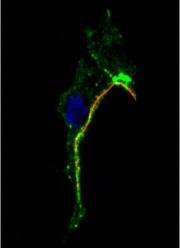
A tube-cell image. In red, the tube; in blue, the cell nuclei; in green, cell shape. (electron microscopy). Credit: Copyright IRB Barcelona. J. Casanova

Scientists at the Institute for Research in Biomedicine (IRB Barcelona) and CSIC report on the formation of the small-diameter respiratory tubes of the fly Drosophila, a process that resembles the development of the finest blood vessels, the capillaries, in mammals. These tubes or capillaries, formed by a single cell, connect the main tubes of the respiratory system with organs and tissues, thereby providing oxygen. The study has been published in the journal Current Biology.

Jordi Casanova, professor at CSIC who heads a developmental biology group at IRB Barcelona, Spain, addresses the that leads to the formation of different parts of an organism. Revealing how respiratory tubes develop in Drosophila is relevant because the genes and mechanisms involved are very similar to those present in the mammalian respiratory and circulatory systems. "Our study explains the formation of the smallest tubes that develop to transport nutrients and oxygen to tissues", says Casanova.

Capillary formation is tightly linked to the development of tumours since these have the capacity to generate new capillaries to obtain more nutrients, in a process known as . Indeed, one of the strategies under study to prevent tumour growth is to inhibit the formation of these supply routes.

Studying cell-to-tube transformation in vivo

The tubes measure only a few microns in diameter and are formed inside a cell. The lengthening of a cell and the development of a tube occur simultaneously. "If a tissue or organ requires oxygen, it sends a signal to cells in the main tube. At that point, a single cell begins to lengthen towards its target, while the tube is developing inside. It is like putting a finger into a wrinkled glove: the material stretches as the finger slides in".

In order to follow the process in vivo, the researchers have filmed the development of under a microscope. "Real time observation of embryo development has allowed us to see what happens in the entire organism and to understand the interaction with neighbouring tissue. After, using molecular biology techniques, we have identified the components that participate", explains the first author of the study, Louis Gervais, postdoctoral fellow in Casanova's group.

The signal that the tissue cells emit is called Fibroblast Growth Factor (FGF) and the cell of the tube reacts by activating the Serum Response Factor (SRF), which is the same gene that is active in the capillaries of the circulatory system in mammals. "We have discovered how this genetic machinery acts inside the cell to ensure its reorganisation and cell-to-tube transformation." The researchers have identified the two main players: actin, a protein linked to cell movement, which is concentrated in the tip of the cell where it will begin to extend, and microtubules, very fine fibres that anchor on one side to actin and on the other to the opposite side of the cell.

The microtubule network is like rails along which the components to be incorporated travel both to the outer membrane of the cell and the inner membrane of the tube so that both grow, while actin acts as an explorer, indicating the direction of growth. Thus, the actin and microtubule conjunction organises the lengthening of the cell and tube growth towards the target tissue.

More information: "In vivo coupling of cell elongation and lumen formation in a single cell" Louis Gervais and Jordi Casanova. Current Biology 2010, DOI 10.1016/j.cub.2009.12.043

Provided by Institute for Research in Biomedicine


Rank 5 /5 (2 votes)
Related Stories
Relevant PhysicsForums posts
  • Pertubance in a model
    created1 hour ago
  • Cancer drugs and Alzheimer's, Oh my!
    created10 hours ago
  • Squishing cells
    created10 hours ago
  • Any books/articles for evolutionary stable strategy models in humans?
    created22 hours ago
  • Science behind the bore feeling?
    createdFeb 09, 2012
  • Homo Sapien vs. Chimpanzee - Divergence Timeline
    createdFeb 09, 2012
  • More from Physics Forums - Biology

More news stories

The power of estrogen -- male snakes attract other males

A new study has shown that boosting the estrogen levels of male garter snakes causes them to secrete the same pheromones that females use to attract suitors, and turned the males into just about the sexiest ...

Biology / Plants & Animals

created 27 minutes ago | popularity not rated yet | comments 0 | with audio podcast

Experts reveal how plants don't get sunburn

(PhysOrg.com) -- Experts at the University of Glasgow have discovered how plants survive the harmful rays of the sun.

Biology / Cell & Microbiology

created 14 minutes ago | popularity not rated yet | comments 0 | with audio podcast

New drugs schedule makes horse racing a sure thing

What do Gai Waterhouse and Anthony Cummings have in common with Queen Elizabeth II?

Biology / Plants & Animals

created 26 minutes ago | popularity not rated yet | comments 0

Miami battling invasion of giant African snails

No one knows how they got there. But an invasion of African giant snails has southern Florida in a panic over potential crop damage, disease and general yuckiness surrounding the slimy gastropods.

Biology / Ecology

created 4 hours ago | popularity not rated yet | comments 2

Protein libraries in a snap

(PhysOrg.com) -- A Rice University undergraduate will depart with not only a degree but also a possible patent for his invention of an efficient way to create protein libraries, an important component of biomolecular ...

Biology / Cell & Microbiology

created 3 hours ago | popularity 5 / 5 (1) | comments 0 | with audio podcast


Could Venus be shifting gear?

(PhysOrg.com) -- ESA’s Venus Express spacecraft has discovered that our cloud-covered neighbour spins a little slower than previously measured. Peering through the dense atmosphere in the infrared, the ...

Team isolates nerve cells involved in storing long term memory and gene proteins associated with them

(Medical Xpress) -- A research team in Taiwan has succeeded in isolating two nerve cells in fruit fly brains that are believed to be the major players in allowing for the formation of long term memories. Furthermore, ...

Fool's gold may prove an unlikely alternative to overexploited catalytic materials

Catalytic materials, which lower the energy barriers for chemical reactions, are used in everything from the commercial production of chemicals to catalytic converters in car engines. However, with current catalytic materials ...

Measurements from high-energy collisions lead to better understanding of why meson particles disappear

For several years, physicists at the Relativistic Heavy Ion Collider (RHIC) at Brookhaven National Laboratory (BNL), USA, have studied an unusual state of matter called the quark–gluon plasma, which they ...

What does a nebula sound like?

What do things sound like out in the cosmos? Of course, sound waves can’t travel through the vacuum of space; however, electromagnetic waves can. These electromagnetic waves can be recorded by devices called spectrographs ...

Two new moons for Jupiter

Advances in technology have lead to the discovery of new planets outside of our Solar System, and now even new moons in our own backyard.