Study challenges bird-from-dinosaur theory of evolution - was it the other way around?
February 9, 2010
Study challenges bird-from-dinosaur theory of evolution - was it the other way around?

Enlarge

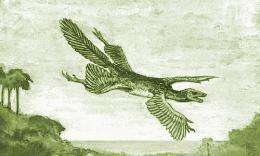
An image drawn in 1915 by naturalist William Beebe suggests a hypothetical view of what early birds may have looked like, gliding down from trees - and it bears a striking similarity to a fossil discovered in 2003 that is raising new doubts about whether birds descended from ground-dwelling theropod dinosaurs. Photo courtesy of Oregon State University

(PhysOrg.com) -- A new study just published in the Proceedings of the National Academy of Sciences provides yet more evidence that birds did not descend from ground-dwelling theropod dinosaurs, experts say, and continues to challenge decades of accepted theories about the evolution of flight.

A new analysis was done of an unusual fossil specimen discovered in 2003 called "microraptor," in which three-dimensional models were used to study its possible flight potential, and it concluded this small, feathered species must have been a "glider" that came down from trees. The research is well done and consistent with a string of studies in recent years that pose increasing challenge to the birds-from-dinosaurs theory, said John Ruben, a professor of zoology at Oregon State University who authored a commentary in PNAS on the new research.

The weight of the evidence is now suggesting that not only did birds not descend from dinosaurs, Ruben said, but that some species now believed to be dinosaurs may have descended from birds.

"We're finally breaking out of the conventional wisdom of the last 20 years, which insisted that birds evolved from dinosaurs and that the debate is all over and done with," Ruben said. "This issue isn't resolved at all. There are just too many inconsistencies with the idea that birds had dinosaur ancestors, and this newest study adds to that."

Almost 20 years of research at OSU on the morphology of birds and dinosaurs, along with other studies and the newest PNAS research, Ruben said, are actually much more consistent with a different premise - that birds may have had an ancient with dinosaurs, but they evolved separately on their own path, and after millions of years of separate evolution birds also gave rise to the raptors. Small animals such as that have generally been thought to be dinosaurs are more likely , he said.

"Raptors look quite a bit like dinosaurs but they have much more in common with birds than they do with other theropod dinosaurs such as Tyrannosaurus," Ruben said. "We think the evidence is finally showing that these animals which are usually considered dinosaurs were actually descended from birds, not the other way around."

Another study last year from Florida State University raised similar doubts, Ruben said.

In the newest PNAS study, scientists examined a remarkable fossil specimen that had feathers on all four limbs, somewhat resembling a bi-plane. Glide tests based on its structure concluded it would not have been practical for it to have flown from the ground up, but it could have glided from the trees down, somewhat like a modern-day flying squirrel. Many researchers have long believed that gliders such as this were the ancestors of modern birds.

"This model was not consistent with successful flight from the ground up, and that makes it pretty difficult to make a case for a ground-dwelling theropod dinosaur to have developed wings and flown away," Ruben said. "On the other hand, it would have been quite possible for birds to have evolved and then, at some point, have various species lose their flight capabilities and become ground-dwelling, flightless animals - the raptors. This may be hugely upsetting to a lot of people, but it makes perfect sense."

In their own research, including one study just last year in the Journal of Morphology, OSU scientists found that the position of the thigh bone and muscles in birds is critical to their ability to have adequate lung capacity for sustained long-distance flight, a fundamental aspect of bird biology. Theropod dinosaurs did not share this feature. Other morphological features have also been identified that are inconsistent with a bird-from-dinosaur theory. And perhaps most significant, birds were already found in the fossil record before the elaboration of the they supposedly descended from. That would be consistent with raptors descending from , Ruben said, but not the reverse.

OSU research on avian biology and physiology has been raising questions on this issue since the 1990s, often in isolation. More scientists and other studies are now challenging the same premise, Ruben said. The old theories were popular, had public appeal and "many people saw what they wanted to see" instead of carefully interpreting the data, he said.

"Pesky new fossils...sharply at odds with conventional wisdom never seem to cease popping up," Ruben wrote in his PNAS commentary. "Given the vagaries of the fossil record, current notions of near resolution of many of the most basic questions about long-extinct forms should probably be regarded with caution."

Provided by Oregon State University (news : web)

Filter


Move the slider to adjust rank threshold, so that you can hide some of the comments.


Display comments: newest first

Caliban
Feb 09, 2010

Rank: 1 / 5 (1)
Doesn't this theorizing necessarily presuppose a much greater age for the bird lineage? By, say, upwards of as much as 100 million years? Gonna have to dig up the fossils to prove it.
acarrilho
Feb 09, 2010

Rank: not rated yet
Was there a shortage of predators in the places where these birds allegedly became flightless? I don't see how it's better to become flightless in most places, apart from isolated islands.
barakn
Feb 09, 2010

Rank: 1 / 5 (1)
Oh, those island-dwelling ostriches. Oh, wait...
ubavontuba
Feb 09, 2010

Rank: not rated yet
Doesn't this theorizing necessarily presuppose a much greater age for the bird lineage? By, say, upwards of as much as 100 million years? Gonna have to dig up the fossils to prove it.


It says, "...birds were already found in the fossil record before the elaboration of the dinosaurs they supposedly descended from."

But then we're left wondering, just what in the heck did birds descend from? Flying fish?
Mercury_01
Feb 10, 2010

Rank: not rated yet
If its true, it changes the way I think about veloceraptor and deinonychus. Terrifying animals.
Doug_Huffman
Feb 10, 2010

Rank: not rated yet
If it's[sic] true, then it changes the way I think of crows and shrikes. Terrifying animals. Thank goodness they're small.
JayK
Feb 10, 2010

Rank: 1 / 5 (2)
Turkeys. It always comes back to those dang turkeys.

Thanksgiving is just thanking evolution for not ending up with humans being prey for turkeys.

Keep in mind that this article is from a "scientist" at Oregon State that has always been more interested in proving his hypothesis rather than following data. His challenges have been readily scoffed at by other evolutionary scientists and have been touted by none other than the Discovery Institute.
acarrilho
Feb 10, 2010

Rank: not rated yet
Oh, those island-dwelling ostriches. Oh, wait...


"Oh, wait" what? You realized there are, in fact, island-dwelling ostriches?
Lago
Feb 13, 2010

Rank: 5 / 5 (1)
The scientists above did not just discover something new and figure it must drive them towards a certain conclusion. They have been trying to back this idea for many years, and the evidence keeps making them look silly. To try and save face they keep making up new stories and positions to help their cases, but they just get more and more silly.

For example, they used to say the Maniraptorian dinosaurs were not related to birds, and birds could not be derived from them. Now we have huge amounts of maniraptorian fossils with feathers and every possible intermediate trait one could want between these dinosaurs and birds. So, did they give in? Of course not. Their new idea is now to claim those very same maniraptorian dinosaurs...the ones they said it was impossible to derive birds from in the first place according to them, are in fact birds, not theropod dinosaurs despite all the huge cladistical evidence that clearly, over and over again, places them neatly into that hierarchy.
Rank 4 /5 (19 votes)
Related Stories
Relevant PhysicsForums posts

More news stories

US workers are 'giving away the store,' costing firms billions

Nearly 70 percent of the nation's service employees give away free goods and services – from hamburgers to cable TV – costing companies billions of dollars a year, according to a groundbreaking study.

Other Sciences / Economics & Business

created 8 hours ago | popularity not rated yet | comments 6

Prague gets hold of modern genetics founder Mendel's papers

Germany has handed to the Czech Republic a manuscript of Johann Gregor Mendel, founder of modern genetics, on his plant hybridization experiments, the Czech foreign minister said Thursday.

Other Sciences / Other

created 5 hours ago | popularity not rated yet | comments 1

Storm warning: Financial tsunami heading this way

In today's global village, national coffers are more interconnected than ever before. And as the current economic crisis has proven, a downturn in one country can travel in a wave across the globe, like a financial tsunami. ...

Other Sciences / Economics & Business

created 9 hours ago | popularity 3 / 5 (2) | comments 5

Kids show cultural gender bias

(PhysOrg.com) -- Talk about gender confusion! A recent study by University of Alberta researchers Elena Nicoladis and Cassandra Foursha-Stevenson in the Journal of Cross-Cultural Psychology into whether speaki ...

Other Sciences / Social Sciences

created 14 hours ago | popularity 2 / 5 (1) | comments 2

'Flipped classroom' teaching model gains an online community

Researchers at Harvard University have launched the Peer Instruction (PI) Network, a new global social network for users of interactive teaching methods.

Other Sciences / Social Sciences

created 9 hours ago | popularity 5 / 5 (2) | comments 0


'Dark plasmons' transmit energy

Microscopic channels of gold nanoparticles have the ability to transmit electromagnetic energy that starts as light and propagates via "dark plasmons," according to researchers at Rice University.

Hydrogen from acidic water: Researchers develop potential low cost alternative to platinum for splitting water

A technique for creating a new molecule that structurally and chemically replicates the active part of the widely used industrial catalyst molybdenite has been developed by researchers with the Lawrence Berkeley ...

FDA-approved drug rapidly clears amyloid from the brain, reverses Alzheimer's symptoms in mice

Neuroscientists at Case Western Reserve University School of Medicine have made a dramatic breakthrough in their efforts to find a cure for Alzheimer's disease. The researchers' findings, published in the journal Science, show t ...

Ultraviolet protection molecule in plants yields its secrets

Lying around in the sun all day is hazardous not just for humans but also for plants, which have no means of escape. Ultraviolet (UV) radiation from the sun can damage proteins and DNA inside cells, leading ...

Anyone can learn to be more inventive, cognitive researcher says

There will always be a wild and unpredictable quality to creativity and invention, says Anthony McCaffrey, a cognitive psychology researcher at the University of Massachusetts Amherst, because an "Aha moment" is rare and ...

Cell biologists describes mechanism by which some people may be more susceptible to colon cancer

An international research team led by cell biologists at the University of California, Riverside has uncovered a new insight into colon cancer, the third leading cause of cancer-related deaths in the United ...