Climate 'Tipping Points' May Arrive Without Warning, Says Top Forecaster
February 9, 2010
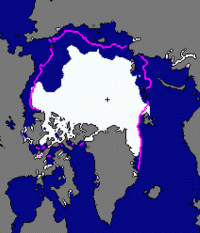
This graphic shows the extent of Arctic sea ice in September 2009 (in white) compared with the median ice extent for September from 1979 to 2000 (in magenta). (U.S. National Snow and Ice Data Center/map)
(PhysOrg.com) -- A new University of California, Davis, study by a top ecological forecaster says it is harder than experts thought to predict when sudden shifts in Earth's natural systems will occur -- a worrisome finding for scientists trying to identify the tipping points that could push climate change into an irreparable global disaster.
"Many scientists are looking for the warning signs that herald sudden changes in natural systems, in hopes of forestalling those changes, or improving our preparations for them," said UC Davis theoretical ecologist Alan Hastings. "Our new study found, unfortunately, that regime shifts with potentially large consequences can happen without warning -- systems can 'tip' precipitously.
"This means that some effects of global climate change on ecosystems can be seen only once the effects are dramatic. By that point returning the system to a desirable state will be difficult, if not impossible."
The current study focuses on models from ecology, but its findings may be applicable to other complex systems, especially ones involving human dynamics such as harvesting of fish stocks or financial markets.
Hastings, a professor in the UC Davis Department of Environmental Science and Policy, is one of the world's top experts in using mathematical models (sets of equations) to understand natural systems. His current studies range from researching the dynamics of salmon and cod populations to modeling plant and animal species' response to global climate change.
In 2006, Hastings received the Robert H. MacArthur Award, the highest honor given by the Ecological Society of America.
Hastings' collaborator and co-author on the new study, Derin Wysham, was previously a postdoctoral scholar at UC Davis and is now a research scientist in the Department of Computational and Systems Biology at the John Innes Center in Norwich, England.
Scientists widely agree that global climate change is already causing major environmental effects, such as changes in the frequency and intensity of precipitation, droughts, heat waves and wildfires; rising sea level; water shortages in arid regions; new and larger pest outbreaks afflicting crops and forests; and expanding ranges for tropical pathogens that cause human illness.
And they fear that worse is in store. As U.S. presidential science adviser John Holdren (not an author of the new UC Davis study) recently told a congressional committee: "Climate scientists worry about 'tipping points' ... thresholds beyond which a small additional increase in average temperature or some associated climate variable results in major changes to the affected system."
Among the tipping points Holdren listed were: the complete disappearance of Arctic sea ice in summer, leading to drastic changes in ocean circulation and climate patterns across the whole Northern Hemisphere; acceleration of ice loss from the Greenland and Antarctic ice sheets, driving rates of sea-level increase to 6 feet or more per century; and ocean acidification from carbon dioxide absorption, causing massive disruption in ocean food webs.
More information: The study, "Regime shifts in ecological systems can occur with no warning," was published online today by the journal Ecology Letters, in its Early View feature: http://www3.inters … 879/abstract .
Provided by University of California - Davis
-
Study: Icebergs create ocean 'hot spots'
Jun 20, 2007 |
not rated yet |
0
-
Research indicates ocean current shutdown may be gradual
Jul 16, 2009 |
not rated yet |
0
-
Coral Reefs: Ever Closer to Cliff's Edge
Nov 01, 2007 |
not rated yet |
0
-
Scientists warn on climate tipping points
Mar 17, 2009 |
not rated yet |
0
-
Sea level on the rise – in real and virtual worlds
Feb 01, 2007 |
not rated yet |
0
-
Engineers build first sub-10-nm carbon nanotube transistor
Feb 01, 2012 |
4.9 / 5 (31) |
30
-
Something old, something new: Evolution and the structural divergence of duplicate genes
Jan 31, 2012 |
4.6 / 5 (7) |
1
-
The hidden nanoworld of ice crystals: Revealing the dynamic behavior of quasi-liquid layers
Jan 30, 2012 |
5 / 5 (3) |
1
-
Stock market network reveals investor clustering
Jan 27, 2012 |
3.9 / 5 (23) |
8
-
Of microchemistry and molecules: Electronic microfluidic device synthesizes biocompatible probes
Jan 26, 2012 |
5 / 5 (1) |
0
-
Discrepancy between oxygen and carbon-dioxide levels
Feb 09, 2012
-
where gems are found in the world
Feb 09, 2012
-
Wind Waves in Reservoir ~ Wind run-up and Wind set-up
Feb 08, 2012
-
Balance of oxygen in the atmosphere
Feb 01, 2012
-
The case for a methanol-based economy
Jan 30, 2012
-
Weather in a rotating cylinder
Jan 25, 2012
- More from Physics Forums - Earth
More news stories
Humans may have helped the decline of African rainforests 3000 years ago
(PhysOrg.com) -- Large areas of rainforests in Central Africa mysteriously disappeared over three thousand years ago, to be replaced by savannas. The prevailing theory has been that the cause was a change ...
Could Venus be shifting gear?
(PhysOrg.com) -- ESAs Venus Express spacecraft has discovered that our cloud-covered neighbour spins a little slower than previously measured. Peering through the dense atmosphere in the infrared, the ...
Space & Earth / Space Exploration
16 hours ago |
5 / 5 (7) |
7
|
NASA budget will axe Mars deal with Europe: scientists
US President Barack Obama's budget proposal to be submitted next week for 2013 will cut NASA's budget by 20 percent and eliminate a major partnership with Europe on Mars exploration, scientists said Thursday.
Space & Earth / Space Exploration
19 hours ago |
5 / 5 (2) |
18
Mars Science Laboratory computer issue resolved
(PhysOrg.com) -- Engineers have found the root cause of a computer reset that occurred two months ago on NASA's Mars Science Laboratory and have determined how to correct it.
Space & Earth / Space Exploration
17 hours ago |
4.7 / 5 (6) |
3
|
Two new moons for Jupiter
Advances in technology have lead to the discovery of new planets outside of our Solar System, and now even new moons in our own backyard.
Space & Earth / Space Exploration
16 hours ago |
4 / 5 (1) |
7
Anonymous knocks CIA website offline (Update)
The website of the Central Intelligence Agency was inaccessible on Friday after the hacker group Anonymous claimed to have knocked it offline.
Google users warned of threat to smartphone wallets
Users of Google smartphone wallets were being warned on Friday that there is a way to crack pass codes intended to thwart thieves from going on illicit shopping sprees.
New error-correcting codes guarantee the fastest possible rate of data transmission
Error-correcting codes are one of the triumphs of the digital age. Theyre a way of encoding information so that it can be transmitted across a communication channel such as an optical fiber o ...
New power source discovered
(PhysOrg.com) -- Researchers at the Massachusetts Institute of Technology (MIT) and RMIT University have made a breakthrough in energy storage and power generation.
The power of estrogen -- male snakes attract other males
A new study has shown that boosting the estrogen levels of male garter snakes causes them to secrete the same pheromones that females use to attract suitors, and turned the males into just about the sexiest ...
Small modular reactor design could be a 'SUPERSTAR'
(PhysOrg.com) -- Though most of today's nuclear reactors are cooled by water, we've long known that there are alternatives; in fact, the world's first nuclear-powered electricity in 1951 came from a reactor ...
Feb 09, 2010
Rank: 3.8 / 5 (11)
As with any equilibrium state, an energetic system is implied. Once the system has reestablished equilibrium, it requires arbitrarily large amounts of energy to change it to a higher or lower equilibrium state. When you consider this on a global, environmental scale, it should be pretty obvious that the effects are irreversible- at least in any real way.
Feb 09, 2010
Rank: 3 / 5 (11)
The weather, and by extension climate, is not an equilibrium system. It is chaos driven and there fore can not be stable in any sense of the term.
For the article:
The author of the paper is listed as a "theoretical ecologist". Not a meteorologist. Not an atmospheric thermodynamicist or physicist. Were the referenced "tipping points" from computer models or from natural historical events? If it's from models then they need to pile up supporting historical facts, and even then it wouldn't say anything about the hypothetical AGW.
Feb 09, 2010
Rank: 3.5 / 5 (10)
Gotta disagree with you on the principle of equilibrium. While it is true that weather/ climate is chaos driven on a micro-scale, it is an equilibrium system on macroscale, and therefore subject to change with addition or subtraction of energy, whether that energy derives from intrusive geologically-driven events or from absorption of solar energy, or extra-solar sources. Add to that the possibility of interference through human activity(as in fossil-fuel burning), and you have a quite complicated group of interrelated factors that can affect weather/climate on local and/or global scale.
Feb 09, 2010
Rank: 3.2 / 5 (13)
Just because it is chaotic doesn't mean it doesn't have an overall equilibrium, it does. Caliban is exactly right. I have been saying the same thing for over 20 years, people thought I was nuts back then. Unfortunately for us, some people still think it's nuts. We are putting billions of tons of greenhouse gases in the atmosphere, it does not magically disappear or have no effect.
Feb 09, 2010
Rank: 3.5 / 5 (10)
Feb 10, 2010
Rank: 2.1 / 5 (14)
Feb 10, 2010
Rank: 3.6 / 5 (7)
Feb 10, 2010
Rank: 2.8 / 5 (8)
As we know Little Boy virtually destroyed the city of Hiroshima, the current energy imbalance is the equivalent of approx. 700,000 Hiroshimas being destroyed EVERY DAY!!
The above example is of course purely hypothetical and cannot be tested ;-)so cannot be peer-reviewed but it indicates the amount of energy required per day to raise the mean global temperature by 0.5C since 1960. If you still don't think that this much energy will not change climate patterns..............
Feb 10, 2010
Rank: 2.8 / 5 (13)
Oh you mean like the Ordovician, Devonian, Permian, Triassic and Cretacious mass extinctions...hmm
These scientists (or non-scientists...),
They are scientists, unlike Screaming Lord Monckton, new high priest for deniers!
You really have been at the Conspiracy theorist soup today haven't you!
You've really been suckered in by the 'Climategate' nonsense haven't you. Nobody has yet been able to prove any fraud is going on...no one.
Like the bomb analogy Mary, that's a hell of a lot of energy!
Feb 10, 2010
Rank: 3.5 / 5 (12)
Want to quantify the driving forces behind those mass extinctions? I'm fairly sure none of the theories around the above were due to a 1% change in quantity of an atmospheric trace gas. You're being overly alarmist and drawing unsubstantiated conclusions. Let the science be done before you pass judgement on a course of action.
There haven't been any reviews of the FOIA request denials and improper handling of data outside of the self interested institutions involved in the initial incidents.
Feb 10, 2010
Rank: 1.4 / 5 (9)
By the way, has anyone compared a volcanic eruption to man's affect on the weather (not that there is any)?
Feb 10, 2010
Rank: 5 / 5 (2)
The global climate system is a complex system of systems. Relative stability appears to be manifested by periodic oscillations in things like temperature, which generates local yearly weather patterns.
If we think of the injection of CO2 as a form of added energy (as it facilitates more trapped heat), then we should see weather oscillations of increased amplitude in addition to an increase in average global temperatures.
Yup, as you add energy to an oscillating signal, its oscillations get bigger. However, how does that relate to thresholds or break points? Sounds like a very complicated problem.
Feb 10, 2010
Rank: 1.8 / 5 (5)
Then again, they may not.
Feb 10, 2010
Rank: 3.8 / 5 (5)
I just wanted to comment on this piece - nobody is saying that climate change will make the Earth inhospitable to life. At least, certainly not in the immediate future. They are saying that it will change things. Rising oceans and badly screwed up weather will not end humanity; but it may cause tremendous suffering.
Feb 10, 2010
Rank: 2.1 / 5 (7)
Feb 10, 2010
Rank: 2.5 / 5 (8)
An 'honest' climate change scientist is painting yet another scary scenario from his computer!
Wolf! Wolf! Wolf!
Feb 10, 2010
Rank: 1 / 5 (4)
Good point. Though you probably meant to say it *will* cause tremendous suffering (heh-heh).
The recorded history of humanity pretty much documents mankind’s tremendous suffering. Why expect anything different from future history-- because we are somehow smarter? Ha.
If anyone thinks climate calamity will happen anytime soon, then sell your beach house, buy real estate in higher ground (in Canada or Mexico depending on what your best climate model projects). Manhattan, if not already, will be fully owned by China by "then" so really a non-issue. Predictions for tremendous economic activity should accompany any predicted suffering.
Feb 10, 2010
Rank: 4.5 / 5 (2)
Reminds me of Zorg's little monologue (right before he nearly chokes to death), from Fifth Element...
Feb 10, 2010
Rank: 5 / 5 (2)
I should say: no one wants people to suffer, but people will continue to suffer for all kinds of reasons (standard reasons and new reasons yet to be invented) no matter what I or anyone thinks or does. So what's one more reason? New climate challenges will create opportunity?? Probably, yes.
Feb 11, 2010
Rank: 2.7 / 5 (6)
There is no reason to believe in "macro" stability in a chaotic system. It would be, by definition, impossible to make that claim and history doesn't support it.
Feb 11, 2010
Rank: 4 / 5 (8)
Really? I have an experiment for you to try. Put a kettle of water on the stove, and bring that water to a boil. Now: has the temperature of the water stabilized? Is the turbulence inside the kettle not chaotic in nature?
A less artificial example: the atoms and molecules in your body are all moving chaotically. Is your body stable, or did it just fly apart? (If the latter, I'm sorry: I meant no harm...)
Feb 12, 2010
Rank: 3 / 5 (4)
Neither of these are examples of chaos driven systems.
For a brief introduction you might check Wikipedia:
http://en.wikiped...s_theory
Additionally, try checking their entry on Catastrophe theory:
http://en.wikiped...e_theory
Feb 12, 2010
Rank: 3.3 / 5 (4)
For a pot of boiling water, throw in a small plastic bead. Track the trajectory of that bead through time.
Ditto for your body. Take a particular molecule of oxygen, and track its trajectory as it enters and traverses your body.
In both cases, how do the respective trajectories change with a very small perturbation of the initial conditions?
The turbulence in the pot is exactly a chaotic system (as is pretty much any example of turbulence), and here you have the analogy: the turbulence is the weather, whereas the overall average temperature is the climate.
Feb 12, 2010
Rank: 3.8 / 5 (5)
Interesting as well how they either don't read, or, more likely don't understand the links yet still present them as evidence of their anti-science viewpoint. I have noticed this from a number of anti-science contributors lately.
Feb 12, 2010
Rank: 4 / 5 (5)
This is correct as far as it goes. It would adapt if the changes weren't ongoing. Adaptation doesn't just happen to a stable system, it will go into oscillation first before it settles down and then only if the changes stop. The changes are not stopping and the system is in oscillation, as evidenced by the new weather records being broken all the time. Higher highs, lower lows, more of this, less of that, etc. Our destabilizing input to the climate continues and is accelerating, the earth would adapt but we aren't giving it a chance to. When we finally do and it stabilizes, we aren't going to like the new climate. The point of no return is close or already past. Sell your shore property.
Feb 12, 2010
Rank: 2 / 5 (3)
In the absence of stability the only change would be in the rate of adaptation, not in the presence or continuance of adaptation.
You've created a logical inaccuracy, no adaptation is needed when a system no longer oscillates.
Feb 13, 2010
Rank: 3.7 / 5 (3)
TRULY sad, "the sky isn't falling, the sky isn't falling, the sk.....OUCH!"
Feb 13, 2010
Rank: 1 / 5 (3)
You'd think the reporter would at least have read the original paper!.
Based as it is on models, I thought a quote of Richard Lindzen's (Professor of Meteorology at MIT) thoughts on specific Climate Change models was relevant. Quote: [ ..current models depend heavily on undemonstrated positive feedback factors to predict high levels of warming. The effects of clouds have been receiving the closest scrutiny. That is not unreasonable. Cloud cover in models is poorly treated and inaccurately predicted. Yet clouds reflect about seventy-five watts per square meter. Given that a doubling of carbon dioxide would change the surface heat flux by only two watts per square meter, it is evident that a small change in cloud cover can strongly affect the response to carbon dioxide.] Unquote.
Draw your own conclusions people; but once again, a GW scam has been perpetrated, IMHO!
Feb 13, 2010
Rank: 1.5 / 5 (4)
You are mis-representing where energy comes from...
The amount of energy or power produced by humans is insignificant.
The solar constant is 174 PETAWATTS, which is 11 times the power used by all humans combined in 2010, according to wikipedia articles for Kardasheve scale and solar constants.
Get that straight.
Humans used 16 TERAWATTS in 2010.
The Solar constant for earth is 174 PETAWATTS PER SECOND...
Feb 14, 2010
Rank: 3 / 5 (2)
Feb 14, 2010
Rank: 2 / 5 (3)
Feb 15, 2010
Rank: 4 / 5 (4)
Feb 15, 2010
Rank: 5 / 5 (3)
Sancho- global cooling by volcanism occurs because of particulates and aerosols emitted by explosive eruption. By their nature underwater eruptions would not eject this matter into the stratosphere (unless they were particularly HUGE eruptions...which we will have noticed I think ;-)!
Feb 15, 2010
Rank: 5 / 5 (3)
Hello! Do you see any dinosaurs of mammoths around? When "the climate adapts with it", a whole lot of species get wiped out. The ones at the top of the food-chain always do. That is what adaptation means: Cleaning the slate till a stable state is reached. The dirt on the slate happens to be mostly made of carbon. Like us.
Feb 15, 2010
Rank: 2.3 / 5 (4)
Read that again. You're saying the CO2 produced by man, and the CO2 produced by volcanoes have different halflives.
You're incorrect, again.
Feb 15, 2010
Rank: 1 / 5 (3)
2. http://www.cv-hel...est.html sunspots are a key to many issues. 3. The map of the ice does not show thickness or change over time the other way around. How much of an convenient truth that in the 70s were in a ICE AGE panic. You wont see that data because its an incovenient fact the global warming bunch wont publish. Besides that Dupont made a killing when their patent ran out on CFCs almost to the day it was banned. They showed a Ozone hole growing by massaging the data. Someone is going to make a fortune here with the global warming as well. Just know that the powers at be will make us pay no matter what unless the king has no clothes.
Feb 15, 2010
Rank: 2.3 / 5 (3)
Oh dear oh dear, this is something the other troll dachpy does all the time! Advice to our Deutche Canadian troll READ OTHER POSTERS COMMENTS CAREFULLY!!!
It is quite clear that the poster was referring to VOLCANIC PARTICLES, NOT CO2!!
Anymore of this and you will be added to the list of trolls who are better ignored so we can have discussions with those who genuinely want to learn.
Feb 15, 2010
Rank: 1 / 5 (3)
Game over.
Feb 15, 2010
Rank: 4.7 / 5 (3)
Feb 15, 2010
Rank: 1 / 5 (3)
Funny, because my education tells me the primary gasses emitted during an eruption in order of most to least are water vapor (H2O), carbon dioxide (CO2), and sulfur either as sulfur dioxide (SO2) or hydrogen sulfide (H2S).
So which particles are being referred to? The conversation was in regards to gas, and suddenly the term particle was used. I'm guessing you/he are/is talking about ash, which is kind of a joke to really talk about as ash can spend up to a hundred years depending on weight and air currents as well as how high it's ejected into the atmosphere.
Again, I find it interesting that you tend to speak for other posters, when they seem entirely capable of speaking for themselves.
Feb 15, 2010
Rank: 5 / 5 (4)
http://en.wikiped...2004.png
Compared with volcanic emission:
Above excerpted from:
http://en.wikiped...mosphere
Feb 16, 2010
Rank: 3 / 5 (1)
Want to point out where I was speaking about volume of natural vs manmade emissions? My statement was in regards to another posters inaccurate discussion of the "non-issue" of volcanic eruption.
Aside from being in a relative state of climate calm, we're also in a state of abnormal tectonic quiet.
Feb 16, 2010
Rank: 3 / 5 (2)
Feb 16, 2010
Rank: 1 / 5 (1)
So you wouldn't agree with some of your cohorts that it is increasing vulcanism that is heating up the seas, now that's refreshingly honest of you ;-)
Feb 16, 2010
Rank: 5 / 5 (1)
You'd have to point out where I've been dubious prior in order for it to be "refreshing."
No I can't state that increased vulcanism is the cause as I don't know. We really don't have a solid active subsurface volcano map to go off of, let alone the monitoring equipment in place to determine if that is the case.
It's possible that suboceanic volcanoes are warming the planet, but I'd need to see a lot of data for that to be the fact of the matter.
And no one is my "cohort" in a discussion of observation. Science isn't exactly a team sport. It's either true and verified, or not true and disproved.
Feb 16, 2010
Rank: 5 / 5 (3)
Here:
The point wasn't about "different halflives", it was about the fact that human industrial emissions of CO2 utterly dwarf volcanic emissions, already by a factor of 100:1, and continuing to grow rapidly. IOW, modern global civilization is already artificially creating the equivalent of 100 additional volcanic eruptions PER YEAR, every year.
With that in mind, it becomes important to consider how long that additional gas remains in the atmosphere, which would of course determine the ultimate concentration that will be achieved. Apparently, it stays there for a rather prolonged period...