Students find 'lost' office gear with tiny sensors
February 10, 2010
Students find ?lost? office gear with tiny sensors

Enlarge

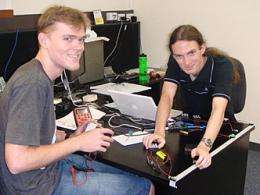
Blake Newman and David Kooymans working on FLECK nano. Image credit - Samuel Klistorner, CSIRO

(PhysOrg.com) -- Miniature sensors being developed by CSIRO promise to provide the answers to questions which seem to arise regularly in modern office workplaces like: "Where's my pen?" and; "Who nicked my stapler?"

CSIRO is developing FLECK Nano - a miniature version of the highly successful FLECK that independently record environmental conditions then cooperate with each other to wirelessly send their data to a collection point.

Two students working with CSIRO's vacation scholarship scheme have been applying their research skills to bringing FLECK Nanos indoors. Doing so means things like temperature and power use can be monitored at a very refined level and small objects can be tracked unobtrusively.

“The idea of pervasive computing has been touted for some time, but is not yet available for everyday office items,” CSIRO ICT Centre researcher, Phil Valencia, says.

“We’re aiming to enable a level of ubiquitous sensing that hasn’t been experienced yet and see how it impacts on day-to-day office activities.”

Two university students have spent their summer holidays working with Mr Valencia as part of CSIRO’s vacation scholarship scheme.

A student at the Australian National University, David Kooymans, is working on reducing the energy demands of mobile FLECK Nanos.

“They communicate with a node in a known location using ,” Mr Kooymans says.

“The more frequently location information is updated the more useful the other data becomes, but the transmitters consume a high proportion of energy so there’s a trade-off to be negotiated there.”

An electrical engineering student at the University of Queensland, Blake Newman, is looking for ways FLECK Nanos could ‘scavenge’ energy from the environment.

“You don’t want to be changing batteries in thousands of little devices so we are designing energy scavenging that will make power from whatever source it can,” Mr Valencia says.

“If a device doesn’t need much power, it’s amazing how much energy is all around just waiting to be tapped. For example, a FLECK Nano attached to a stapler on a desk in a windowless office is able to function if there is enough light to work by.”

More information: http://www.csiro.a … hnology.html

Provided by CSIRO (news : web)

Filter


Move the slider to adjust rank threshold, so that you can hide some of the comments.


Display comments: newest first

fixer
Feb 10, 2010

Rank: not rated yet
Tag everything in your house, including the cards in your wallet and you put an end to most crime.
If your missing wallet communicates with wifi or phone cells you could track it with gps.
Rank 3 /5 (2 votes)
Related Stories
Relevant PhysicsForums posts
  • Calling function with no input argument
    created8 hours ago
  • Force free body diagram problem on gym equipment
    created9 hours ago
  • Empirical data regarding shower heads and water
    created17 hours ago
  • feed hold button on CNC lathe
    createdFeb 09, 2012
  • RFAC in Fortran
    createdFeb 09, 2012
  • dynamics 2/32
    createdFeb 08, 2012
  • More from Physics Forums - General Engineering

More news stories

Google users warned of threat to smartphone wallets

Users of Google smartphone wallets were being warned on Friday that there is a way to crack pass codes intended to thwart thieves from going on illicit shopping sprees.

Technology / Internet

created 1 hour ago | popularity 5 / 5 (1) | comments 0

Anonymous knocks CIA website offline (Update)

The website of the Central Intelligence Agency was inaccessible on Friday after the hacker group Anonymous claimed to have knocked it offline.

Technology / Internet

created 2 hours ago | popularity 5 / 5 (4) | comments 8

New error-correcting codes guarantee the fastest possible rate of data transmission

Error-correcting codes are one of the triumphs of the digital age. They’re a way of encoding information so that it can be transmitted across a communication channel — such as an optical fiber o ...

Technology / Computer Sciences

created 11 hours ago | popularity 5 / 5 (4) | comments 5 | with audio podcast

New power source discovered

(PhysOrg.com) -- Researchers at the Massachusetts Institute of Technology (MIT) and RMIT University have made a breakthrough in energy storage and power generation.

Technology / Energy & Green Tech

created 10 hours ago | popularity 4.8 / 5 (16) | comments 5 | with audio podcast

Small modular reactor design could be a 'SUPERSTAR'

(PhysOrg.com) -- Though most of today's nuclear reactors are cooled by water, we've long known that there are alternatives; in fact, the world's first nuclear-powered electricity in 1951 came from a reactor ...

Technology / Energy & Green Tech

created 10 hours ago | popularity 4.2 / 5 (10) | comments 19 | with audio podcast


Complex wiring of the nervous system may rely on a just a handful of genes and proteins

Researchers at the Salk Institute have discovered a startling feature of early brain development that helps to explain how complex neuron wiring patterns are programmed using just a handful of critical genes. ...

NASA sees wide-eyed cyclone Jasmine

Cyclone Jasmine's eye has opened wider on NASA satellite imagery, as it moves through the Southern Pacific Ocean.

NASA sees Giovanna reach cyclone strength, threaten Madagascar

Tropical Storm 12S built up steam and became a cyclone on February 10, 2012 as NASA's Terra satellite passed overhead. Residents of east-central Madagascar should prepare for this cyclone to make landfall ...

Putting the squeeze on planets outside our solar system

(PhysOrg.com) -- Using high-powered lasers, scientists at Lawrence Livermore National Laboratory and collaborators discovered that molten magnesium silicate undergoes a phase change in the liquid state, abruptly ...

The power of estrogen -- male snakes attract other males

A new study has shown that boosting the estrogen levels of male garter snakes causes them to secrete the same pheromones that females use to attract suitors, and turned the males into just about the sexiest ...

Grass to gas: Researchers' genome map speeds biofuel development

Researchers at the University of Georgia have taken a major step in the ongoing effort to find sources of cleaner, renewable energy by mapping the genomes of two originator cells of Miscanthus x giganteus, a large perenn ...