German researchers develop new tool to investigate ion channels
February 10, 2010
MDC researchers develop new tool to investigate ion channels

Enlarge

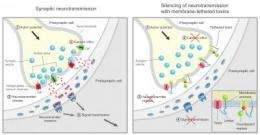
Neurotoxins from cone snails and spiders help neurobiologists Sebastian Auer, Annika S. Stürzebecher and Dr. Ines Ibañez-Tallon of the Max Delbrück Center for Molecular Medicine Berlin-Buch, Germany, to investigate the function of ion channels in neurons. Ion channels in the cell membrane enable cells to communicate with their environment and are therefore of vital importance. The MDC researchers have developed a system which for the first time allows the targeted, long-lasting investigation of ion channel function in mammals and also the blockade of the ion channels with neurotoxins. In transgenic mice they succeeded in blocking chronic pain by introducing a toxin gene into the organism (Nature Method, doi:10.1038/NMETH.1425). Credit: Graphics: Sebastian Auer/Copyright: MDC

Neurotoxins from cone snails and spiders help neurobiologists Sebastian Auer, Annika S. Stürzebecher and Dr. Ines Ibañez-Tallon of the Max Delbrück Center for Molecular Medicine (MDC) Berlin-Buch, Germany, to investigate the function of ion channels in neurons.

Ion channels in the enable cells to communicate with their environment and are therefore of vital importance. The MDC researchers have developed a system which for the first time allows the targeted, long-lasting investigation of ion channel function in mammals and also the blockade of the with neurotoxins. In they succeeded in blocking by introducing a toxin gene into the organism.

There are approximately 500 species of cone snails, each producing 50 - 200 different conotoxins. A similar number of peptide toxins are produced by snakes, spiders, sea anemones, scorpions and other venomous animals. The animals use the neurotoxins to paralyze their prey.

Scientists estimate that more than 100,000 neurotoxins exist. They have become a topic of enormous research interest: Using neurotoxins researchers can target different ion channels, receptors and other signaling molecules and characterize their physiological function.

This kind of research can also give them insight into disease processes and eventually help them to find new therapies to eventually block hyperactive ion channels. For instance, a compound (Ziconotide) based on the toxin of a cone snail is already used to treat severe chronic pain in patients.

Dr. Ibañez-Tallon's research group is concentrating on two ion channels in the membrane of neurons which are activated by electric stimulation (action potential). Once activated, they allow the influx of into the neuron, and the cell then releases chemicals (neurotransmitters), which send the signal to the next neuron.

During the last decades soluble neurotoxins have greatly helped in the characterization of ion channels and receptors because of their ability to specifically bind and inhibit these channels. However, soluble neurotoxins can only be applied for limited time, and their activity cannot be directed to specific cells.

Sebastian Auer, Annika S. Stürzebecher and Dr. Ibañez-Tallon managed to circumvent this problem with genetic engineering. Using lentiviruses they developed a shuttle to deliver the genes of cone snail and spider toxins into the neurons. The result: The neurons now long-lastingly produce toxins which directly bind to the calcium ion channels the researchers want to investigate. This was the first step - the targeted and long-lasting binding of the toxins to a specific ion channel in the cell culture.

Secondly, the researchers were able to demonstrate that with their tool they can also express toxin genes in animals in a targeted way and also lastingly characterize ion channels. In transgenic mice they were able to block certain calcium ion channels with their toxins and thus block chronic pain.

More information: Silencing neurotransmission with membrane-tethered toxins, Nature Methods, doi:10.1038/NMETH.1425.

Provided by Helmholtz Association of German Research Centres (news : web)


Rank not rated yet
Related Stories
Relevant PhysicsForums posts
  • Stoichiometry
    created16 hours ago
  • Boiling and melting point of impure substances
    created17 hours ago
  • Safe nitrogen compound to decompose a 500 deg C in a furnace?
    createdFeb 09, 2012
  • [ask]electron inside drinking water
    createdFeb 08, 2012
  • How to avoid formation of Lithium Chromate ???
    createdFeb 08, 2012
  • how to choose a reduced or oxidated form in a redox
    createdFeb 08, 2012
  • More from Physics Forums - Chemistry

More news stories

Fool's gold may prove an unlikely alternative to overexploited catalytic materials

Catalytic materials, which lower the energy barriers for chemical reactions, are used in everything from the commercial production of chemicals to catalytic converters in car engines. However, with current catalytic materials ...

Chemistry / Materials Science

created 7 hours ago | popularity 4.8 / 5 (4) | comments 2 | with audio podcast

Unpicking HIV’s invisibility cloak

Drug researchers hunting for alternative ways to treat human immunodeficiency virus (HIV) infections may soon have a novel target—its camouflage coat. HIV hides inside a cloak unusually rich in a sugar ...

Chemistry / Biochemistry

created 7 hours ago | popularity 5 / 5 (2) | comments 0

No entry without protein recycling: Researchers discover new coherence in enzyme transport

The group of Prof. Dr. Ralf Erdmann at the Ruhr-Universität Bochum, Germany, discovered a connection of peroxisomal protein import and receptor export. In the Journal of Biological Chemistry, they disclo ...

Chemistry / Biochemistry

created 7 hours ago | popularity not rated yet | comments 0

Under the microscope #7

In this video Dr Ingrid Graz shows us a thin layer of gold on top of rubber. Cracks in the gold allow it to stretch and we can use this for stretchable electronics.

Chemistry / Other

created 9 hours ago | popularity not rated yet | comments 0

Hydrogen from acidic water: Researchers develop potential low cost alternative to platinum for splitting water

A technique for creating a new molecule that structurally and chemically replicates the active part of the widely used industrial catalyst molybdenite has been developed by researchers with the Lawrence Berkeley ...

Chemistry / Materials Science

created Feb 09, 2012 | popularity 5 / 5 (12) | comments 12 | with audio podcast


Google users warned of threat to smartphone wallets

Users of Google smartphone wallets were being warned on Friday that there is a way to crack pass codes intended to thwart thieves from going on illicit shopping sprees.

NASA sees wide-eyed cyclone Jasmine

Cyclone Jasmine's eye has opened wider on NASA satellite imagery, as it moves through the Southern Pacific Ocean.

NASA sees Giovanna reach cyclone strength, threaten Madagascar

Tropical Storm 12S built up steam and became a cyclone on February 10, 2012 as NASA's Terra satellite passed overhead. Residents of east-central Madagascar should prepare for this cyclone to make landfall ...

CIA website offline, Anonymous takes credit

The website of the Central Intelligence Agency was unresponsive on Friday after the hacker group Anonymous claimed to have knocked it offline.

Complex wiring of the nervous system may rely on a just a handful of genes and proteins

Researchers at the Salk Institute have discovered a startling feature of early brain development that helps to explain how complex neuron wiring patterns are programmed using just a handful of critical genes. ...

The power of estrogen -- male snakes attract other males

A new study has shown that boosting the estrogen levels of male garter snakes causes them to secrete the same pheromones that females use to attract suitors, and turned the males into just about the sexiest ...