Are bees also addicted to caffeine and nicotine?
February 10, 2010
bee

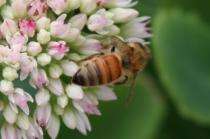
Photo: Annemarie Mountz

A study carried out at the University of Haifa has found that bees prefer nectar with a small concentration of caffeine and nicotine over nectar that does not comprise these substances at all. "This could be an evolutionary trait intended to make the bee addicted," the researchers say.

Bees prefer nectar with small amounts of nicotine and over nectar that does not comprise these substances at all, a study from the University of Haifa reveals. "This could be an evolutionary development intended, as in humans, to make the bee addicted," states Prof. Ido Izhaki, one of the researchers who conducted the study.

Flower nectar is primarily comprised of sugars, which provide energy for the potential pollinators. But the floral nectar of some plant species also includes small quantities of substances known to be toxic, such as caffeine and nicotine. The present study, carried out by researchers at the Department of Environmental and and the Department of Science Education at the University of Haifa-Oranim, headed by Prof. Ido Izhaki along with Prof. Gidi Ne'eman, Prof. Moshe Inbar and Dr. Natarajan Singaravelan, examined whether these substances are intended to "entice" the bees or whether they are byproducts that are not necessarily linked to any such objective.

Nicotine is found naturally in floral nectar at a concentration of up to 2.5 milligrams per liter, primarily in various types of tobacco tree (Nicotiana glauca). Caffeine is found at concentration levels of 11-17.5 milligrams per liter, mostly in citrus flowers. In the nectar of grapefruit flowers, however, caffeine is present in much higher concentrations, reaching 94.2 milligrams per liter. In order to examine whether bees prefer the nectar containing caffeine and nicotine, the researchers offered artificial nectar that comprised various natural sugar levels and various levels of caffeine and nicotine, alongside "clean" nectar that comprised sugar alone. The caffeine and nicotine concentrations ranged from the natural levels in floral nectar up to much higher concentrations than found in nature.

The results showed that bees clearly prefer nectar containing nicotine and caffeine over the "clean" nectar. The preferred nicotine concentration was 1 milligram per liter, similar to that found in nature. Given a choice of higher levels of nicotine versus "clean" nectar, the bees preferred the latter.

According to the researchers, it is difficult to determine for sure whether the addictive substances in the became present in an evolutionary process in order to make pollination more efficient. It can be assumed, however, based on the results of the study, that the plants that survived natural selection are those that developed "correct" levels of these addictive substances, enabling them to attract and not repel bees, thereby giving them a significant advantage over other plants. The researchers emphasized that this study has proved a preference, not addiction, and they are currently examining whether the do indeed become addicted to and caffeine.

Provided by University of Haifa (news : web)

4.6 /5 (5 votes)  

Filter


Move the slider to adjust rank threshold, so that you can hide some of the comments.


Display comments: newest first

yyz
Feb 10, 2010

Rank: not rated yet
If there is something to this finding, what about other plants known to make addictive substances, like poppy and coca?
persephone1961
Feb 10, 2010

Rank: not rated yet
beekeepers use nicotine smoke to stun bees when they are removing the trays of honeycomb from the hives--could this result in a pre-existing addiction to nicotine?
Doug_Huffman
Feb 10, 2010

Rank: not rated yet
Nicotine, certainly, and likely caffeine are used in pesticides.
Caliban
Feb 10, 2010

Rank: 1 / 5 (1)
In this context, gives new meaning to the term "buzzing bees"...not surprising, though- many of our friends in the animal kingdom make use of these compounds. Supposedly, coffee was discoverd by an Abyssinian shepherd, when he noticed that his goats would get frisky after eating the beans of the coffee plant.
CarolinaScotsman
Feb 11, 2010

Rank: 5 / 5 (1)
I suppose next we'll hear of the dangers of second hand honey.
Rank 4.6 /5 (5 votes)
Related Stories
Relevant PhysicsForums posts
  • Homo Sapien vs. Chimpanzee - Divergence Timeline
    created5 hours ago
  • a single mRNA strand is attached to sevaral ribosomes?
    createdFeb 08, 2012
  • Oestrogen and FSH
    createdFeb 07, 2012
  • Linear Blood Vessel Network Examples in Animals or Plants
    createdFeb 07, 2012
  • Neuroscientists: What is a Principal Cell Layer?
    createdFeb 06, 2012
  • How does slime mould grow?
    createdFeb 04, 2012
  • More from Physics Forums - Biology

More news stories

Life in Antarctic lake? It's everywhere else

If scientists find microbes in a frigid lake two miles beneath the thick ice of Antarctica, it will illustrate once again that somehow life finds a way to survive in the strangest and harshest places.

Biology / Plants & Animals

created 1 hour ago | popularity 1 / 5 (1) | comments 0

Fruit flies drawn to the sweet smell of youth

Aging takes its toll on sex appeal and now an international team of researchers led by Baylor College of Medicine and the University of Michigan find that in fruit flies, at least, it even diminishes the come-hither ...

Biology / Plants & Animals

created 1 hour ago | popularity not rated yet | comments 0 | with audio podcast

Amazing skin gives sharks a push

Shark skin has long been known to improve the fish's swimming performance by reducing drag, but now George Lauder and Johannes Oeffner from Harvard University show that in addition, the skin generates thrust, ...

Biology / Plants & Animals

created 1 hour ago | popularity 4 / 5 (2) | comments 0 | with audio podcast

How the zebra got its stripes

If there was a 'Just So' story for how the zebra got its stripes, I'm sure that Rudyard Kipling would have come up with an amusing and entertaining camouflage explanation. But would he have come up with the explanation that ...

Biology / Plants & Animals

created 1 hour ago | popularity 4 / 5 (1) | comments 0

Judge tosses case seeking rights for orcas

(AP) -- An effort to free whales from SeaWorld by claiming they were enslaved made a splash in the news but flopped in court Wednesday.

Biology / Plants & Animals

created 1 hour ago | popularity 4 / 5 (1) | comments 0


Bonding out: Making companies pay up front for potential environmental disasters

Whether it’s building an oil pipeline, drilling for fuel in the ocean or “fracking” to flush natural gas out of the Earth, we’re often asked to believe the process is safe, when companies want to do something ...

Soraa LED light may dim 50-watt halogen rivals

(PhysOrg.com) -- Soraa, a Fremont, California company founded in 2008, this week launched its first product, a light that uses LEDS (light emitting diodes). The "Soraa LED MR16 lamp" is the "perfect" replacement for traditional ...

Facebook discloses details on bonuses

Facebook's top executives, including CEO Mark Zuckerberg, are eligible for twice-a-year bonuses of up to 45 percent of their base salaries and other earnings, according to a Wednesday regulatory filing.

Mexican experts excited to find ancient home ruins

(AP) -- The ruins aren't particularly impressive, just some stone and clay footings for houses that probably supported walls of wood or clay wattle. And it's that very ordinariness that has experts excited.

New study shows high cost of defensive medicine

Vanderbilt University Medical Center researchers estimate that U.S. orthopaedic surgeons create approximately $2 billion per year in unnecessary health care costs associated with orthopaedic care due to the practice of defensive ...

Management of TB cases falls short of international standards

The management of tuberculosis cases in the European Union (EU) is not meeting international standards, according to new research.