Researchers Develop Nanofiber-Based Technology to Make Energy-Efficient Lighting
February 10, 2010
Solid-State Lighting Device
(PhysOrg.com) -- RTI International has developed a revolutionary lighting technology that is more energy efficient than the common incandescent light bulb and does not contain mercury, making it environmentally safer than the compact fluorescent light (CFL) bulb.
At the core of RTI's breakthrough is an advanced nanofiber structure that provides exceptional lighting management. Nanofibers are materials with diameters and surface features much smaller than the human hair but with comparable lengths.
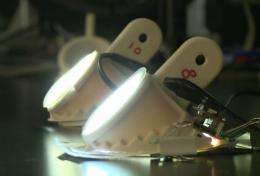
This video describes RTI's development of a polymer nanofiber material with nanoscale properties that provides cost-effective management of visible light in a solid-state lighting device. Prototypes of unique lighting device designs incorporating this breakthrough are also shown in the video. These device prototypes produce full-spectrum white light more efficiently than standard incandescent or fluorescent lights and also provide excellent color-rendering performance. The project is funded by the Department of Energy.
RTI's technology, which was funded in part by the Department of Energy's Solid-State Lighting program, centers around advancements in the nanoscale properties of materials to create high-performance, nanofiber-based reflectors and photoluminescent nanofibers (PLN). When the two nanoscale technologies are combined, a high-efficiency lighting device is produced that is capable of generating in excess of 55 lumens of light output per electrical watt consumed. This efficiency is more than five times greater than that of traditional incandescent bulbs."By using flexible photoluminescent nanofiber technologies for light management, RTI has opened the door to the creation of new designs for solid-state lighting applications," says Lynn Davis, Ph.D., director of RTI's Nanoscale Materials Program. "This new class of materials can provide cost-effective, safe and efficient lighting solutions."
Additionally, RTI's technology produces an aesthetically pleasing light with better color rendering properties than is typically found in CFLs. The technology has demonstrated color rendering indices in excess of 90 for warm white, neutral white, and cool white illumination sources.
"Because lighting consumes almost one-fourth of all electricity generated in the United States, our technology could have a significant impact in reducing energy consumption and carbon dioxide emissions," Davis said. "The technology also does not contain mercury, which makes it more environmentally friendly and safer to handle than CFLs and other fluorescent lamps."
It is anticipated that commercial products containing this breakthrough will be available in three to five years.
Provided by RTI International
-
High-brightness breakthrough
Jun 28, 2005 |
not rated yet |
0
-
First global lighting study is released
Jun 29, 2006 |
not rated yet |
0
-
Universal Display First to Achieve 30 Lumens Per Watt White OLED
Aug 05, 2005 |
not rated yet |
0
-
Advances in Phosphorescent OLED Technology Provide Additional Power Efficiency Gains for White Lighting
Jul 30, 2004 |
not rated yet |
0
-
Company Claims ESLs to be the Future of Light Bulbs (w/ Video)
Sep 16, 2009 |
not rated yet |
0
-
Engineers build first sub-10-nm carbon nanotube transistor
Feb 01, 2012 |
4.9 / 5 (30) |
30
-
Something old, something new: Evolution and the structural divergence of duplicate genes
Jan 31, 2012 |
4.6 / 5 (7) |
1
-
The hidden nanoworld of ice crystals: Revealing the dynamic behavior of quasi-liquid layers
Jan 30, 2012 |
5 / 5 (3) |
1
-
Stock market network reveals investor clustering
Jan 27, 2012 |
3.9 / 5 (23) |
8
-
Of microchemistry and molecules: Electronic microfluidic device synthesizes biocompatible probes
Jan 26, 2012 |
5 / 5 (1) |
0
-
Corrosion Tests on Magnesium
11 hours ago
-
polyethylene copper nanocomposite
17 hours ago
-
Output of xrd analysis
Feb 08, 2012
-
Transport phenomena problem based on problems 18.B11 and 19B.6 from Bird, stewart, lw
Feb 06, 2012
-
Help with material selection - Car Piston
Feb 05, 2012
-
Name of the steel alloy?!!?
Feb 02, 2012
- More from Physics Forums - Materials & Chemical Engineering
More news stories
'Dark plasmons' transmit energy
Microscopic channels of gold nanoparticles have the ability to transmit electromagnetic energy that starts as light and propagates via "dark plasmons," according to researchers at Rice University.
7 hours ago |
5 / 5 (4) |
0
|
Nanotube therapy takes aim at breast cancer stem cells
Wake Forest Baptist Medical Center researchers have again proven that injecting multiwalled carbon nanotubes (MWCNTs) into tumors and heating them with a quick, 30-second laser treatment can kill them.
Nanotechnology / Bio & Medicine
12 hours ago |
5 / 5 (1) |
0
|
Inspired by steel, nanomanufacturing gets wear-resistant carbide tip
(PhysOrg.com) -- Scientists at the University of Pennsylvania, the University of Wisconsin-Madison and IBM Research - Zurich have fabricated an ultrasharp silicon carbide tip possessing such high strength ...
17 hours ago |
5 / 5 (3) |
1
|
New technology platform for molecule-based electronics
Researchers at the Nano-Science Center at the University of Copenhagen have developed a new nano-technology platform for the development of molecule-based electronic components using the wonder material graphene. At the same ...
Nanotechnology / Nanomaterials
14 hours ago |
5 / 5 (2) |
0
Australians risking skin cancer to avoid nanoparticles
More than three in five Australians are concerned enough about the health implications of nanoparticles in sunscreens to want to know more about their impact. And while the initial scientific information released suggests ...
Nanotechnology / Bio & Medicine
16 hours ago |
5 / 5 (1) |
0
FDA-approved drug rapidly clears amyloid from the brain, reverses Alzheimer's symptoms in mice
Neuroscientists at Case Western Reserve University School of Medicine have made a dramatic breakthrough in their efforts to find a cure for Alzheimer's disease. The researchers' findings, published in the journal Science, show t ...
Hydrogen from acidic water: Researchers develop potential low cost alternative to platinum for splitting water
A technique for creating a new molecule that structurally and chemically replicates the active part of the widely used industrial catalyst molybdenite has been developed by researchers with the Lawrence Berkeley ...
Ultraviolet protection molecule in plants yields its secrets
Lying around in the sun all day is hazardous not just for humans but also for plants, which have no means of escape. Ultraviolet (UV) radiation from the sun can damage proteins and DNA inside cells, leading ...
Anyone can learn to be more inventive, cognitive researcher says
There will always be a wild and unpredictable quality to creativity and invention, says Anthony McCaffrey, a cognitive psychology researcher at the University of Massachusetts Amherst, because an "Aha moment" is rare and ...
Soraa LED light may dim 50-watt halogen rivals
(PhysOrg.com) -- Soraa, a Fremont, California company founded in 2008, this week launched its first product, a light that uses LEDS (light emitting diodes). The "Soraa LED MR16 lamp" is the "perfect" replacement ...
New method makes culture of complex tissue possible in any lab
Scientists at the University of California, San Diego have developed a new method for making scaffolds for culturing tissue in three-dimensional arrangements that mimic those in the body. This advance, published online in ...
Feb 10, 2010
Rank: not rated yet
Feb 10, 2010
Rank: not rated yet
Feb 10, 2010
Rank: 5 / 5 (2)
I wouldn't call this a "breakthrough" so much as a useful innovation. You can already buy fairly cheap compact fluorescent bulbs that get you the same lumens as a 100W incandescent bulb for about 25W of power. CFLs are now available in many colors, even 3-way bulbs.
I have no objection to my government funding such research, but I'm not jumping for joy at this news. Make me a bulb that lights my world for 1/10th the energy of incandescent, and then we'll throw a parade.
Feb 10, 2010
Rank: not rated yet
Certainly, very, very useful. Any advances in solid state lighting would be useful. This will be viable shortly, practical later, possibly massively distributed soon. Not a point source or two dimensional source like incandescent for fluorescent but a light that reduces shadows, is more efficient than either = a breakthrough. It is really hard to do better than Nicole Tesla ...
Feb 11, 2010
Rank: not rated yet
Feb 12, 2010
Rank: not rated yet
Mar 08, 2010
Rank: not rated yet