IBM develops promising contender for cheaper solar cells
February 11, 2010 by Lin Edwards
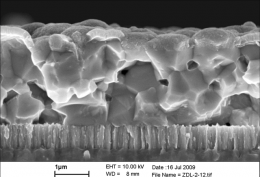
Magnified view of a cross section of the compound Cu2ZnSn(S,Se)4.
(PhysOrg.com) -- Solar cells could make fossil fuels virtually redundant if they were cheaper, but their use of rare elements and complex manufacturing processes makes them expensive. Now IBM Research has developed a prototype solar cell that solves both problems, using common, cheap elements and using an inexpensive manufacturing process. Their paper is published in the Advanced Materials journal.
The new photovoltaic cells are known as “kesterite” cells, which are produced using a printing technology in which a solution containing nanoparticles is spin-coated onto a glass substrate. According to IBM their efficiency is close to that of established solar cells.
IBM researcher David Mitzi, who is also manager of the company’s photovoltaic science and technology department, said they wanted to reduce the cost and use more abundant elements for thin-film photovoltaic cells. The current technology uses the rare elements indium and tellurium. Indium is in particularly short supply because it is also used in the manufacture of transparent transistors and is in high demand for flat panel display systems. By contrast IBM’s kesterite cells uses the common elements tin (Sn), zinc (Zn), copper (Cu), selenium (Se), and sulfur (S).
The new solar cells are also cheaper to manufacture, using a “printing” technique that uses a hydrazine solution containing copper and tin with nanoparticles of zinc dispersed within it. The solution is then spin-coated and heat treated in the presence of selenium or sulfur vapor. This process is much cheaper than the traditional manufacturing process, which uses an expensive vacuum-based technique.
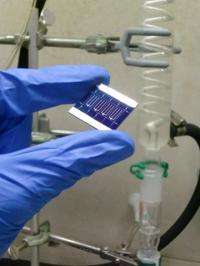
IBM's solar cell device.
A team at the Nagaoka National College of Technology in Japan produced a thin-film kesterite cell in 2009, which had an efficiency of 6.8 per cent. IBM’s kesterite cell has increased the efficiency by 40 per cent. Mitzi said they are planning to increase the efficiency above 11 per cent, which is equal to or better than the traditional solar cells.Solar cells contribute under 0.1 per cent of the Earth’s electricity supply at the moment, largely due to their expense and the rarity of their key elements. The IBM solar cell could change all of that. IBM will patent and license the technology and says it is open to partnerships with existing photovoltaic cell manufacturers to bring it to the market.
More information:
-- High-Efficiency Solar Cell with Earth-Abundant Liquid-Processed Absorber, Advanced Materials, DOI:10.1002/adma.200904155
-- IBM's Smarter Planet Blog
© 2010 PhysOrg.com
-
Sharp to Begin Mass-Production of Thin-Film Photovoltaic Modules
Jul 08, 2005 |
not rated yet |
0
-
Low-cost solution processing method developed for CIGS-based solar cells
Jul 07, 2009 |
not rated yet |
0
-
LG Electronics to Invest in Solar Cell Production Line
Oct 21, 2008 |
not rated yet |
0
-
Honda to Mass Produce Next-Generation Thin Film Solar Cell
Dec 19, 2005 |
not rated yet |
0
-
Sharp Develops Mass-Production Technology for Triple-Junction Thin-Film Solar Cells
Jan 25, 2007 |
not rated yet |
0
-
Engineers build first sub-10-nm carbon nanotube transistor
Feb 01, 2012 |
4.9 / 5 (30) |
30
-
Something old, something new: Evolution and the structural divergence of duplicate genes
Jan 31, 2012 |
4.6 / 5 (7) |
1
-
The hidden nanoworld of ice crystals: Revealing the dynamic behavior of quasi-liquid layers
Jan 30, 2012 |
5 / 5 (3) |
1
-
Stock market network reveals investor clustering
Jan 27, 2012 |
3.9 / 5 (23) |
8
-
Of microchemistry and molecules: Electronic microfluidic device synthesizes biocompatible probes
Jan 26, 2012 |
5 / 5 (1) |
0
-
Corrosion Tests on Magnesium
9 hours ago
-
polyethylene copper nanocomposite
14 hours ago
-
Output of xrd analysis
Feb 08, 2012
-
Transport phenomena problem based on problems 18.B11 and 19B.6 from Bird, stewart, lw
Feb 06, 2012
-
Help with material selection - Car Piston
Feb 05, 2012
-
Name of the steel alloy?!!?
Feb 02, 2012
- More from Physics Forums - Materials & Chemical Engineering
More news stories
'Dark plasmons' transmit energy
Microscopic channels of gold nanoparticles have the ability to transmit electromagnetic energy that starts as light and propagates via "dark plasmons," according to researchers at Rice University.
5 hours ago |
5 / 5 (3) |
0
|
Nanotube therapy takes aim at breast cancer stem cells
Wake Forest Baptist Medical Center researchers have again proven that injecting multiwalled carbon nanotubes (MWCNTs) into tumors and heating them with a quick, 30-second laser treatment can kill them.
Nanotechnology / Bio & Medicine
10 hours ago |
5 / 5 (1) |
0
|
Inspired by steel, nanomanufacturing gets wear-resistant carbide tip
(PhysOrg.com) -- Scientists at the University of Pennsylvania, the University of Wisconsin-Madison and IBM Research - Zurich have fabricated an ultrasharp silicon carbide tip possessing such high strength ...
15 hours ago |
5 / 5 (2) |
1
|
New technology platform for molecule-based electronics
Researchers at the Nano-Science Center at the University of Copenhagen have developed a new nano-technology platform for the development of molecule-based electronic components using the wonder material graphene. At the same ...
Nanotechnology / Nanomaterials
12 hours ago |
5 / 5 (2) |
0
Australians risking skin cancer to avoid nanoparticles
More than three in five Australians are concerned enough about the health implications of nanoparticles in sunscreens to want to know more about their impact. And while the initial scientific information released suggests ...
Nanotechnology / Bio & Medicine
13 hours ago |
5 / 5 (1) |
0
Hydrogen from acidic water: Researchers develop potential low cost alternative to platinum for splitting water
A technique for creating a new molecule that structurally and chemically replicates the active part of the widely used industrial catalyst molybdenite has been developed by researchers with the Lawrence Berkeley ...
Ultraviolet protection molecule in plants yields its secrets
Lying around in the sun all day is hazardous not just for humans but also for plants, which have no means of escape. Ultraviolet (UV) radiation from the sun can damage proteins and DNA inside cells, leading ...
FDA-approved drug rapidly clears amyloid from the brain, reverses Alzheimer's symptoms in mice
Neuroscientists at Case Western Reserve University School of Medicine have made a dramatic breakthrough in their efforts to find a cure for Alzheimer's disease. The researchers' findings, published in the journal Science, show t ...
Anyone can learn to be more inventive, cognitive researcher says
There will always be a wild and unpredictable quality to creativity and invention, says Anthony McCaffrey, a cognitive psychology researcher at the University of Massachusetts Amherst, because an "Aha moment" is rare and ...
Cell biologists describes mechanism by which some people may be more susceptible to colon cancer
An international research team led by cell biologists at the University of California, Riverside has uncovered a new insight into colon cancer, the third leading cause of cancer-related deaths in the United ...
New method makes culture of complex tissue possible in any lab
Scientists at the University of California, San Diego have developed a new method for making scaffolds for culturing tissue in three-dimensional arrangements that mimic those in the body. This advance, published online in ...

Feb 11, 2010
Rank: 5 / 5 (2)
Feb 11, 2010
Rank: 5 / 5 (3)
Feb 11, 2010
Rank: 2 / 5 (8)
A little problem - hydrazine is extremely toxic, even in aqueous solution.
From http://en.wikiped...ydrazine
Hydrazine is highly toxic and dangerously unstable with autoignition temperature 24-270 C.
It means, it can be easily ignited even at room temperature or a bit higher.
Also wrom Wiki: "On February 21, 2008, the United States government destroyed the disabled spy satellite USA 193 with a sea-launched missile, reportedly due to the potential danger of a hydrazine release if it re-entered the Earth's atmosphere intact"
They even destroy satellites, containing hydrazine fuel, before they reach the Earth atmosphere. How can solar cell, containig such material, be called a "green tech"? Pb and Cd are a way less dangerous but they aren't used in modern electronics due to RoHS requirements (at least in EU).
Feb 11, 2010
Rank: 5 / 5 (6)
Feb 11, 2010
Rank: 5 / 5 (2)
I say, keep up the good work.
Feb 11, 2010
Rank: 5 / 5 (3)
But Gallium Arsenide is ok with you ?
Feb 11, 2010
Rank: 1.4 / 5 (9)
... but the workers will be exposed to it during the production for a substantial time. There are a lot of people agitating against using silicon in solar cells just because the production involves hazardous substances. The same arguments can be applied here.
"But Gallium Arsenide is ok with you ?"
Nope, and that's one of the reasons why it is NOT used on a large scale (the other reason - higher costs)
Feb 11, 2010
Rank: 3 / 5 (3)
They know what they're doing in these places. OSHA and other regulations make sure that containment and transportation of these chemicals happens in redundantly safe manners. You on the other hand, obviously have no clue.
Feb 11, 2010
Rank: 4.5 / 5 (2)
At the risk of sounding foolish, toxicity is overrated IMHO. Develop an effective containment plan and stick to it. Screen workers. Move forward.
Feb 11, 2010
Rank: 2 / 5 (2)
Take a few seconds to do Google searches before you post, please.
Feb 11, 2010
Rank: 4 / 5 (2)
Or HF acids, sulphuric acid, pure arsenic, phosphorus, and the like used in ion implanters as dopants? I know those very well, I spent 20 years as an ion implant field service engineer. I'll take my chances with the hydrazine. Or how about the gold deposition process using cyanide?
Feb 12, 2010
Rank: 5 / 5 (3)
Adrian Miller
Advanced Materials
Feb 12, 2010
Rank: 2.3 / 5 (3)
I believe this to be inevitable.
Feb 12, 2010
Rank: 3.7 / 5 (3)
Do you have a point? The manufacturing of many of the materials you use everyday include chemicals that have toxicities.
Feb 12, 2010
Rank: 5 / 5 (1)
Along with JayK's statement, the inherent toxicity of all manufactured goods is a result of their natural toxicity.
Mercury isn't edible if you dug it up, is it?
But that's an overly simplistic view. Toxicity is what it is, and to affix manufacture as the reason for it is ridiculous.
Feb 15, 2010
Rank: 5 / 5 (1)
Actually, the US destroyed the spy satellite because it was a BRAND-NEW SPY SATELLITE, not because it contained hydrazine. There was no way they could risk a foreign government getting their hands on any part of it...
Feb 16, 2010
Rank: 5 / 5 (1)
Hydrazine..
Toxic? Yes.
Dangerous? Yes.
Useful and safe when handled by trained personnel? Yes
That sattilite would have never reached ground with any hydrazine left...That could not have been the reason for destroying it...but was a convienent cover story wasnt it?
Point, hydrazine has it's dangers, but when used under proper conditions by trained personnel it presents minimal risk. Any good safety officer could set up the operation to minimize those risks and have approperate emergency response in place to deal with the situation when things go all pear shaped.
Feb 18, 2010
Rank: 3 / 5 (1)
Feb 18, 2010
Rank: 5 / 5 (1)
As has been said before everything is toxic in the wrong amount.
Feb 18, 2010
Rank: 5 / 5 (2)