Scientists produce archaeological 'time machine'
February 11, 2010
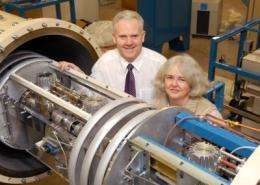
Professor Gerry McCormac and Dr Paula Reimer pictured in the 14 Chrono Centre at Queen's University Belfast. Staff at the Centre have been involved in the creation of a new calibration curve, which extends back 50,000 years. Credit: Queen's University Belfast
Researchers at Queen's University have helped produce a new archaeological tool which could answer key questions in human evolution.
The new calibration curve, which extends back 50,000 years is a major landmark in radiocarbon dating-- the method used by archaeologists and geoscientists to establish the age of carbon-based materials.
It could help research issues including the effect of climate change on human adaption and migrations.
The project was led by Queen's University Belfast through a National Environment Research Centre (NERC) funded research grant to Dr Paula Reimer and Professor Gerry McCormac from the Centre for Climate, the Environment and Chronology (14CHRONO) at Queen's and statisticians at the University of Sheffield.
Ron Reimer and Professor Emeritus Mike Baillie from Queen's School of Geography, Archaeology and Palaeoecology also contributed to the work.
The curve called INTCAL09, has just been published in the journal Radiocarbon. It not only extends radiocarbon calibration but also considerably improves earlier parts of the curve.
Dr Reimer said: "The new radiocarbon calibration curve will be used worldwide by archaeologists and earth scientists to convert radiocarbon ages into a meaningful time scale comparable to historical dates or other estimates of calendar age.
"It is significant because this agreed calibration curve now extends over the entire normal range of radiocarbon dating, up to 50,000 years before today. Comparisons of the new curve to ice-core or other climate archives will provide information about changes in solar activity and ocean circulation."
It has taken nearly 30 years for researchers to produce a calibration curve this far back in time.
Since the early 1980s, an international working group called INTCAL has been working on the project.
The principle of radiocarbon dating is that plants and animals absorb trace amounts of radioactive carbon-14 from carbon dioxide in the atmosphere while they are alive but stop doing so when they die. The carbon-14 decays from archaeological and geological samples so the amount left in the sample gives an indication of how old the sample is.
As the amount of carbon -14 in the atmosphere is not constant, but varies with the strength of the earth's magnetic field, solar activity and ocean radiocarbon ages must be corrected with a calibration curve.
Most experts consider the technical limit of radiocarbon dating to be about 50,000 years, after which there is too little carbon-14 left to measure accurately with present day technology.
More information: Further information on the work of Queen's Chrono Centre can be found online at http://chrono.qub.ac.uk/
Provided by Queen's University Belfast
-
New technology for dating ancient rock paintings
Mar 11, 2009 |
not rated yet |
0
-
Researchers can now determine when a human was born by looking into the eyes of the dead
Jan 30, 2008 |
not rated yet |
0
-
Scientists redate Neanderthal fossils
Jan 05, 2006 |
not rated yet |
0
-
When did humans return after last Ice Age?
Jul 27, 2009 |
not rated yet |
0
-
New research suggests Neanderthals weren't stupid
Jan 11, 2010 |
not rated yet |
0
-
Engineers build first sub-10-nm carbon nanotube transistor
Feb 01, 2012 |
4.9 / 5 (31) |
30
-
Something old, something new: Evolution and the structural divergence of duplicate genes
Jan 31, 2012 |
4.6 / 5 (7) |
1
-
The hidden nanoworld of ice crystals: Revealing the dynamic behavior of quasi-liquid layers
Jan 30, 2012 |
5 / 5 (3) |
1
-
Stock market network reveals investor clustering
Jan 27, 2012 |
3.9 / 5 (23) |
8
-
Of microchemistry and molecules: Electronic microfluidic device synthesizes biocompatible probes
Jan 26, 2012 |
5 / 5 (1) |
0
-
Books To Inspire a Beginnig Physics Student
1 hour ago
-
Pith balls problem
2 hours ago
-
Electrostatics
2 hours ago
-
what is phase constant
2 hours ago
-
Basics In electromagnetic wave
2 hours ago
-
How to calculate theoretical initial velocity?
3 hours ago
- More from Physics Forums - General Physics
More news stories
Putting the squeeze on planets outside our solar system
(PhysOrg.com) -- Using high-powered lasers, scientists at Lawrence Livermore National Laboratory and collaborators discovered that molten magnesium silicate undergoes a phase change in the liquid state, abruptly ...
13 hours ago |
4.3 / 5 (7) |
0
|
Hovering not hard if you're top-heavy, researchers find
Top-heavy structures are more likely to maintain their balance while hovering in the air than are those that bear a lower center of gravity, researchers at New York University's Courant Institute of Mathematical Sciences ...
14 hours ago |
5 / 5 (1) |
1
|
SLAC, Stanford team focuses on high-energy electrons to treat cancer
Accelerator physicists at SLAC and cancer specialists from Stanford are working on a new technology that could dramatically reduce the time needed for cancer radiation treatments. The team ran an initial experiment ...
17 hours ago |
5 / 5 (2) |
0
Measurements from high-energy collisions lead to better understanding of why meson particles disappear
For several years, physicists at the Relativistic Heavy Ion Collider (RHIC) at Brookhaven National Laboratory (BNL), USA, have studied an unusual state of matter called the quarkgluon plasma, which they ...
17 hours ago |
4.5 / 5 (4) |
0
Explained: Sigma
It's a question that arises with virtually every major new finding in science or medicine: What makes a result reliable enough to be taken seriously? The answer has to do with statistical significance -- but ...
Feb 09, 2012 |
5 / 5 (16) |
53
Anonymous knocks CIA website offline (Update)
The website of the Central Intelligence Agency was inaccessible on Friday after the hacker group Anonymous claimed to have knocked it offline.
New error-correcting codes guarantee the fastest possible rate of data transmission
Error-correcting codes are one of the triumphs of the digital age. Theyre a way of encoding information so that it can be transmitted across a communication channel such as an optical fiber o ...
Google users warned of threat to smartphone wallets
Users of Google smartphone wallets were being warned on Friday that there is a way to crack pass codes intended to thwart thieves from going on illicit shopping sprees.
Humans may have helped the decline of African rainforests 3000 years ago
(PhysOrg.com) -- Large areas of rainforests in Central Africa mysteriously disappeared over three thousand years ago, to be replaced by savannas. The prevailing theory has been that the cause was a change ...
New power source discovered
(PhysOrg.com) -- Researchers at the Massachusetts Institute of Technology (MIT) and RMIT University have made a breakthrough in energy storage and power generation.
Small modular reactor design could be a 'SUPERSTAR'
(PhysOrg.com) -- Though most of today's nuclear reactors are cooled by water, we've long known that there are alternatives; in fact, the world's first nuclear-powered electricity in 1951 came from a reactor ...