New picture of ancient ocean chemistry argues for chemically layered water
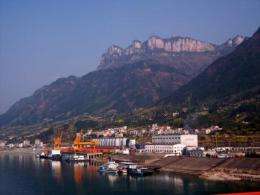
A research team led by biogeochemists at the University of California, Riverside has developed a detailed and dynamic three-dimensional model of Earth's early ocean chemistry that can significantly advance our understanding of how early animal life evolved on the planet.
Working on rock samples from the Doushantuo Formation of South China, one of the oldest fossil beds and long viewed by paleontologists to be a window to early animal evolution, the research team is the first to show that Earth's early ocean chemistry during a large portion of the Ediacaran Period (635-551 million years ago) was far more complex than previously imagined.
Their work is the first comprehensive geochemical study of the Doushantuo Formation to investigate the structure of the ocean going from shallow to deep water environments. It is also one of the most comprehensive studies for any Precambrian interval. (The Precambrian refers to a stretch of time spanning from the inception of the Earth approximately 4.5 billion years ago to about 540 million years ago. It was in the Precambrian when the first single-celled microbes evolved 3.5 billion years ago or earlier, followed by the first multicellular animals much later, around 700 million years ago.)
The researchers' model for the ancient ocean argues for a stratified marine basin, one with a chemically layered water column. While the surface ocean was oxygen-rich, the deep ocean was ferruginous - oxygen-deprived and iron-dominated. Further, sandwiched in this deep ocean was a dynamic wedge of sulfidic water, highly toxic to animal life, that impinged against the continental shelf.
Dominated by dissolved hydrogen sulfide, the sulfidic wedge was in a state of flux, varying in size and capable of encroaching on previously oxygenated areas of the continental shelf — killing all animal life there. The overall picture is a marine basin with co-existing oxygen-rich, sulfidic and ferruginous water layers.
Study results appear Feb. 11 in Science Express.
In the modern sulfur-rich ocean, hydrogen sulfide in oxygen-poor waters reacts with iron to form the mineral pyrite, thus stripping the dissolved iron from the water column. But the researchers' results show that under specific geochemical conditions in the early ocean, when levels of dissolved sulfate (the source of hydrogen sulfide in the ocean) and oxygen were particularly low compared to the modern ocean, layers of sulfidic waters could coexist with ferruginous water masses, and even persist for long periods of time.
"This is an entirely new interpretation of ancient ocean chemistry," said Chao Li, a research specialist in UC Riverside's Department of Earth Sciences and the first/lead author of the research paper. "Our model provides a brand-new backdrop for the earliest evolution of animal life on the planet. We show that the sulfidic ocean wedge, along with an absence of oxygen, can hinder the colonization of early animals on the shallow seafloor and influence their evolution as they take a foothold. In other words, we cannot ignore hydrogen sulfide when piecing together how animals and other eukaryotes such as algae evolved on our planet."
The researchers posit that their robust pattern of a stratified marine basin is the best example of a new paradigm in studies of Precambrian ocean chemistry. They predict the record of much of the early ocean elsewhere will show similarities to the complex chemical layering seen in South China.
"This new world order asks that we take into account co-occurring spatial variations in water chemistry in an ocean basin, specifically when moving from near the shallow shoreline along continental shelves to progressively outwards into deeper waters, and when applying a diverse range of complementary geochemical analyses to elucidate these changes in ocean chemistry," said Gordon Love, an assistant professor of biogeochemistry, who collaborated on the study and in whose lab Li works.
Li explained that in the scientific literature the generally patchy fossil record of early animals observed through the Ediacaran has largely been attributed to poor preservation of fossils. The new research shows, however, that changes in environmental conditions, in this case variations in distribution of hydrogen sulfide, may explain gaps seen in the Ediacaran fossil record.
"Our model points to early animal life having to cope with changing chemical environments even in the shallow waters of the continental shelf," said Love, the principal investigator on the National Science Foundation grant that funded the study. "At times, movement of toxic sulfide-rich waters into the shallow water would be calamitous to animal life. This well explains the patchy time record of animal fossils in most Ediacaran basins."
Timothy Lyons, a professor of biogeochemistry and a co-principal investigator on the NSF grant, explained that only an incomplete temporal record of animal microfossils has been unearthed in the Doushantuo Formation despite considerable efforts.
"Much of the unequivocal fossil evidence for animals is in the form of microfossil cysts found in only a few sedimentary layers, suggesting that the early animals were environmentally stressed," he said. "An explanation for this pattern is certain to lie in our model."
According to the researchers, a stratified marine basin was favored by an overall deficiency of dissolved sulfate in seawater following a long history of oxygen deficiency in the ocean. Ordinarily, sulfate gets introduced into the ocean from the weathering of continental sulfide minerals exposed to an atmosphere with photosynthetically produced oxygen. But the researchers argue that major glaciation events predating Doushantuo time exacerbated the scarcity of sulfate. They note that if glaciation was globally extensive, gas and chemical interactions between the oceans and atmosphere would be suppressed by a layer of ice cover in many areas.
"Ocean chemistry changes as the ice coverage acts like a pie crust sealing off the ocean interior from the atmosphere," Love said. "The effects of such ice coverage are a reduction of sulfate inputs into the ocean brought in by rivers and a buildup of dissolved iron in the deep ocean sourced by volcanic activity along the mid-ocean ridges. Later, as the ice cover abated, sulfate inputs from rivers localized the animal-inhibiting wedge of hydrogen sulfide along the shallow basin margins."
Provided by University of California - Riverside


